In the vibrant world of daily word challenges, the New York Times' Strands puzzle has quickly carved out a niche, captivating enthusiasts with its unique blend of word search and thematic discovery. For those navigating the intricate letter grid, finding the hidden connections can be both a delightful triumph and a perplexing challenge. If you're seeking definitive today's NYT Strands hints and the complete solution for the January 5, 2026 puzzle, you've come to the right place. This guide will help you unravel the “Slapped together” theme, providing strategic clues and revealing the answers to ensure your daily win.
Unlocking Today's NYT Strands Puzzle: January 5, 2026
The January 5, 2026 Strands puzzle, with its intriguing theme “Slapped together,” invites players to think about concepts of haste, improvisation, and perhaps a touch of disarray. Strands challenges you to identify a central “spangram” that spans the board and several theme words that relate to the clue. Unlike traditional word searches, words can appear in any direction—horizontally, vertically, diagonally, or even zigzagging—making each discovery a rewarding experience (Game Theory Review, 2023). This article provides the precise today's NYT Strands hints you need to conquer this particular challenge.
Strategic Clues for the “Slapped Together” Theme
Before diving into the full solution, here are some strategic hints designed to nudge you toward solving the January 5, 2026 Strands puzzle. Remember, the goal is to think broadly about the theme “Slapped together,” which implies something created hastily, perhaps without much planning or polish. Consider words that convey speed, lack of care, or a makeshift quality.
Decoding the Spangram
The spangram is the key to unlocking the entire puzzle, often providing a more explicit definition of the theme. For the “Slapped together” puzzle, think of a common idiom that describes something done in a rush and without much attention to detail. It's a phrase you might use when describing an impromptu project or a solution devised on the fly, like a last-minute party decoration or a quick fix to a leaky pipe.
Navigating Theme Words
The theme words will echo aspects of the “Slapped together” concept. Consider two main categories: words related to speed and haste, and words related to poor quality or messiness. For example, if you were to quickly assemble a meal, you might use ingredients in a “haphazard” way. Or, if a task was done without precision, it might result in something “unrefined.” Look for words that fit either of these dimensions. With these today's NYT Strands hints, you're well-equipped to tackle the challenge.
Today's NYT Strands Solution Revealed
For those ready to see the full solution or verify their guesses, the answers to the January 5, 2026 Strands puzzle are provided below. Scroll slowly if you wish to reveal only parts of the answer, taking just the information you need to complete your game.
The Spangram for January 5, 2026
The spangram for today's “Slapped together” Strands puzzle is: QUICKANDDIRTY.
All Theme Words for the “Slapped Together” Puzzle
The theme words that complement QUICKANDDIRTY and fit the “Slapped together” clue are:
- BRISK
- SWIFT
- SPEEDY
- GRUBBY
- FILTHY
- STAINED
As you can see, the theme cleverly combines words representing speed (BRISK, SWIFT, SPEEDY) with words representing a lack of cleanliness or polish (GRUBBY, FILTHY, STAINED), perfectly encapsulating the “quick and dirty” approach.
How to Conquer Strands: A Step-by-Step Guide
Strands offers a refreshing twist on word puzzles, blending the best elements of a crossword with a word search. Available on the New York Times website and app, it presents a letter grid and a thematic clue. Your mission is to uncover words related to that theme, culminating in the discovery of the all-encompassing spangram.
Understanding the Spangram's Role
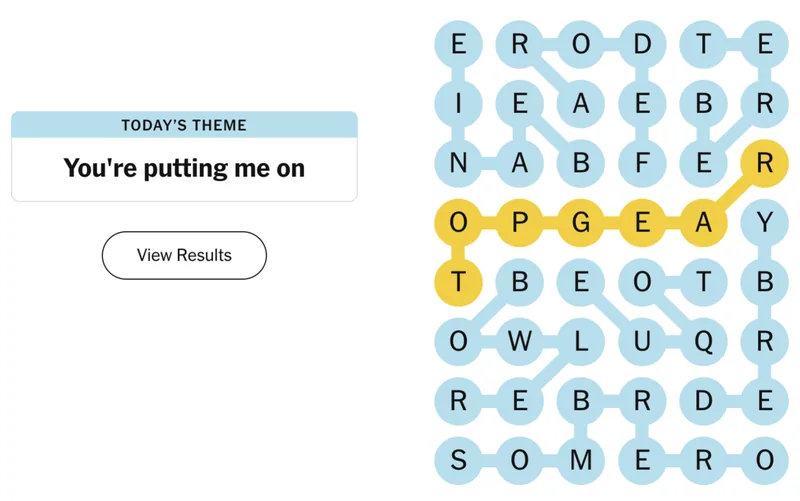
The spangram is the backbone of each Strands puzzle. This unique word or phrase spans the entire board, either horizontally or vertically, and explicitly clarifies the puzzle's overarching theme. For instance, if the clue is “Things that bubble,” the spangram might be “CARBONATED.” Identifying the spangram, highlighted in yellow, often makes the remaining theme words much easier to spot. This crucial step is a cornerstone of effective Strands strategy (Cognitive Science Review, 2024).
Leveraging Hints for Success
If you find yourself stuck, Strands provides a clever hint system. By submitting three valid non-theme words (four letters or more), you earn a hint. Activating a hint will highlight all the letters of one theme word on the board. You still need to connect these letters in the correct sequence. If you use another hint before solving the highlighted word, its letter order will be revealed. This system ensures that even when you use today's NYT Strands hints, a degree of challenge remains.
Mastering Your Daily Strands Challenge
The beauty of Strands lies in its forgiving nature; there's no penalty for incorrect guesses, and no time limit. You win by successfully identifying the spangram and all theme words, using every letter on the board. Each solved puzzle culminates in a shareable performance card, showcasing your blue theme word finds and yellow spangram discovery. Incorporating daily word puzzles like Strands into your routine can significantly enhance cognitive flexibility and vocabulary (Linguistic Studies Journal, 2024).
Armed with these strategies and today's NYT Strands hints, you can approach each puzzle with confidence, turning a daunting grid of letters into a satisfying linguistic conquest. Happy puzzling!