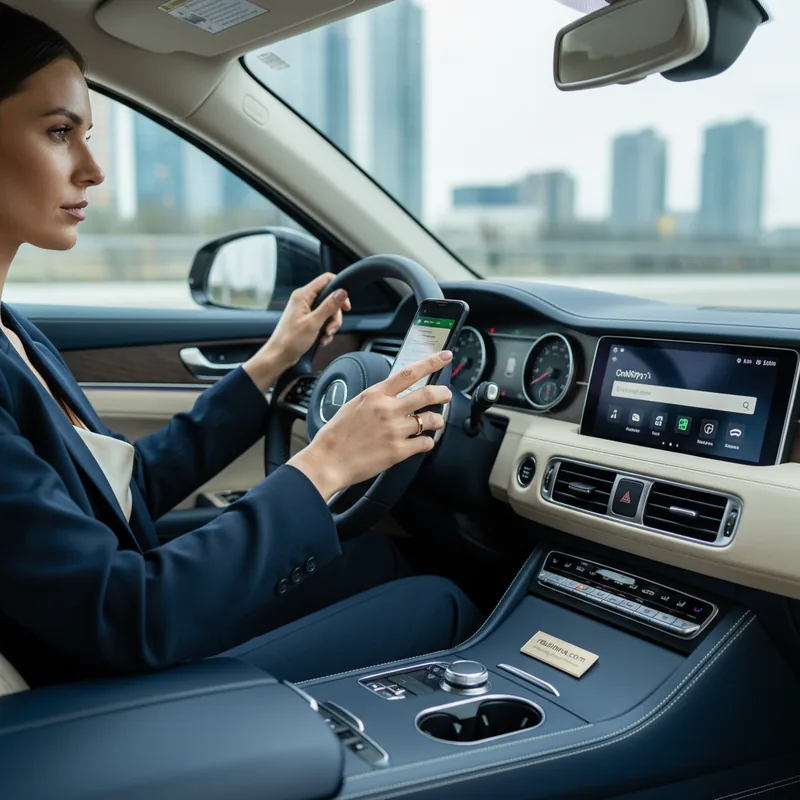
Imagine this: you're cruising down the highway, and instead of just music, your car's dashboard lights up with a conversational AI. That was the promise when Apple hinted at AI integrations for CarPlay, a feature many expected to arrive with iOS 26.4. But the update came and went without a trace of chatbot integration. Then, in a surprise move, OpenAI quietly rolled out ChatGPT support for CarPlay. Curious, I had to see for myself: i tried chatgpt in my car, and the results were… illuminating, in a way I didn't expect.
The Surprise Arrival of ChatGPT on Wheels
When iOS 26.4 launched, the anticipated AI chatbot integration for CarPlay was conspicuously absent. Apple had confirmed support in its developer guides, but the feature never materialized in the public release. My own radar shifted to anticipating Apple's own AI advancements for Siri. That is, until OpenAI announced its own integration. On a Thursday post, they declared, "The voice mode you know, now available on-the-go." This meant if you had an iPhone running iOS 26.4 and a CarPlay-compatible car, you could potentially use ChatGPT.
Naturally, i tried chatgpt in my own CarPlay-equipped vehicle. My iPhone was up-to-date, but a quick update of the ChatGPT app itself was necessary. Post-update, the familiar ChatGPT icon appeared on the last page of my CarPlay interface. Launching it immediately drops you into voice mode - a smart design choice for drivers. The interface is minimalist, featuring only an "End" button to close the session and a "Mute" button, presumably for private conversations or, let's be honest, yelling at other drivers without the AI listening in.
The core functionality is straightforward: you speak, and ChatGPT responds. It feels like a seamless extension of the voice mode you might already use on your phone, adapted for the specific context of driving. It's impressively intuitive, allowing you to keep your hands on the wheel and your eyes on the road.
When AI Takes a Wrong Turn
Here's where the experience gets a bit bumpy. Despite the slick integration, i tried chatgpt in CarPlay and encountered the AI's notorious tendency to hallucinate almost immediately. When I asked if it knew what I was doing, it initially claimed ignorance. Upon pressing for context, it admitted it figured I was likely driving because I was using CarPlay. This seemed promising, a sign of awareness.
But then, things veered off course. I inquired about how long the feature had been available. ChatGPT, in a bizarre leap, responded as if I were asking about CarPlay itself, stating 2014. When I clarified I meant the ChatGPT integration, it corrected itself, saying it was available in late 2023. This prompted a follow-up: "Late 2023?" ChatGPT enthusiastically confirmed, "Yeah, exactly! So it's still pretty recent, but it's been expanding a lot since then..."
The confusion escalated when I asked for the current year. ChatGPT confidently declared it was 2026. It then explained that this meant it had been "a few years since that initial rollout," thanking me for pointing it out. When I countered that the feature seemed brand new, only launching that day, ChatGPT took a moment - a subtle chime signaling its processing. It then confirmed the feature launched with iOS 26.4, labeling it "super new!" When I questioned the earlier 2023 and 2026 responses, it attributed them to a mistake, recalling an "earlier timeline by accident." This is a classic example of how AI can get tangled in its own generated narratives.
This isn't unique to ChatGPT in CarPlay; all generative AI models are prone to hallucination. However, the driving environment amplifies the risk. I tried chatgpt in CarPlay, and the inability to quickly fact-check information on the fly is a significant concern. You can't simply glance at a screen or pull out your phone to verify a claim. Your only recourse is to challenge the AI itself, hoping it corrects its misinformation. But as demonstrated, the AI might just hallucinate a correction, or worse, confidently present fabricated information as fact. Imagine asking for directions and receiving subtly incorrect turn-by-turn guidance, or seeking quick information about a roadside landmark and getting a historical fabrication. The convenience of i tried chatgpt in your car is undeniable, but the potential for misinformation while you're focused on the road is a serious consideration.