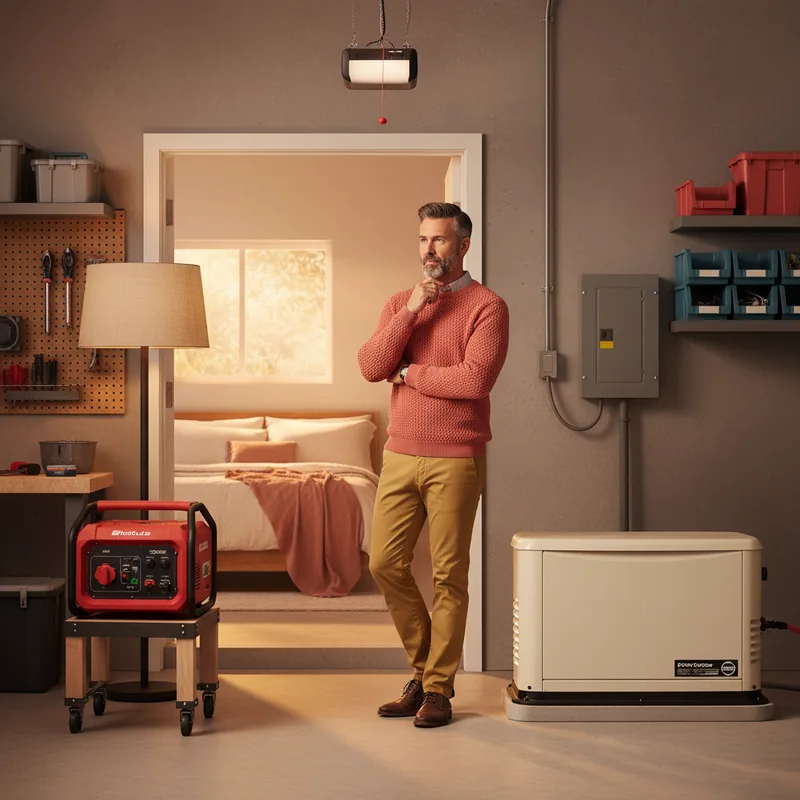
Picture this: The storm hits, the lights flicker, and then--darkness. Your home, usually a sanctuary, is suddenly cold, quiet, and disconnected. In an age where power outages are becoming more frequent and prolonged, ensuring your household remains functional and comfortable during a blackout is no longer a luxury, but a vital aspect of modern home preparedness. Learning how to choose right backup generator is crucial for maintaining your peace of mind and protecting your family's well-being.
The Growing Need for Power Preparedness
The U.S. power grid is experiencing unprecedented strain, leading to more frequent and longer-lasting outages. Reports indicate that a significant portion of utility customers experienced a blackout in recent years, a trend exacerbated by an aging infrastructure, increasing demand from climate-driven air conditioning use, and the burgeoning energy needs of artificial intelligence (Energy Information Administration, 2024). Experts predict that the risk of power disruptions could escalate dramatically in the coming years, making personal power solutions more critical than ever.
While rechargeable power stations offer temporary relief for smaller devices, a robust backup generator provides the sustained power needed to weather extended outages in comfort. However, simply picking the first generator you see on sale can lead to frustration and inadequate protection. Making an informed decision about your home's backup power requires careful consideration of several key factors tailored to your specific needs and circumstances.
Assessing Your Home Power Requirements
The foundational step in determining how to choose right generator for your home is to accurately calculate your power needs. This involves three critical data points: the anticipated duration of outages, the essential appliances and systems you wish to power, and their individual wattage demands.
Outage Duration and Preparedness
While predicting the future is impossible, historical data from your region or personal experience can offer valuable insights. Have past outages been brief inconveniences or multi-day ordeals? If your area is prone to extended blackouts due to severe weather or grid instability, you'll need a generator with greater fuel capacity and endurance. Conversely, if outages are typically short, a smaller, more portable unit might suffice for critical items.
Identifying Essential Appliances
Create a comprehensive list of everything you absolutely need to run during a power loss. This goes beyond basic lighting and phone chargers. Consider:
- Refrigeration: To preserve food and medicine.
- Heating/Cooling: Essential for comfort and safety, especially in extreme temperatures.
- Water Systems: Sump pumps, well pumps for homes not on municipal water.
- Medical Devices: Any life-sustaining or critical medical equipment.
- Communication: Internet router, charging for laptops and phones.
- Home Office Essentials: If working remotely is a necessity.
Every item added to this list directly impacts the capacity of the generator you'll require. A well-prepared home might prioritize a refrigerator, a few lights, and an internet router, while others might include a well pump, a medical oxygen concentrator, and a dedicated freezer (Consumer Reports, 2024).
Calculating Wattage Demands
Once your essential list is complete, you'll need to sum the wattage each item consumes. Most appliances have this information on a label, in the user manual, or available online. If only amps are provided, a general rule is to multiply the amperage by 120 (standard household voltage) to get an approximate wattage.
It's crucial to account for starting watts (surge watts) versus running watts. Many motor-driven appliances, like refrigerators, sump pumps, and well pumps, draw significantly more power for a brief moment when they first start up than they do during continuous operation. To ensure your generator can handle these surges, it's a good practice to multiply your total running wattage by 1.5. This provides a buffer for simultaneous startup demands.
Example Scenarios:
- Basic Needs: Refrigerator (600 running watts), a few lights (200 running watts), phone chargers/router (100 running watts). Total running: 900 watts. Required generator capacity (with 1.5x surge): 1350 watts.
- Moderate Needs: Refrigerator (600W), sump pump (1000W running, 3000W starting), medical oxygen concentrator (400W), lights/router (300W). Total running: 2300 watts. With the sump pump's high starting surge, you'd need a generator capable of at least 3000-4000 watts to handle the peak load.
- Extended Comfort: Refrigerator (600W), well pump (1200W running, 3600W starting), dedicated freezer (300W running, 900W starting), furnace fan (800W), lights/electronics (500W). Total running: 3400 watts. Considering the two major starting surges, a generator with 5000-7000 watts would be a more appropriate choice.
This careful calculation is paramount to understanding how to choose right generator size without overspending or being underprepared.
Understanding Generator Types and Their Fit
Once your power needs are clear, the next step in learning how to choose right generator involves selecting the type that best suits your lifestyle and budget.
Standby Generators: The Seamless Solution
- Description: These are permanently installed units, typically fueled by natural gas or propane from your home's supply. They automatically detect power outages and turn on, providing uninterrupted power to your entire home.
- Pros: Fully automatic, whole-house power (often 8,000 to 20,000+ watts), quiet operation compared to portables, no refueling during an outage.
- Cons: Most expensive option (typically $8,000 - $16,000+ installed), requires professional installation, needs dedicated outdoor space.
- Ideal For: Homeowners in areas with frequent or lengthy outages, those seeking ultimate convenience and peace of mind, or individuals with critical medical equipment.
Portable Generators: Versatile and Accessible
- Description: The most common and affordable type, these wheeled units are designed for mobility. They range from small 1,000-watt models to large units capable of 20,000 watts.
- Pros: Affordable ($300 - $4,000), versatile for home use, camping, or job sites, wide range of power outputs.
- Cons: Manual startup and refueling, can be noisy, require extension cords to power appliances, must be operated outdoors away from the home.
- Ideal For: Most homeowners needing a reliable backup for essential items, those on a budget, or individuals who also need power for outdoor projects or recreation.
Inverter Generators: Efficient and Quiet
- Description: A subset of portable generators, inverters use advanced technology to produce clean, stable power more efficiently. They throttle engine speed based on demand, leading to quieter operation and better fuel economy.
- Pros: Quieter than conventional portables, more fuel-efficient, produce 'clean' power safe for sensitive electronics, often lightweight and portable.
- Cons: Generally more expensive per watt than conventional portables, may have lower maximum power output (though larger models exist).
- Ideal For: Users needing quiet operation (e.g., in residential areas), powering sensitive electronics, or those prioritizing fuel efficiency and portability.
Power Stations: Battery Backup Clarified
- Description: Often mistakenly called 'solar generators,' these are large, rechargeable batteries that store energy. They can be charged via wall outlets, car chargers, or solar panels.
- Pros: Silent operation, no emissions, minimal maintenance, can be used indoors (unlike fuel generators).
- Cons: Limited run time (dependent on battery capacity), slow to recharge, higher initial cost per watt-hour compared to fuel generators, not ideal for very long outages without continuous solar input.
- Ideal For: Small, temporary power needs, indoor use, eco-conscious consumers, or as a supplement to a fuel-based generator.
Fueling Your Backup Power Source
For portable and inverter generators, the choice of fuel is a significant consideration, impacting storage, availability, and maintenance. Standby generators typically run on natural gas or propane, often drawing directly from your home's existing supply.
Gasoline: Common but Perishable
- Pros: Widely available at gas stations.
- Cons: Gasoline degrades over time (can't be stored indefinitely), requires fuel stabilizers for longer storage, emits more fumes, and requires careful handling. You'll need to store it safely and ensure a fresh supply.
Propane: Stable and Clean
- Pros: Can be stored for extended periods without degradation, burns cleaner than gasoline (less carbon buildup), readily available in tanks.
- Cons: May be less convenient to acquire in large quantities during an emergency, requires multiple tanks for extended run times, can be less fuel-efficient than gasoline.
Diesel: Durable and Efficient
- Pros: Known for durability and longevity, often more fuel-efficient, and requires less maintenance due to the self-lubricating properties of diesel fuel.
- Cons: Diesel generators can be louder and heavier, produce more exhaust fumes and odors, and diesel fuel may be less accessible for residential users.
Dual and Tri-Fuel: Ultimate Flexibility
- Description: These generators offer the flexibility to run on multiple fuel types (e.g., gasoline and propane for dual-fuel; gasoline, propane, and natural gas for tri-fuel).
- Pros: Provides maximum versatility and peace of mind, allowing you to use whichever fuel is most accessible during an emergency.
- Cons: Typically more expensive and potentially more complex in design.
Understanding these fuel characteristics is essential for how to choose right generator that aligns with your storage capabilities and local fuel availability.
Key Features to Consider for Optimal Functionality
Beyond the core specifications, several additional features can significantly enhance the safety, convenience, and longevity of your backup generator.
Electric Start: For Ease of Use
Many portable generators still rely on a manual pull-cord start. For those with physical limitations or who prefer convenience, an electric start (push-button) feature is invaluable. This requires a small battery, which will need occasional maintenance and charging.
Automatic Shutdown: For Safety and Protection
Generators produce carbon monoxide (CO), a colorless, odorless, and deadly gas. A CO sensor that automatically shuts down the generator if dangerous levels are detected is a critical safety feature. Remember: never operate a generator inside your home or too close to windows and doors. Additionally, a low-oil shutdown feature protects the engine from damage by automatically turning off the unit if oil levels drop too low.
Receptacle Variety and Quantity
All the power in the world is useless if you can't plug in your appliances. Ensure the generator has a sufficient number and variety of outlets (e.g., 120V household outlets, 240V outlets for larger appliances, USB ports) to meet your needs. Consider a transfer switch for safer and more efficient connection to your home's electrical panel (National Grid, 2023).
Remote Monitoring and Smart Features
Some modern generators offer remote monitoring capabilities via smartphone apps. This allows you to check fuel levels, run status, and even start/stop the generator from a distance, adding a layer of convenience and control, especially during extended outages or when you're away from home.
Making the Informed Choice
Navigating the options for backup power can seem daunting, but by systematically evaluating your needs and understanding the available solutions, you can make a confident decision. From calculating your precise wattage requirements to selecting the ideal generator type and fuel source, each step brings you closer to a reliable power solution. Ultimately, how to choose right backup generator is a personalized journey towards ensuring your home remains a haven of comfort and functionality, no matter what the grid throws your way.