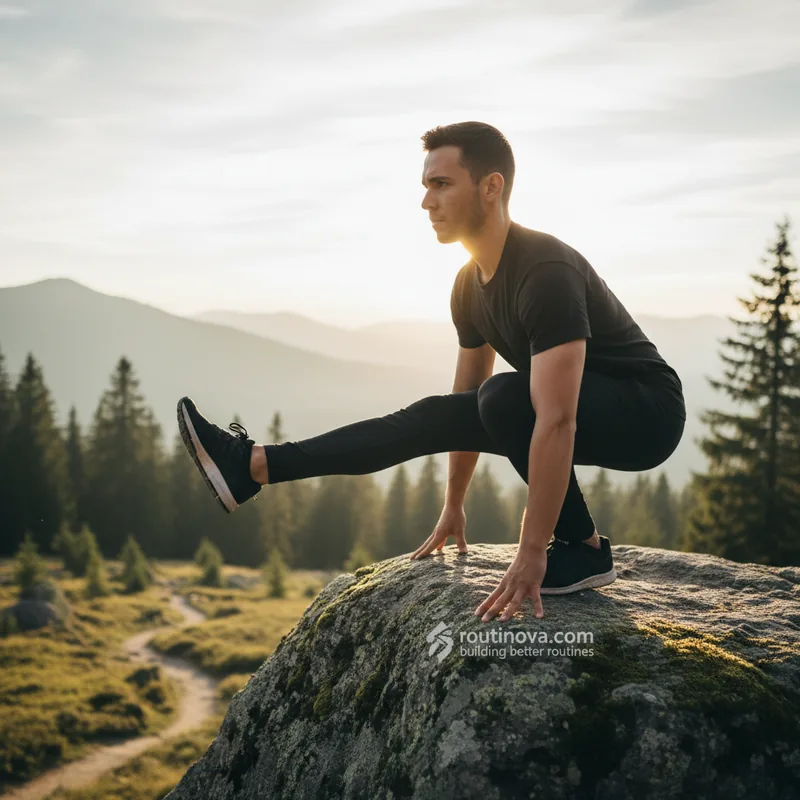
Ever seen someone effortlessly drop into a one-legged squat, holding their other leg straight out like a ballerina? It’s a mesmerizing display of strength and control. But for most of us, the mere thought of it feels impossible. So, why are pistol squats so incredibly hard? It's not just one thing; it's a complex interplay of strength, balance, and mobility that challenges our bodies in ways few other single-leg movements can.
The Pistol Squat Unpacked
At its core, a pistol squat is a unilateral (single-leg) squat. You extend one leg straight out in front of you while bending the knee of your standing leg. The goal is to lower your hips to or below knee level while maintaining an upright torso and keeping that extended leg straight and off the ground. The name, fittingly, evokes the image of a pistol with the extended leg as the barrel.
While some might nail it on their first try, for the vast majority, this move is a significant hurdle. It demands a high level of coordination and physical preparedness. The challenge stems from needing to support your entire body weight on a single limb, while simultaneously managing balance and ensuring adequate range of motion.
You might be tempted to touch the toe of your free leg with your hand for stability, or perhaps bend that leg slightly. And honestly? That’s perfectly fine, especially when you're starting out. Similarly, achieving a deep “ass-to-grass” squat isn’t mandatory for mastering the basic pistol squat, though it certainly adds to the impressiveness. Some variations even involve holding weight, like a kettlebell, which can aid balance but increases the strength requirement.
The Strength Component: More Than Just Quads
Let's get straight to it: your legs need to be seriously strong to handle the load of a pistol squat. When you squat on two legs, your body weight is distributed. On one leg, that same weight is concentrated, meaning your muscles work exponentially harder. The quadriceps, the four muscles at the front of your thigh, are the primary drivers here.
Think of it this way: if you can comfortably squat with a barbell on your back that equals your body weight, your legs likely possess the raw strength to *begin* tackling pistol squats (Mayo Clinic, 2023). However, this is just a baseline. The stronger your legs, the more accessible pistol squats become.
How to build it: Focus on progressive overload with exercises like goblet squats, lunges, and barbell squats. But crucially, incorporate single-leg strength work. This directly mimics the demands of a pistol squat and prepares your legs for unilateral loading.
Beyond Quads: Essential Single-Leg Support
Raw quad strength is only part of the equation. When you’re balancing on one leg, a host of other muscles must engage to keep you stable and moving correctly. You need:
- Abductor strength: These are the muscles on the outside of your hips and glutes, crucial for preventing your knee from collapsing inward.
- Adductor strength: Your inner thigh muscles help stabilize and assist the primary squatting muscles.
- Hip flexor strength: These muscles at the front of your hip are vital for holding your free leg up in that characteristic pistol position without it dropping.
How to build it: While direct work like hip abduction/adduction exercises and leg raises (seated or hanging) is beneficial, you can get fantastic results from compound unilateral movements. Try step-ups onto an elevated surface, increasing the height or adding weight over time. Lunges (forward, reverse, or lateral) are excellent. Bulgarian split squats, where your rear foot is elevated, also build immense single-leg power and stability. Another effective drill is the step-down, where you focus on controlling the descent and then powerfully pushing back up.
A helpful technique when starting is to hold your free leg's toe with your hand. This takes some of the hip flexor demand out of the equation, allowing you to focus on the squatting mechanics and strength.
The Art of Balance: Finding Your Center
It’s one thing to stand on one leg; it’s another entirely to control your descent and ascent while squatting. Balance isn’t just about staying upright; it's about dynamic stability. As you lower yourself, your center of gravity shifts, and your body constantly makes micro-adjustments to prevent a fall. This is a skill that improves rapidly with practice.
Think about standing on one foot. Now, try bending that knee. Notice how you instinctively shift your hips back and lean your chest forward? This counterbalance is fundamental to squatting. The better you understand and control these shifts, the more stable your pistol squat will be (Physiology Today, 2022).
How to build it: All the single-leg exercises mentioned previously are fantastic for balance. Beyond that, dedicate time to simple one-legged standing. Try it while brushing your teeth or waiting in line. Progress to single-leg squats, even if you can only go down a few inches. Holding the bottom position of the pistol squat, even with hand support on the floor, builds crucial proprioception and stability.
Mobility Matters: The Key to Depth
The most impressive pistol squats are deep ones. Achieving significant depth requires remarkable mobility, particularly in the ankles and hips. For your glutes to get close to the ground, your shins need to travel forward over your toes. This demands a significant stretch in the Achilles tendon and the muscles surrounding your ankle.
Limited ankle dorsiflexion—the ability to bring your shin forward over your foot—is often the primary culprit preventing a deep squat. Without it, your body compensates, often by rounding the lower back or lifting the heel, both of which compromise the squat's integrity and safety.
How to build it: Incorporate regular ankle mobility drills. Calf stretches, especially those targeting the soleus (bent knee) and gastrocnemius (straight knee), are essential. Consider using weightlifting shoes with an elevated heel temporarily, as this immediately reduces the ankle mobility requirement and allows you to practice the squatting pattern. Pay attention to hip mobility too; tight hips can restrict your range of motion.
The Crucial Ingredient: Consistent Practice
Even with ample strength and mobility, the pistol squat is a skilled movement that requires learning and refinement. Balancing while standing is different from balancing in a deep squat. You need to practice the entire range of motion, understanding how your balance shifts at each point.
When practicing, you might find pausing at the bottom helps you reset and stabilize before the upward drive. Others prefer a more dynamic, explosive ascent. Experiment to see what feels best for your body.
How to build it: Start with regressions. A popular method is to lower yourself into the pistol squat position as controlled as possible, then roll back onto your glutes. From there, you can use your hands to help push yourself back up. This builds the eccentric (lowering) strength and control. Another excellent progression is the pistol squat to a box or bench. Start with a higher surface, which makes the movement easier, and gradually lower the height as your strength and confidence grow. This isolates the single-leg stand-up movement.
Ultimately, mastering why pistol squats are so challenging involves identifying and addressing your personal weak points. Are you strong but lack mobility? Or perhaps you have good range of motion but struggle with balance? Work on all aspects, and you'll eventually conquer this impressive feat.