Ever stared at a grid of 16 words, convinced you're just one connection away from a breakthrough, only to find yourself staring blankly five minutes later? We've all been there. That moment when the New York Times Connections puzzle feels less like a game and more like a personal challenge from a mischievous word wizard. If you're hunting for the Connections answer for Monday, February 16, 2026, you've landed in the right spot. We're about to unravel today's NYT Connections hints, guide you through the tricky categories, and ultimately reveal the full solution to puzzle #981. Get ready to turn that blank stare into an 'aha!' moment.
Unlocking Today's NYT Connections: February 16, 2026
The beauty of Connections lies in its deceptive simplicity. You see 16 words, and your brain immediately starts making links. But the real challenge? Identifying the *specific* four-word groups the puzzle creators had in mind, especially when multiple words seem to fit several categories. Today's puzzle, #981, is no different, offering a delightful mix of wordplay and clever associations.
To truly master this game, it's not just about knowing the answers; it's about understanding the *process* of elimination and deduction. We'll provide you with subtle nudges and strategic insights, culminating in the complete breakdown of today's NYT Connections hints and solutions. Remember, the goal isn't just to win, but to sharpen your cognitive skills along the way (Harvard Health, 2023).
Decoding the Puzzle: Category Types & Themes
Before we dive into the specifics, let's set the stage. The Connections puzzle organizes its 16 words into four distinct categories, each with a different difficulty level indicated by color: Yellow (easiest), Green, Blue, and Purple (hardest). Knowing the *type* of category can sometimes be a hint in itself, even without knowing the words.
Spoiler-Free Category Types
Here's a sneak peek at the nature of today's Connections categories, without giving away any words:
- Yellow category: Similar nouns.
- Green category: Wordplay.
- Blue category: Related verbs.
- Purple category: Related verbs.
Notice the overlap in verb categories? That's a classic Connections trick! It forces you to look for more nuanced distinctions between seemingly similar words. This is where the true challenge of today's NYT Connections hints lies.
Gentle Nudges: Hints for Today's Themes
Ready for a few more clues? These hints describe the *themes* of each grouping, still without revealing the words themselves. Scroll slowly, and take only what you need to get your brain buzzing.
- Yellow category: How you might describe a comedy.
- Green category: They sound similar, but they're not.
- Blue category: Livestock chatter.
- Purple category: What you might do when encountering a bear.
These thematic hints are designed to guide your thinking without giving away the farm. For example, 'livestock chatter' immediately points you towards animal sounds, but which ones? And how do they fit with the other words on the board?
You May Also Like
Credit: Connections/NYT
The Full Reveal: Today's Connections Solution
Alright, this is your final warning: we're about to dive into the full solutions for Connections puzzle #981. If you're still working through it, consider these the ultimate today's NYT Connections hints. Scroll with caution if you want to preserve the challenge!
Navigating Tricky Words
Sometimes, a single word can throw off your entire strategy. Today's puzzle features a few contenders for that title:
- FAWN: Often thought of as a baby deer, here it's a verb meaning to excessively flatter or show servile affection. Think of someone trying to curry favor.
- SCREAM: While it can mean to yell, it also has an older, colloquial meaning for something utterly hilarious, like a 'scream of a joke.'
- BUCK: Beyond a male deer, 'buck' can refer to a sudden, forceful movement, or even a sound.
These multiple meanings are precisely how Connections aims to trip you up. Always consider all possible interpretations of a word before committing to a category.
The Categories Unveiled
Here are the complete categories and their words for Monday, February 16, 2026:
Yellow Category: KNEE SLAPPER
The easiest grouping, this category captures words describing something incredibly funny or entertaining. The theme is KNEE SLAPPER, and the words are: HOOT, LAUGH, RIOT, SCREAM.
Green Category: HOMOPHONES
The second-easiest, this group plays on words that sound alike but have different spellings and meanings. The theme is HOMOPHONES, and the words are: DO, DOE, DOH, DOUGH.
Blue Category: SOUNDS A CHICKEN MAKES
Moving into the harder territory, this category groups specific vocalizations. The theme is SOUNDS A CHICKEN MAKES, and the words are: BUCK, CACKLE, CLUCK, SQUAWK. Yes, 'buck' can indeed refer to a chicken's sound!
Purple Category: STRESS RESPONSES
The most challenging group, these words describe instinctive reactions to perceived danger. The theme is STRESS RESPONSES, and the words are: FAWN, FIGHT, FLIGHT, FREEZE. This is where the tricky verb meaning of FAWN comes into play.
My Strategy Session: How I Cracked This Puzzle
Solving Connections often feels like a dance between intuition and logical deduction. For today's puzzle, I initially spotted a few tempting overlaps. SQUAWK, HOOT, and CLUCK immediately screamed 'bird sounds.' Then, SCREAM, LAUGH, HOOT, and RIOT felt like they belonged together as words for something hilarious or exciting, like 'the party was an absolute RIOT.'
The 'fight or flight' instinct also jumped out: FIGHT, FLIGHT, FREEZE, and perhaps SCREAM could all be responses to danger. This is where the game gets tricky. I tried the comedy group first: SCREAM, LAUGH, RIOT, and HOOT. Success! (🟨)
With the yellow category out of the way, I knew FIGHT, FLIGHT, and FREEZE were a strong trio. My first thought for the fourth was 'BUCK' as a verb for throwing someone off, but it still left me 'one away.' This indicated I needed to reconsider.
Next, the homophones: DOE, DO, DOH, and DOUGH. This felt almost too obvious, but sometimes the simplest connections are the right ones. It worked! (🟩) That was a satisfying click.
Now, with the homophones sorted, the remaining words for the stress response category clicked into place. FAWN, FIGHT, FLIGHT, and FREEZE formed the purple group. (🟪) The tricky meaning of FAWN was the key here.
That left BUCK, CACKLE, SQUAWK, and CLUCK. My initial thought of 'bird sounds' was close, but the specific theme of 'SOUNDS A CHICKEN MAKES' was a surprise, especially 'BUCK.' Sometimes, you just have to trust the process and the remaining words. (🟦)
``` Connections Puzzle #981 🟨🟪🟪🟪 🟨🟨🟨🟨 🟦🟪🟪🟪 🟩🟩🟩🟩 🟪🟪🟪🟪 🟦🟦🟦🟦 ```
Mastering Connections: Beyond Today's Hints
Connections isn't just a daily diversion; it's a fantastic brain workout. Each puzzle challenges your vocabulary, lateral thinking, and ability to spot subtle patterns. Here's a quick refresher on how to play and some strategies to help you conquer future grids, even without today's NYT Connections hints.
How to Play Connections: The Basics
You'll find the game on the New York Times website or in their Games app. The board presents 16 tiles, each with a word or phrase. Your mission is to select four tiles that share a common thread. These connections can be straightforward, like types of fruit, or involve clever wordplay, such as words that can precede "ball" (e.g., EYE, FOOT, BASE, WRECKING).
Select your four items and hit 'Submit.' A correct guess reveals the category and its color (Yellow being the easiest, Purple the hardest). Incorrect guesses cost you a try. You win by correctly identifying all four groups before making four mistakes. It's a race against your own assumptions!
Winning Strategies for Connections
The game is designed to be tricky, often featuring overlapping groups to tempt you into false connections. Here are a few strategies to keep in mind:
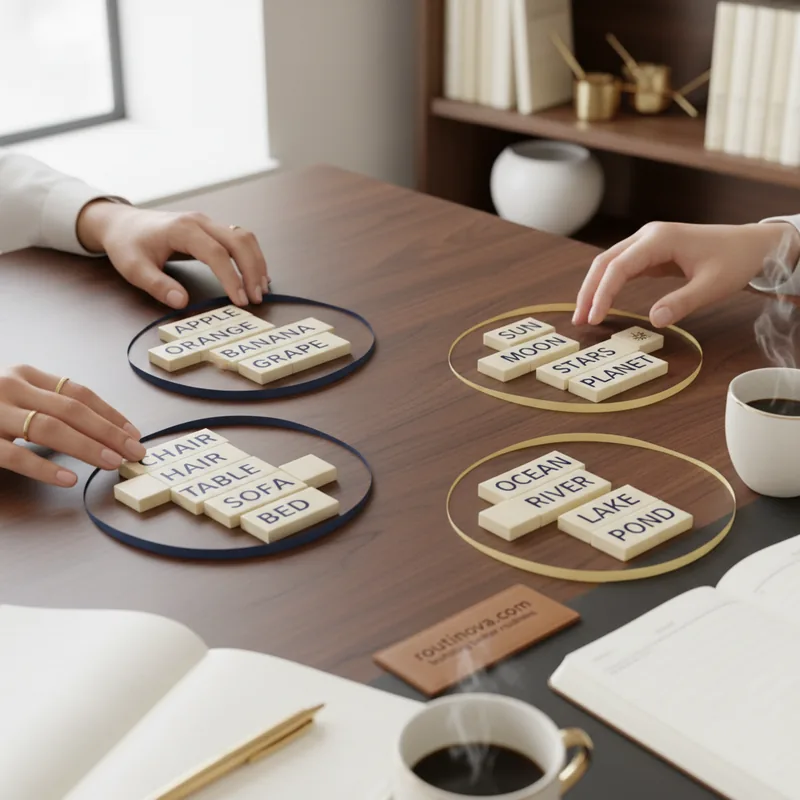
- Beware of Red Herrings: Don't jump on the first obvious grouping. For instance, a puzzle might include words like 'ORANGE,' 'PEAR,' 'APPLE,' and 'JUICE.' While the first three are fruits, 'JUICE' might belong to a category like 'Things That Flow' (e.g., JUICE, RIVER, CURRENT, ELECTRICITY). Always double-check that all four words *only* fit your chosen category.
- Look for the Outliers: Sometimes, the key to a category is finding the words that *don't* seem to fit anywhere else. If three words clearly form a group, but a fourth word feels like an odd one out, try to find a less obvious connection for that outlier. For example, if you see 'BATTERY,' 'DRUM,' 'RHYTHM,' and 'CHARGE,' you might initially group BATTERY and CHARGE. But 'DRUM' and 'RHYTHM' suggest a musical theme. Perhaps 'CHARGE' and 'BATTERY' are part of 'Things That Power Devices,' while 'DRUM' and 'RHYTHM' are 'Musical Elements.'
- Consider Wordplay: Many categories rely on puns, homophones, or words that can precede or follow another word. A classic example might be words that can be '___ CARD' (e.g., WILD, GREETING, CREDIT, PUNCH). Always think beyond the literal meaning.
- Don't Be Afraid to Google (After You've Tried!): If a word has a meaning you're unfamiliar with, a quick search can sometimes unlock an entire category. Just be careful not to spoil the whole puzzle!
These mental gymnastics aren't just for fun; they're excellent for cognitive function. Engaging with puzzles like Connections can improve memory, problem-solving skills, and even mood (Mayo Clinic, 2023). So, keep playing, keep learning, and check back tomorrow for more today's NYT Connections hints and solutions!