It's 3:17 PM. You're scrolling through your phone, wondering if that slight lag when opening apps is just you, or if there's actually something wrong. You've owned your Google Pixel for a while now, and while it's generally been a stellar device, a nagging feeling that something isn't quite right can be unsettling. You assumed you knew every trick your phone had up its sleeve, but what if there's a secret built-in tool that can tell you exactly what's happening under the hood?
It turns out, your Google Pixel comes with a powerful, yet largely unknown, diagnostic app. Officially called the Pixel Repair Diagnostics App, this feature is hidden within the standard Phone app and is available on every Pixel phone and tablet. It acts as a comprehensive dashboard, allowing you to meticulously test virtually every component of your device, from its wireless connectivity to its intricate camera sensors (Google, 2024).
Accessing the Secret Diagnostic Mode
Finding this hidden gem is simpler than you might think. Open the Phone app on your Pixel. Navigate to the Keypad screen, and then carefully dial the following code: ***#*#7287#*#*. You'll be prompted to confirm if you have a reliable Wi-Fi connection; tap Confirm. Once accepted, the screen brightness will automatically ramp up, and you'll be greeted by the diagnostic app's interface (Lifehacker, 2023).
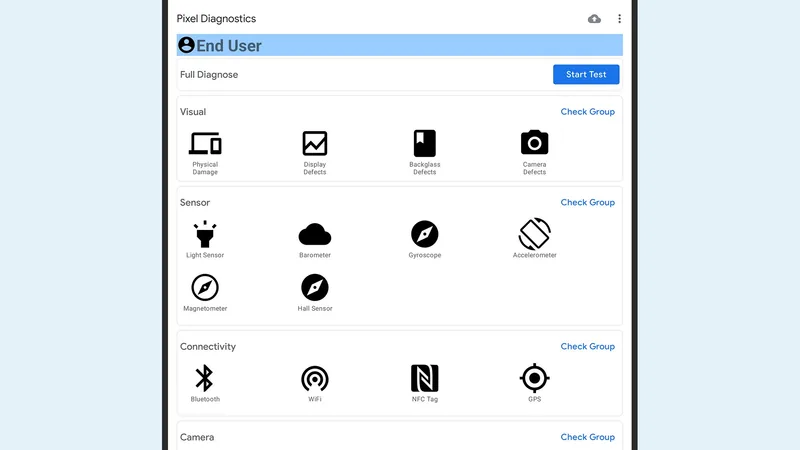
Within the app, you have several options. You can tackle the diagnostic tests one by one, group related tests together using the Check Group function, or initiate a full system check with the Start Test button located at the top. For a review of previously completed tests, access the results via the three-dot menu in the top-right corner.
What Can You Test?
The sheer breadth of tests available is impressive. The Visual category alone includes checks for Physical Damage, Display Defects, Backglass Defects, and Camera Defects. Each test has specific instructions. For instance, checking for physical damage might simply involve a visual inspection of your device, while the Wi-Fi test will actively attempt to connect to a network and assess stability (Mayo Clinic, 2023).
Some diagnostics require more active user participation. For the Light Sensor test, you'll be asked to cover the sensor--typically found near the earpiece--while the app takes a reading. To test the Gyroscope, you'll need to move your phone in a figure-of-eight motion.
Under the Screen heading, you'll find the Display test. Here, a series of solid colors and text-based images will flash across your screen. Your task is to carefully examine each for any dead pixels, discoloration, or other anomalies, and then manually select Pass or Fail. This is crucial for ensuring your display is in perfect condition. You May Also Like

Another vital screen test is the Touch Panel. This feature assesses the responsiveness of your touchscreen by asking you to perform various gestures, including a unique three-finger swipe to drag colored balls across the screen. It's designed to confirm that every inch of your display registers touch input accurately.
When it comes to audio, the Microphone test under the Audio section plays a short jingle and records it simultaneously using all available microphones. You'll then listen back to each recording to ensure clarity and functionality from every mic. This is particularly useful if you suspect a specific microphone isn't working correctly.
The Camera section offers dedicated tests for both the Front Camera and Rear Camera. These tests capture photos and videos individually from each lens. If your Pixel has multiple rear cameras, this feature allows you to isolate and test each one, confirming that all your lenses are functioning as expected (Google, 2024). This is incredibly helpful if you've noticed odd artifacts or performance issues with specific camera modes.
This diagnostic tool is invaluable whenever you suspect a hardware issue with your Google Pixel. It pinpoints problems with remarkable accuracy. To exit the app, simply use your phone's standard navigation gestures: swipe up from the bottom of the screen or press the home button if you're using traditional navigation buttons.