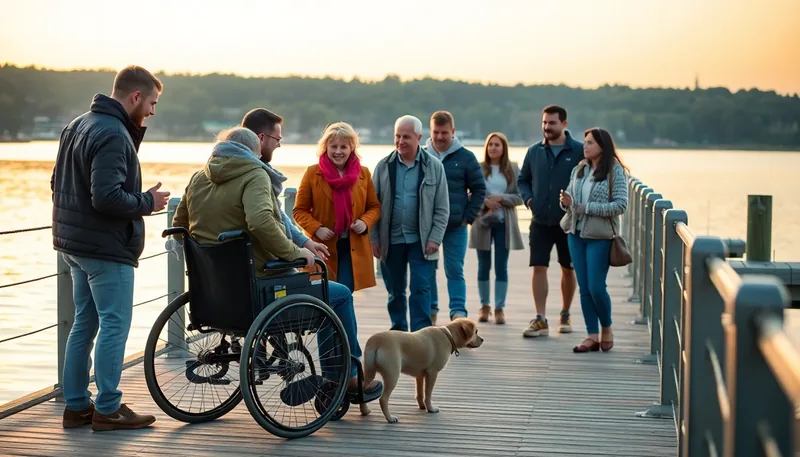
Imagine waking up to a world where everyday actions--like navigating a public building or engaging in a conversation--are subtly, or overtly, designed to exclude you. For millions, this isn't imagination; it's the daily reality shaped by ableism. Sarah, a talented architect, faced this often. Despite her innovative ideas, clients sometimes questioned her ability to manage projects simply because she used a wheelchair, assuming her physical difference equated to professional incompetence. This ingrained bias, known as ableism, affects individuals across all walks of life, challenging their worth and denying their full participation.
Ableism is discrimination and social prejudice against people with disabilities, rooted in the belief that there is a "normal" or "ideal" way for bodies and minds to function, and that any deviation is inherently inferior or "needs fixing." This systemic bias devalues individuals with disabilities, impacting their access, opportunities, and overall well-being. Understanding ableism: what it means, is crucial for fostering a truly equitable and compassionate society that recognizes the inherent value and diverse capabilities of every individual.
Understanding Ableism: What It Truly Means
Ableism operates on the harmful premise that non-disabled individuals are superior to those with disabilities. This prejudice can manifest in countless ways, from overt discrimination to unconscious biases, and is often embedded in societal structures and individual interactions. It perpetuates the idea that people with disabilities are "less than" or incomplete, needing to be cured or fixed rather than accommodated and respected for their unique identities.
To truly grasp ableism: what it means, we must look beyond individual acts of unkindness. It encompasses a broad spectrum of beliefs and practices that marginalize disabled people, limiting their opportunities in education, employment, social life, and public spaces. Recognizing this pervasive mindset is the first step toward dismantling it.
The Deep Roots of Ableism in History
While the term "ableism" itself is relatively modern, coined in the 1980s by American feminists during civil rights movements, the history of discrimination against disabled people stretches back centuries (Oxford Reference, 2023). In the Middle Ages, individuals with disabilities were often seen as possessed by malevolent spirits or as divine punishment, leading to neglect and cruel treatment rather than care or understanding (NCCJ, 2021).
A Dark Chapter: Eugenics
The 19th century introduced a particularly disturbing manifestation of ableism through the eugenics movement. This pseudo-scientific ideology sought to "improve" the human race by promoting selective breeding for "desirable" traits and discouraging or preventing reproduction among those deemed "undesirable." This concept, which influenced discriminatory laws in the United States and inspired Nazi Germany's horrific racial policies, was inherently racist, classist, and ableist.
Eugenics advocated for practices like forced sterilization and restrictive marriage laws, positioning White, non-disabled individuals as the "ideal" human form. Though significant progress has been made in challenging such beliefs, the echoes of this dark history persist in subtle societal biases and structural inequalities that continue to affect disabled communities today.
Recognizing the Forms of Ableism: Physical and Mental
Ableism generally manifests in two primary categories: physical and mental. While these distinctions help us understand its varied expressions, it's important to remember that they often intersect, impacting individuals in complex ways.
Physical Ableism
Physical ableism involves discrimination against individuals with physical disabilities. For those who are not disabled, these barriers can be virtually invisible. Non-disabled people may not notice how public spaces, services, and systems are often designed without considering the needs of people with mobility challenges or sensory impairments.
- Inaccessible Infrastructure: Buildings lacking ramps, elevators, or automatic doors, making entry impossible for wheelchair users.
- Lack of Sensory Accommodation: Public signs without braille or audio descriptions, excluding visually impaired individuals.
- Presumption of Incapability: Assuming someone who uses a mobility aid is less intelligent or capable than their non-disabled peers.
- Digital Barriers: Websites or apps that lack screen reader compatibility, making them unusable for visually impaired users.
Mental Ableism
Mental ableism targets individuals who are mentally ill, neurodivergent, or have developmental disabilities. This form of discrimination can be equally damaging, often leading to stigma, isolation, and reduced opportunities.
- Educational Segregation: Separating neurodivergent students into specialized classes or schools, limiting their integration and access to diverse learning environments.
- Derogatory Language: The casual use of terms like "dumb," "crazy," "moron," or "retarded" in everyday conversation, perpetuating harmful stereotypes.
- Wage Discrimination: The legality in some regions of paying mentally disabled individuals below minimum wage, devaluing their labor.
- Dismissing Neurodiversity: Assuming someone with ADHD is simply "lazy" or "unfocused" rather than acknowledging a neurological difference that requires specific support.
Subtle to Overt: Identifying Ableist Behaviors
Ableism isn't always as glaring as a staircase without a ramp. It frequently appears in subtle ways, and many non-disabled individuals unknowingly participate in ableist behaviors. Understanding these nuances is crucial for fostering a more inclusive environment.
Outright Discrimination
This is the most overt form of ableism, characterized by explicit actions that exclude or disadvantage disabled people. These actions are often intentional and directly deny opportunities or access.
- Employment Bias: Refusing to hire a qualified candidate solely because of their disability, despite their abilities.
- Inaccessible Venues: Choosing a meeting or event location that cannot accommodate individuals with mobility impairments.
- Intrusive Questions: Asking invasive and personal questions about someone's disability without their consent or a legitimate reason.
- Lack of Accessibility Features: Producing media like movies or presentations without essential features such as closed captioning or audio descriptions.
Microaggressions
Unlike overt discrimination, microaggressions are subtle, often unintentional expressions of prejudice. They can be verbal, behavioral, or environmental and communicate hostile, derogatory, or negative messages to disabled individuals.
Common microaggressions include assuming someone with a disability is helpless, minimizing their condition by implying they are exaggerating their limits, or treating disabled adults as childlike and incompetent. Phrases deeply ingrained in our language can also be ableist microaggressions.
Consider expressions like "the blind leading the blind," "fell on deaf ears," "that's so lame," "I'm so OCD when it comes to cleaning," or "that girl is a psycho." While often spoken without malicious intent, these phrases normalize derogatory views of disabilities and contribute to a culture that marginalizes disabled people.
Systemic or Institutional Ableism
Systemic ableism is embedded within the policies, practices, and structures of institutions and society at large. It's often the hardest to identify because it's part of the "normal" way things are done. Most non-disabled people are complicit in systemic ableism to some degree, simply by existing within these structures.
This complicity can manifest as a failure to advocate for change when noticing inaccessible public spaces or when an employer hesitates to hire a disabled person. While individuals don't typically create institutional ableism, they play a vital role in challenging it. Supporting local disability advocacy groups and amplifying the voices of disabled individuals are crucial steps in dismantling these entrenched biases. For example, public transportation systems with infrequent or unreliable accessible vehicles exemplify systemic ableism, making independent travel difficult for many.
The Far-Reaching Impact of Ableism
The consequences of ableism are profound and multifaceted, severely affecting the lives of disabled individuals. It creates barriers that can be emotional, physical, academic, and economic.
Emotionally, ableist remarks or attitudes can inflict deep psychological harm, eroding self-esteem and fostering feelings of isolation. For instance, a blind person hearing the phrase "like the blind leading the blind" can experience a painful reminder of societal devaluation.
Physically, inaccessible environments force disabled individuals to navigate a world not built for them, leading to frustration, exhaustion, and sometimes even physical injury. Academically, ableism can result in battles for inclusion, with disabled students often denied necessary accommodations or segregated from their non-disabled peers.
Economically, the impact is stark. Disabled people frequently face fewer job opportunities, lower wages, and significant employment gaps, earning an average of 37% less annually than their non-disabled counterparts (AIR, 2022). This systemic disadvantage limits financial independence and perpetuates cycles of poverty.
Cultivating an Inclusive World: Your Role
The good news is that by simply learning about ableism: what it means, you've already taken a crucial first step toward becoming a more inclusive individual. Meaningful change begins with awareness and a commitment to action.
Now that you understand how ableism manifests in society, here are actionable steps you can take to challenge it and foster a more inclusive world:
- Inclusive Hiring Practices: If you are an employer, actively seek to hire and support people with disabilities, ensuring accessible workplaces and reasonable accommodations.
- Mindful Language: Consciously eliminate ableist language from your vocabulary, choosing respectful and person-first terminology.
- Challenge Assumptions: Never assume a disabled person is less capable or valuable. Engage with them as you would anyone else, respecting their autonomy and agency.
- Advocate for Accessibility: When encountering inaccessible spaces or services, speak up to managerial staff or relevant authorities to demand change.
- Respect Accessible Spaces: Refrain from using accessible bathrooms or parking spaces unless you genuinely need them, ensuring they are available for those who do.
- Prioritize Needs: If you are able, use stairs instead of elevators to leave more space available for individuals who rely on elevators due to mobility impairments.
- Beyond Inspiration: Remember that disabled people are not here to inspire others. Value them for their inherent worth, not for overcoming challenges.
- Direct Learning: Actively seek out and learn from disabled writers, creators, and activists. Follow them on social media, listen to their podcasts, and read their articles to gain authentic perspectives.