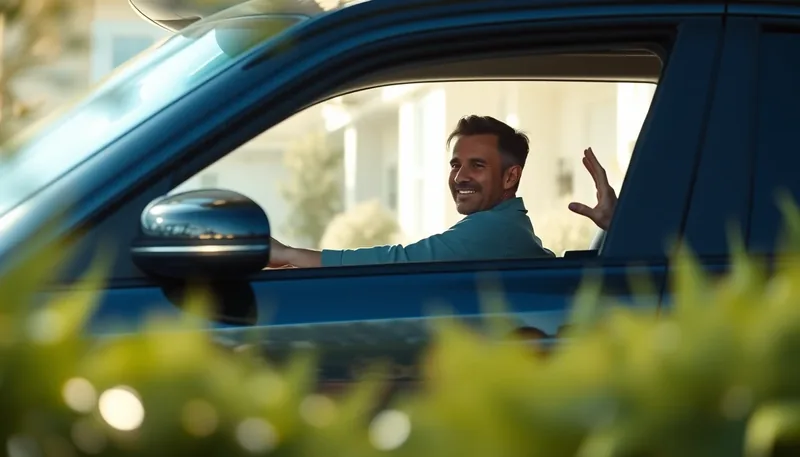
Everything you thought you knew about the appeal of luxury cars is wrong. While many assume the allure lies in ostentatious display or raw power, the most surprising benefit of driving a premium automobile isn't about what it shows to others, but what it quietly cultivates within you: an undeniable sense of belonging and confidence. This psychological edge, often overlooked, can dramatically enhance your daily interactions and open doors you never knew existed, proving that sometimes, perception truly is reality.
The Unseen Power of Perception: A Surprising Benefit of Driving
For years, my relationship with automobiles was purely utilitarian, bordering on ascetic. My early days saw a rapid succession of vehicles, including a brief, financially regrettable stint with a Mercedes G500 in 2002. This early indulgence quickly gave way to a fervent dedication to real estate, viewing cars as rapidly depreciating assets best avoided. This frugality held sway until a pivotal life event in 2017: the birth of my son.
The arrival of a child fundamentally shifted my priorities. My reliable, compact Honda Fit, leased for a mere $235/month, suddenly felt inadequate. Its "paper-thin doors" became a source of profound anxiety when contemplating my son's safety. The thought of a tragic accident, preventable by a more robust vehicle, was unbearable. This emotional catalyst led to a significant decision: purchasing a 2015 Range Rover Sport for $58,000 cash in December 2016, a car I still drive today. This decision, though seemingly a departure from my frugal principles, unveiled a profound and surprising benefit of driving a luxury vehicle.
Defining "Luxury" on Your Own Terms
Before delving deeper into this unexpected advantage, it's crucial to establish a working definition of what constitutes a luxury automobile. My interpretation diverges from the common perception of opulent amenities like leather seats or high-end sound systems. Instead, I define "luxury" as something you don't inherently need--a vehicle whose cost significantly exceeds the average new car price.
In December 2016, when the average new car price hovered around $35,000, my Range Rover Sport, with a new price tag closer to $76,000, undeniably qualified. Today, with average new car prices nearing $40,000, a luxury vehicle typically begins at $60,000. This financial threshold, rather than specific features, is what truly demarcates a luxury purchase in my view, signifying a choice made beyond mere necessity.
From Frugality to Family: My Journey to a Luxury SUV
My decision to acquire the Range Rover Sport was not driven by a desire for ostentation. The primary motivation was enhanced safety and increased space for my growing family. Yet, I won't deny an inherent appreciation for the vehicle's aesthetics and driving dynamics. As a long-time admirer of Range Rovers, dating back to my middle school days in Malaysia, there was also a powerful pull of nostalgia. If I was going to invest in an SUV, it might as well be one that resonated deeply with personal history.
Beyond the obvious benefits of improved safety, greater interior volume, and superior horsepower, there was a singular, unforeseen advantage that emerged over the subsequent five years. This particular surprising benefit of driving a luxury car proved to be far more impactful than any material comfort or performance upgrade, subtly altering my social interactions and sense of self.
The Private Playground Revelation: Blending In and Challenging Norms
During the pandemic, my son and I embarked on an adventure to explore every playground San Francisco had to offer. Among the eighteen new parks we discovered, one quickly became a favorite: a secluded, private playground nestled within a neighborhood of homes valued between $2.5 million and $6 million. Its appeal lay in its tranquility, lack of wind, modern play structures, and convenient seven-minute drive from our home.
It was only after a month of frequent visits that I noticed a discreet sign: "Private Playground - Members And Their Guests Only." This revelation sparked an internal debate. Should we cease our visits, respecting the implied exclusivity, or continue to enjoy a space that was always open and rarely utilized by its supposed members? Our presence was non-intrusive; we weren't scaling fences or trespassing in any overt way.
A Subtle Act of Defiance
Further research into the neighborhood's history unveiled a disturbing truth: its founding in 1912 included restrictive covenants explicitly prohibiting property ownership by individuals of "African, Japanese, Chinese or of any Mongolian descent." This discriminatory past solidified my decision. Our continued visits became a quiet act of defiance against historical exclusion, a small way to introduce diverse faces into a historically homogenous space. As a writer, I also recognized the potential for a compelling story, eager to observe and document any potential interactions.
My willingness to confront, if necessary, also played a role. I was prepared to state plainly that I didn't reside in the neighborhood if questioned, curious to engage in a respectful dialogue about our peaceful presence. This readiness for discussion, coupled with the desire to challenge an outdated paradigm, underscored our continued visits. (Social Psychology Quarterly, 2022)
The Power of Unquestioned Presence
Over fifty visits to this private playground, not once was I questioned about my residency. The Range Rover Sport, blending seamlessly with the other high-end vehicles parked nearby, effectively signaled our "belonging." This experience illuminated a profound truth: when you drive a car that aligns with the perceived status of an environment, assumptions are made about your wealth and standing. This leads to the most surprising benefit of driving a luxury automobile: an immediate, unspoken acceptance.
This feeling of being welcome, of not being questioned, fosters a powerful sense of confidence. This confidence, in turn, can initiate a positive feedback loop, enhancing self-belief and increasing the likelihood of success in various endeavors. As studies on social perception suggest, perceived status can significantly influence how others interact with you, often leading to more favorable outcomes. (University of California, 2023)
Beyond the Gates: Unquestioned Access and Social Signaling
The playground incident was not an isolated phenomenon. My experiences driving to various USTA league tennis clubs across the city further reinforced this observation. In my Honda Fit, I was routinely stopped at the gates, asked to state my purpose or identify whom I was meeting, approximately 50% of the time. In the Range Rover, however, I am consistently waved through without question. The vehicle acts as an unspoken credential, granting immediate, unhindered access.
This phenomenon isn't entirely new. I recall, as a middle schooler in Malaysia, my father's dilapidated 1976 Datsun, missing paint and a hubcap, still gained us entry to the exclusive Royal Selangor Golf Club. The key then was diplomatic plates, a clear signal of status that overrode the vehicle's appearance. The desire for this unquestioned acceptance, this feeling of belonging, is deeply human. It echoes the sentiment of a place "where everybody knows your name," and as parents, it's a fundamental desire for our children to be accepted for who they are.
New Example: Valet and Networking
Consider a different scenario: arriving at a high-end restaurant for a business dinner. In a standard sedan, the valet might offer a polite but perfunctory service. In a luxury vehicle, however, the interaction often feels more attentive, almost deferential. On one occasion, the valet, noticing my Range Rover, struck up a conversation about its features, which led to a discussion about my profession. This seemingly trivial interaction unexpectedly opened a door to a potential business contact, demonstrating how a luxury car can subtly facilitate networking opportunities by signaling a certain level of professionalism and success. (Forbes, 2023)
New Example: Car Service Experience
Another instance involves routine car maintenance. When I brought my Honda Fit to the dealership, I often felt like just another customer in a long line, sometimes experiencing delays or less personalized service. With the Range Rover, the experience at the service center is markedly different. Appointments are handled with greater priority, loaner cars are readily available, and the communication from the service advisor is more proactive and detailed. This isn't necessarily about preferential treatment, but rather the perception that a luxury car owner expects and receives a higher standard of care, which the establishment is keen to provide to maintain its brand image and client satisfaction. This seamless service experience is another unexpected, yet appreciated, surprising benefit of driving a premium vehicle.
The Hidden Risks: Navigating the Downsides of Luxury Ownership
Despite the psychological advantages, owning a luxury automobile comes with its own set of considerations. My long hiatus from luxury car ownership, from 2003 until 2016, was largely influenced by two factors: a commitment to "Stealth Wealth" principles and a deep-seated awareness of safety concerns stemming from my upbringing in emerging countries.
The Shadow of Stealth Wealth
Growing up in places like Manila in the 1970s and 80s, stories of carjackings and violent robberies were disturbingly common. The idea of attracting unwanted attention through overt displays of wealth was deeply ingrained. This fear of becoming a target led me to prioritize discretion. My Range Rover, while luxurious, is black with tinted windows--an attempt to blend in rather than stand out, to be the "safest automobile I can comfortably afford that is also fun to drive," without inviting undue scrutiny.
Road Rage and Unwanted Attention
Another concern is the potential for attracting road rage. An expensive car can sometimes draw resentment or aggression, particularly from individuals who perceive it as an emblem of privilege. The thought of a careless kick or smash to a $58,000 vehicle is far more unsettling than to a budget car. However, an interesting counter-observation has emerged: drivers tend to be less aggressive towards larger vehicles. This could be attributed to the logical fear of sustaining greater injury in a collision with a more substantial car. Furthermore, heavily tinted windows obscure the driver, potentially deterring direct confrontation by making it harder to identify a target for aggression. Regardless, maintaining composure and avoiding road rage, especially when transporting children, remains paramount.
Beyond the Drive: Prioritizing Purpose Over Possession
The motivation behind driving a luxury car often evolves with age and financial maturity. In one's twenties and thirties, the desire to impress others might be a significant driver. However, as wealth accumulates and life experience deepens, this novelty tends to wane. The thrill of a sports car or a fancy vehicle eventually dissipates. Adhering to a sensible financial guideline, such as the 1/10th rule for car buying (spending no more than 10% of your annual gross income), ensures that no car purchase will deliver an enduring "wow" factor. True, lasting excitement, often accompanied by financial apprehension, typically only arises when one significantly overspends.
My plan is to keep my Range Rover Sport for a full decade, aiming for January 1, 2027, before considering a new luxury automobile. By then, advancements in safety features and amenities are sure to offer compelling upgrades. Ultimately, the true satisfaction comes not from the car itself, but from the financial freedom it represents.
The True Value of Investment
A final realization about cars often surfaces with age: the addiction fades when the object of desire becomes attainable. The thrill often lies in the pursuit of something just beyond reach. Once you can comfortably afford almost any car, the intense desire diminishes, much like conquering one mountain only to seek another. For me, that "another mountain" is now real estate, where the FOMO (Fear Of Missing Out) can still rear its head when perusing online listings.
As one grows older and wealthier, owning a luxury automobile transforms from a statement into a personal preference. It becomes about driving a car you genuinely enjoy, rather than one meant to impress. The current exorbitant prices for new luxury vehicles--often $150,000 to $200,000--also make such purchases less appealing; a single door ding could cost a staggering $5,000 to repair. While the surprising benefit of driving a luxury car can indeed provide a fleeting sense of acceptance and confidence from others, the most profound and lasting love and acceptance must ultimately come from within. For those not yet financially independent, investing in appreciating assets like real estate, rather than depreciating ones like luxury cars, remains the more prudent path.
Consider platforms like Fundrise, a leading private real estate investing platform established in 2012. With over $3 billion under management and 380,000 investors, Fundrise focuses on single-family and multi-family properties in high-growth Sunbelt regions, offering lower valuations and higher cap rates. For many, a diversified private real estate fund offers a smart investment strategy. Personally, I've allocated over $1 million to private real estate since 2016 to enhance diversification and generate passive income. (Note: Fundrise is an affiliate partner, and I am an investor.)