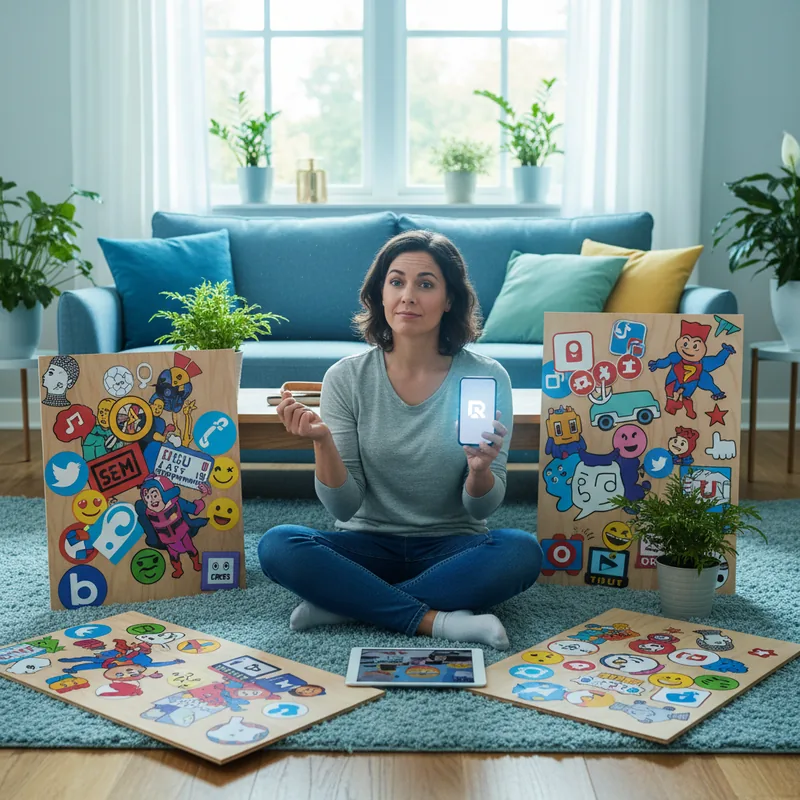
Sarah stared at her phone, a familiar wave of disorientation washing over her. Another day, another viral trend that made absolutely no sense. Was that a celebrity endorsing a questionable diet pill, or just a deepfake? And why were so many people filming themselves pretending to catch their partners cheating in their kitchens? For those of us who didn't grow up with the internet as a second brain, navigating today's digital landscape feels like deciphering an alien language. Authenticity, a value we once held dear, seems to have dissolved into a sea of manufactured moments and clever marketing. This is your guide to understanding the baffling, the bizarre, and the outright unbelievable corner of kid culture that leaves us feeling perpetually out-of-touch.
Decoding the Internet's Absurdity
The line between genuine expression and calculated performance has blurred into non-existence. Every viral video could be a stealth advertising campaign, every breakout artist an industry plant designed to capture your attention (and your wallet). We’re talking about the all-encompassing scams, the maximalist absurdity that defines much of online culture. Whether it’s a rapper inexplicably linked to a fast-food chain or staged domestic dramas, understanding these phenomena requires a new lens.
Consider the curious case of Rod Wave’s Arby’s Takeover. Rod Wave, a rapper known for his soulful trap music, and Arby’s, the fast-food giant famous for its roast beef sandwiches, seem like an odd pairing. Yet, the internet, in its infinite wisdom, decided they were a match made in meme heaven. The joke? To create outlandish, AI-generated flyers advertising a fictional collaboration, pushing the boundaries of what's appetizing and what's art. The resulting surreal images are a testament to the power of prompts like "more, MORE, MORE," leaving us to wonder if this is genuine grassroots comedy or a cleverly disguised marketing ploy. It’s a prime example of how the digital age can turn anything into a potential brand opportunity, leaving us asking: Is this real, or just a very convincing simulation?
This phenomenon also reignited interest in Arby’s legendary “Meat Mountain.” Online lore speaks of a secret menu item, a colossal sandwich piled high with every meat Arby’s offers. While initially a marketing visual from their 2014 “We Have the Meats” campaign, it evolved. Customers pointed, ordered, and Arby’s, allegedly, complied. Now, a new generation is reviving the Meat Mountain, turning a marketing stunt into a tangible, albeit gargantuan, menu item. It’s a fascinating cycle of meme creation, consumption, and reinterpretation, proving that what starts as a joke can become a delicious, if questionable, reality.
Beyond food fiascos, we see intricate webs of manufactured narratives. Take, for instance, the rise of AI-generated art showcasing fantastical food creations. A user might prompt an AI to visualize a "burger made of diamonds and lava," resulting in images that are visually stunning but entirely synthetic. These are shared across platforms, blurring the lines between artistic expression and the potential for commercial exploitation, much like the Arby's flyers. This constant flux of what is real and what is created, often for profit, is a hallmark of our current digital ecosystem.
Staged Infidelity and the Affiliate Economy
While many TikTok creators chase views with dance challenges or beauty tutorials, a more peculiar genre has emerged: staged infidelity videos. You’ve likely seen them – a woman in a kitchen, chopping vegetables, only to “discover” her husband’s infidelity. These videos, often featuring questionable acting and oddly inadequate kitchen knives, seem designed to provoke a reaction. The knife itself, often a focal point of viewer comments, becomes a symbol of the scene’s artificiality. Why the wrong knife? It’s rage-bait, designed to generate engagement through outrage and mockery.
But the true purpose behind these domestic dramas is far more complex and, frankly, more depressing. These aren't just amateur soap operas; they are sophisticated, self-produced commercials. They’re part of an elaborate affiliate marketing scheme for products like CheatCatcher, an AI-powered service that supposedly tracks a spouse’s infidelities. This falls under the umbrella of the Online Infidelity Industrial Complex (OIIC), which includes a host of services designed to capitalize on suspicion and distrust.
This is just a sliver of the vast affiliate program universe. From high-end jewelry to cheap impulse buys from Temu, almost everything is being funneled through influencers, media outlets, and even our social circles. It’s a hall of mirrors where every click, every share, potentially leads to a sale. The staged infidelity videos, with their manufactured drama, are simply one of the more overt examples of how deeply embedded affiliate marketing has become in our online lives. It’s a system built on generating clicks and conversions, often by playing on our emotions and insecurities.
Consider a new trend where influencers post seemingly candid “day in the life” videos that meticulously showcase sponsored products. A morning routine might feature a specific brand of coffee, a particular skincare product, and a sponsored workout app, all seamlessly integrated. While presented as authentic glimpses into their lives, these videos are carefully curated advertisements, each item linked for viewer purchase. This is the modern iteration of the OIIC, but applied to every facet of life, not just relationships.
Organic Chaos and Viral Stunts
Not every online trend is a sophisticated marketing scheme. Some are born from genuine, albeit chaotic, impulses. Take the “Scientology speedrun” phenomenon. This trend involves individuals running into Scientology buildings, attempting to get as far inside as possible before being stopped, and documenting the experience. It’s chaotic, potentially illegal, but undeniably “organic” in its roots, harkening back to earlier internet-era stunts by groups like Anonymous.
These videos capture a raw, youthful energy. TikTokers initially posted street encounters, but the trend escalated to physical intrusions. While TikTok often removes videos depicting illegal activities, the sheer volume and underlying humor keep some of these clips circulating, and platforms like X (formerly Twitter) are less stringent. The spectacle of young people challenging a secretive organization, even in a reckless manner, holds a certain viral appeal. It’s a form of rebellion, amplified by the digital stage.
Then there’s the simple, mesmerizing allure of the “Power Hot Ball.” This TikTok account gained millions of views by showcasing a metal ball heated to extreme temperatures (around 1,000°C) melting through various objects. From fruits and electronics to different materials, the slow, destructive cascade is oddly satisfying to watch. It’s a pure, unadulterated spectacle that requires no explanation, just viewership. The fact that a humble coconut can withstand its fiery assault adds a touch of unexpected humor, proving that even the most extreme viral content can have its limits.
These viral stunts, from the daring to the downright bizarre, highlight a segment of internet culture driven by a desire for attention, a spirit of rebellion, or simply the pursuit of mesmerizing visuals. They are a stark contrast to the calculated affiliate marketing schemes, offering a glimpse into the raw, unfiltered, and often strange creativity that defines online trends. For the out-of-touch adult, these are the moments that make you pause and think, "What is happening?" but also, perhaps, understand the pull of the inherently human desire to witness the extraordinary, even if it’s just a ball of metal melting a phone.
Understanding these trends isn't about judging them; it's about recognizing the underlying mechanisms. Whether it's the sophisticated affiliate marketing woven into staged dramas or the raw, chaotic energy of viral stunts, they all speak to the evolving nature of online interaction and influence. For those of us feeling like out-of-touch adults navigating this landscape, a little insight goes a long way in making sense of the digital world our kids inhabit.