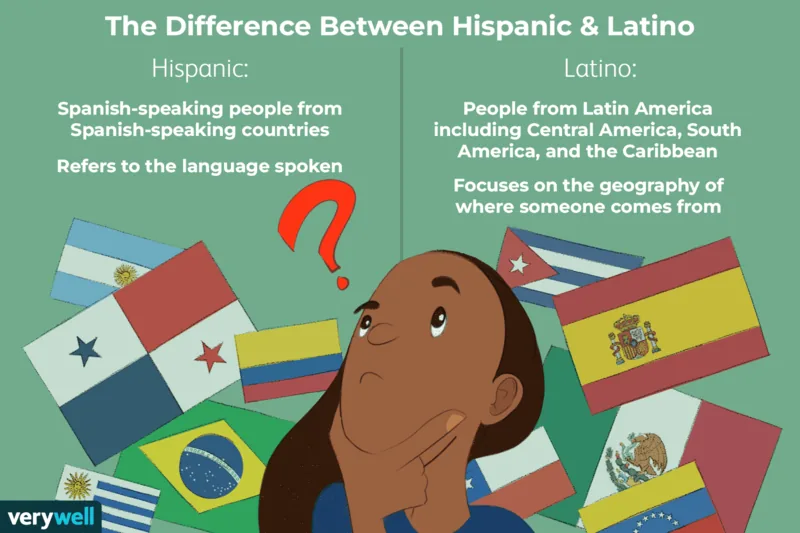
Ever found yourself wondering if 'Hispanic' and 'Latino' mean the same thing? You're not alone. While often used interchangeably, these terms represent distinct identities rooted in language and geography. Understanding the difference between Hispanic and Latino isn't just about semantics; it's about respecting cultural heritage and individual identity. The core distinction lies here: Hispanic refers to people from Spanish-speaking countries, emphasizing linguistic heritage, while Latino refers to people from Latin American countries, highlighting a geographical connection. This fundamental difference shapes how people identify and how we can best refer to them.
The Crucial Divide: Language vs. Geography
Think of it this way: 'Hispanic' is about the language spoken, specifically Spanish, or a heritage tied to Spanish colonization. It's a linguistic umbrella. 'Latino,' on the other hand, is a geographical identifier. It encompasses people from countries in Latin America, which includes South America, Central America, and parts of the Caribbean. This means someone can be Hispanic but not Latino, Latino but not Hispanic, both, or neither.
What is the difference between these labels? Let's break it down. For instance, someone from Spain is Hispanic because they speak Spanish, but they aren't Latino because Spain is in Europe, not Latin America. Conversely, someone from Brazil is Latino because Brazil is in Latin America. However, they aren't Hispanic because Portuguese, not Spanish, is the primary language spoken there (Pew Research Center, n.d.). This highlights that the what is difference between these terms is significant for accurate self-identification.
Defining 'Hispanic': A Linguistic Heritage
When we talk about 'Hispanic,' we're primarily referring to a connection to the Spanish language. This includes people whose families originally came from Spain or any of the numerous countries where Spanish is the official or primary language. It's a label that unites people through a shared linguistic past and, often, a shared history of Spanish colonial influence.
However, it's important to note that not everyone who is considered Hispanic speaks Spanish fluently, or at all. Generational shifts, assimilation, and individual circumstances mean that language proficiency can vary widely. Yet, the cultural and ancestral ties to a Spanish-speaking heritage remain the defining characteristic (Pew Research Center, n.d.). For example, someone whose grandparents emigrated from Mexico might identify as Hispanic due to their family's background, even if they themselves primarily speak English.
Defining 'Latino': A Regional Identity
The term 'Latino' casts a wider net geographically. It includes individuals from all of the Latin American countries, regardless of the language they speak. This means Brazilians (Portuguese-speaking), French-speaking Haitians, and Spanish-speaking Argentinians can all be considered Latino. It's a term that celebrates the diverse cultures and peoples within the vast region of Latin America.
But here's where it gets complex: not everyone from a Latin American country identifies as Latino. Some Caribbean nations, even those geographically within Latin America, might not be included in the common understanding of the term. For example, English-speaking Jamaica or French-speaking Haiti are often excluded, and their citizens may not identify with the 'Latino' label (Berkeley News, n.d.). This shows that while geography is key, cultural self-identification plays a crucial role. The what is difference between Hispanic and Latino becomes even more apparent when considering these nuances.
Beyond the Binary: Overlapping and Distinct Identities
So, can you be both Hispanic and Latino? Absolutely. Many people, particularly those from Spanish-speaking countries in Latin America (like Mexico, Colombia, or Cuba), fall into both categories. They have a Spanish-speaking heritage and are from Latin America.
But what about someone from, say, Argentina? They are Latino because they are from Latin America, and they are also Hispanic because they speak Spanish. Conversely, a person from Portugal is European and speaks Portuguese; they are neither Hispanic nor Latino. A person from the Philippines, while having a history of Spanish colonization and speaking Spanish-influenced languages, is generally not considered Hispanic or Latino in the way these terms are used in the U.S. context, as their primary cultural and geographical identity is Asian.
The evolution of these terms also includes newer identities. 'Latinx' has emerged as a gender-neutral alternative, aiming for greater inclusivity, particularly within LGBTQ+ communities. However, its adoption is debated, with many preferring traditional terms or their country of origin (Ramos et al., 2023). This ongoing discussion highlights the dynamic nature of identity and the personal choices individuals make in defining themselves.
How Terms Evolved: Media and Census Influence
The popularization and understanding of 'Hispanic' and 'Latino' have been significantly shaped by their inclusion in the U.S. Census and their portrayal in media. In the 1980 census, 'Hispanic' was first included as an ethnicity option, allowing individuals to identify their heritage separately from race. The term 'Latino' followed, appearing on the census in 2000, reflecting a growing awareness and desire to categorize this diverse population (Schut, 2021).
Media outlets often favor one term over the other. Historically, 'Hispanic' was more prevalent, but 'Latino' has gained traction, possibly because it's perceived as broader, encompassing culture, music, and broader societal aspects beyond just language. This usage can influence public perception and how individuals choose to identify. The what is difference between how these terms are used in official capacities versus popular culture can sometimes create confusion.
Respecting Individual Identity
Ultimately, the most important aspect when discussing these identities is respect for individual preference. While 'Hispanic' and 'Latino' offer frameworks for understanding shared heritage and experience, they are not one-size-fits-all labels. Some individuals may prefer to identify solely by their country of origin, such as 'Mexican,' 'Salvadoran,' or 'Brazilian.' Others might use hyphenated identities like 'Mexican-American' or embrace broader terms like 'American.' Some may even choose not to use either term at all.
The key takeaway is that you should always use the term a person uses for themselves. Asking directly can sometimes feel intrusive, especially if someone hasn't offered the information. Instead, listen to how people describe themselves. If you're unsure, it's often best to use their country of origin or a more general term like 'people of Latin American descent' if appropriate, or simply avoid labels altogether.
Understanding the core what is difference between Hispanic and Latino is a step toward more inclusive and accurate communication. It acknowledges the rich diversity within these communities and honors the personal journeys of those who navigate these identities every day.
Sources: Berkeley News, n.d.; Pew Research Center, n.d.; Pew Research Center, n.d.; Ramos et al., 2023; Schut, 2021