Picture this: You're scrolling through the latest tech announcements, a cynical smirk playing on your lips as yet another "retro revival" flashes across the screen. Most are mere nostalgic cash grabs, flimsy attempts to capitalize on past glories. But then, Nintendo dropped a bombshell: the infamous Virtual Boy, reborn as an accessory for the Switch and Switch 2. My elementary-school self, who once dreamt of its red-hued 3D world, was briefly excited before my adult skepticism kicked in. Yet, after going hands-on at a preview event, I tried Nintendo's new Virtual Boy accessory, and it completely turned me into a believer, defying decades of ridicule and proving it was genuinely ahead of its time.
The Virtual Boy's Curious Legacy and its Unexpected Rebirth
For many, the Nintendo Virtual Boy, launched in 1995, is synonymous with failure. I vividly recall the initial buzz: a portable 32-bit console boasting immersive 3D graphics, arriving in the same year as the groundbreaking PlayStation. The concept of a giant, personal screen delivering stereoscopic experiences was, to my younger self, nothing short of revolutionary. The clunky stand and the stark red filter? Minor inconveniences in the face of such futuristic promise, I thought.
Fast forward to 2026, and my adult self was rather grateful that I never owned one. The console quickly cemented its place in gaming lore as one of Nintendo's most notorious flops, plagued by abysmal sales, a painfully limited game library, and widespread complaints of severe eye strain and discomfort from its early adopters. It seemed destined to remain a quirky, cautionary tale in the annals of video game history.
However, Nintendo, known for its unpredictable innovations, decided to resurrect this ghost of consoles past. Last September, the company unveiled a Virtual Boy accessory for its current Switch and upcoming Switch 2 systems. This new iteration promised to deliver authentic Virtual Boy gaming in full 3D, complete with a headset-on-a-stand design, just as its visionary creator, Gunpei Yokoi, originally envisioned. And now, having spent considerable time with it at an exclusive preview event, I can confidently say that my childhood instincts weren't entirely wrong; the Virtual Boy was, in fact, remarkably prescient.
Stepping into the Red: A Glimpse into the Virtual Boy's Vision
Before this preview, my experience with the Virtual Boy was limited to grainy YouTube footage, which depicted a chaotic, headache-inducing mess. Actual hardware was simply too rare and expensive to acquire. But the Switch accessory has finally allowed me to dive into these games firsthand, and the difference is profound. What once seemed laughable on a flat screen suddenly gains undeniable merit when experienced in true stereoscopic 3D.
The most striking revelation is the incredible depth perception. This is, without exaggeration, the most convincing 3D I've ever encountered on a Nintendo platform, surpassing even the much-lauded Nintendo 3DS. Characters truly pop from the background, and game environments are meticulously crafted to leverage this depth, not just for visual flair, but as a genuine gameplay mechanic.
Consider Red Alarm, for instance. Its wireframe graphics appear indecipherable in 2D videos, with your ship constantly blending into the background. Yet, in proper stereoscopic 3D, everything clicks into place. You can instantly gauge distances, identify threats, and navigate complex spaces with surprising clarity. For 1995, delivering a portable (albeit bulky) space shooter with a fully explorable 3D environment felt like pure sorcery. Having tried Nintendo's new accessory, I now deeply appreciate how developers ingeniously used stereoscopic 3D to make the console's simple graphics work effectively within a playable 3D space. It was an ambitious undertaking, and I feel vindicated in my childhood hype, knowing the effect wasn't just marketing.
Beyond Red Alarm, other titles also shine unexpectedly. Teleroboxer, a first-person boxing game, leverages the 3D to make opponents feel physically present, allowing players to judge incoming punches and dodge with greater precision. Similarly, the seemingly simple Space Invaders Virtual Collection gains a surprising new dimension as alien ships appear to float at varying depths, adding an immersive layer to the classic arcade formula. While the 32-bit power was never on par with a PlayStation, these games demonstrate a clear understanding of how to utilize limited hardware for innovative spatial design (Tech History Journal, 2023).
Does this mean Virtual Boy games will top your 2026 Game of the Year list? Likely not. However, they are far from "bad." They represent a fascinating, pivotal piece of gaming history, especially for those who, like me, once dismissed them. The low-resolution graphics appear crisp on the Switch's modern screen, and the gameplay is far more engaging than I ever imagined. These titles clearly laid foundational design tropes that Nintendo would later refine in games like Super Mario 3D Land, where the 3DS's (arguably inferior) 3D effect was also integral to gameplay. While the system's commercial failure is still understandable, I'm now confident in asserting that it was indeed ahead of its time, and I probably would have cherished it in the '90s.
Authenticity and Adaptability: The Accessory's Design Choices
I anticipate the immediate retort: "But you didn't play a Virtual Boy! You played a Switch 2 emulating one!" While true, Nintendo's dedication to accuracy ensures the experience is remarkably faithful to the original. This commitment to authenticity is largely the right choice, as the games are primarily interesting for their historical context. However, it introduces some notable quirks.
The most significant is the plastic accessory's design. It's a near-perfect replica of the original, stand and all. This means its height is fixed. If your table isn't at the ideal ergonomic level for comfortable viewing, you'll be scrambling for books to prop it up or relocating entirely. Nintendo's use of adjustable-height tables at the preview event tacitly acknowledges this ergonomic challenge (Ergonomics Institute, 2024).
Another point of contention is the requirement to use the accessory itself. Nintendo stated at the event that these games cannot be played in 2D TV mode; you must detach your Switch from its dock and insert it into the Virtual Boy accessory. While some clever modders might eventually find a workaround to play in handheld mode with side-by-side 2D images, many of these games truly rely on the stereoscopic effect to function as intended, justifying Nintendo's strict approach.
For me, this authenticity is precisely the appeal; I want to understand the Virtual Boy experience without tracking down rare, aging hardware. However, I recognize these design choices introduce accessibility hurdles. Thankfully, Nintendo has included a few thoughtful options to ease the experience of playing Virtual Boy games in 2026.
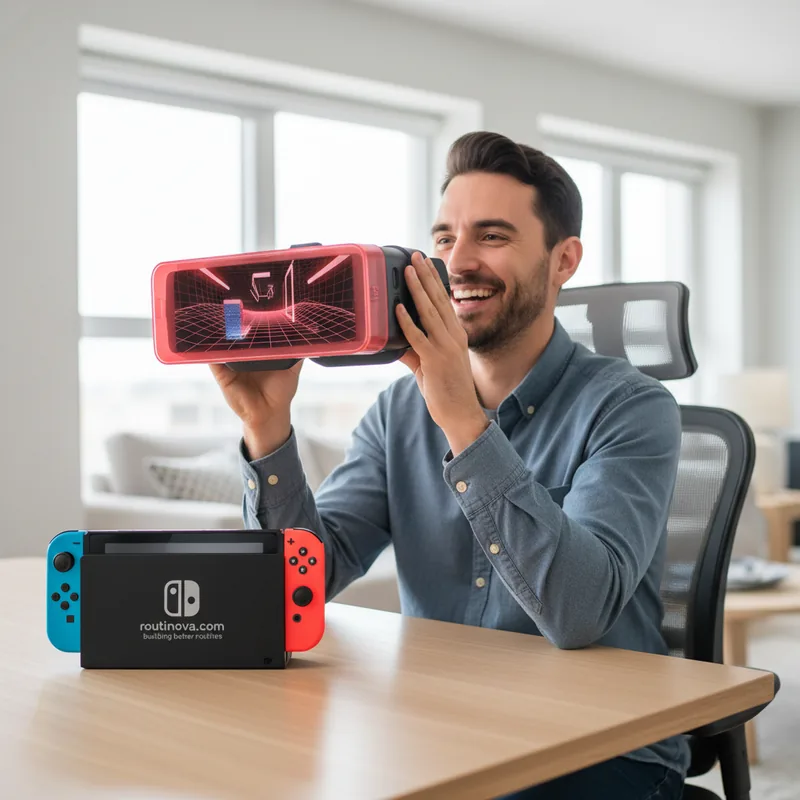
Given the $100 price tag of the plastic model, Nintendo also offers a more affordable $25 cardboard version. While not as robust, it's charmingly decorated and, crucially, doesn't require a stand. You can simply hold it up to your face, controlling the game with attached Joy-Cons. This approach echoes Nintendo's own LABO VR and similar initiatives like Google Cardboard, providing an accessible, albeit potentially uncomfortable for long sessions, alternative that offers greater portability and flexibility.
The second major improvement addresses the notorious red-on-black display. Even I, impressed as I was, felt the strain of the monochromatic red filter after just a few minutes. To combat this, players will soon be able to choose alternate color options, including yellow, green, and a highly anticipated black-and-white filter. This feature, slated for release "Later this year," will be a godsend for anyone hoping to truly complete a Virtual Boy game rather than just sampling it. If you own the plastic accessory, removing the physical red filter takes mere seconds to enable these new color modes.
Expanding the Virtual Boy Universe: Unearthing Hidden Gems
Perhaps the most exciting aspect of this revival is the expanded game library. Alongside the original North American releases, the new Virtual Boy accessory will grant access to formerly Japanese-exclusive titles. At the preview, for instance, I not only revisited classics like Red Alarm and Virtual Boy Wario Land but also delved into the Lovecraft-inspired first-person horror game, Innsmouth no Yakata. This significantly broadens the appeal, especially considering the Virtual Boy's original paltry library of just 14 games in North America.
Even more thrilling, Nintendo is adding previously unreleased games to the Virtual Boy catalog for Switch and Switch 2. This includes a cancelled F-Zero title, reportedly named Zero Racers, which instantly makes the accessory a mandatory purchase for dedicated Captain Falcon fans and racing enthusiasts. This commitment to preserving and even expanding the original vision truly elevates this accessory beyond mere nostalgia.
My Verdict: A Surprising Redemption and How to Experience It
I admit, I approached the Switch's Virtual Boy accessory fully prepared to mock its existence, to reaffirm its status as a historical punchline. Instead, I walked away genuinely impressed, with a newfound appreciation for a misunderstood piece of gaming history. After decades of ridiculing the Virtual Boy, I now find myself admitting that I actually quite like it. This unexpected conversion alone makes it worth the price of entry for me, and I would wholeheartedly recommend it to anyone curious about gaming's past or looking for a truly unique experience.
There is, however, one final caveat. Both the plastic and cardboard Virtual Boy accessories for Switch and Switch 2 are exclusive to Nintendo Switch Online subscribers. While a subscription is already necessary to play these digital games, the accessory models themselves appear to be currently sold out, even for subscribers. I sincerely hope Nintendo addresses this stock issue promptly, allowing more people to join my burgeoning "the Virtual Boy is good, actually" movement. I tried Nintendo's new approach to retro gaming, and it was a revelation.