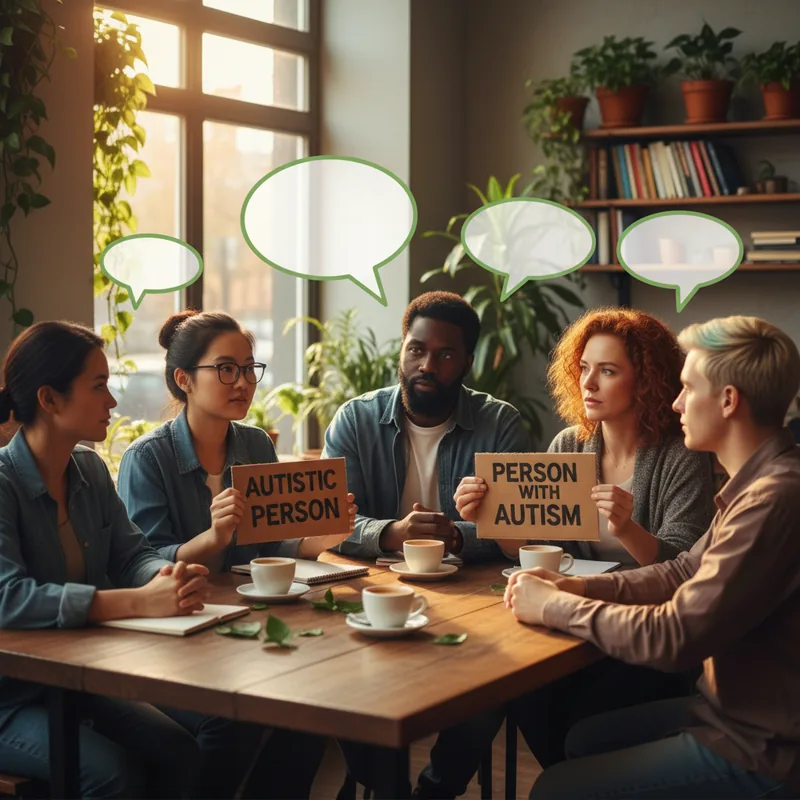
According to a significant 2022 survey by Autistic Not Weird, over 76% of autistic individuals prefer to be called an “autistic person” rather than a “person with autism” (Autistic Not Weird, 2022). If you’ve ever paused, wondering which phrase is correct, you’re not alone. This isn't just about semantics; it's about respect, identity, and the power of language. The autistic community overwhelmingly prefers "autistic person" over "person with autism." This choice reflects a deep understanding of identity, where autism is seen as an integral part of who someone is, not merely a condition they possess. So, the question isn't just what to say, but why it matters. Specifically, should you say “person with autism” or “autistic person”? Let's explore.
The Evolving Language of Identity
Language is a living thing, constantly shifting and evolving. What was considered appropriate or even progressive yesterday might be outdated or even harmful today. This dynamic nature is particularly evident when we talk about identity and disability, where terminology often reflects deeper societal understandings and attitudes.
For a long time, the language around conditions listed in the Diagnostic and Statistical Manual of Mental Disorders (DSM) was dictated primarily by medical and mental health professionals. This meant that the words used to describe entire communities were often chosen by those outside of them (Crocker & Smith, 2019).
But here's the thing: as advocacy for mental health and disability rights has grown, so has the demand for community voices to lead these conversations. We've learned that the most accurate and respectful language comes directly from the people whose lives are being discussed.
Of course, no community is a monolith. Individual preferences will always exist, and it’s crucial to honor them in one-on-one interactions. However, when we speak, write, or research about the broader autistic community, we must prioritize the collective voice. Their preferences guide us toward truly inclusive communication.
Understanding Person-First Language (PFL)
Person-First Language (PFL) places the individual before their diagnosis. Phrases like "people with disabilities" are classic examples. The intention behind PFL, popularized in the 1970s, was noble: to reduce dehumanizing language and stigma by emphasizing the person, not the condition (DC.Gov, 2006).
PFL aimed to ensure that a diagnosis was seen as something a person has, rather than something they are. It aimed to answer the question, should you say “person with a disability” rather than labeling someone by their condition? For example, saying "a person with schizophrenia" instead of "a schizophrenic" was a significant step forward in fighting stigma around certain diagnoses.
However, what works for one community doesn't always work for another. While well-intentioned, many in the autistic community find PFL isolating. It implies that autism is a separate entity, something that can be removed or treated, rather than an intrinsic part of their being. Think about it: you wouldn't say "a person with tallness"; you'd say "a tall person." This highlights how some traits are simply part of who you are.
Autistic individuals experience the world fundamentally differently due to their neurotype. Their perception, their processing, their very way of being, is shaped by autism. For many, it's not an ailment they carry; it's the lens through which they see and interact with everything (Anderson-Chavarria, 2022).
Embracing Identity-First Language (IFL)
Identity-First Language (IFL) flips the script, placing the identity or diagnosis at the forefront. Instead of "person with autism," it's "autistic person." This isn't just a stylistic choice; it's a powerful statement of self-acceptance and pride. IFL pushes back against the idea that a diagnosis is something to be ashamed of or hidden.
For many, PFL can inadvertently reinforce stigma by implying that the diagnosis is a burden or something to be overcome. IFL, conversely, simply states the identity, without judgment or commentary on its impact. This shift in perspective directly addresses the question of should you say “person with autism” or embrace the identity-first approach.
Historically, IFL was sometimes used by organizations to emphasize perceived deficits and justify reduced autonomy. But here's where it gets interesting: many groups have reclaimed IFL, transforming it into a tool for self-advocacy and a symbol of neurodivergent pride. It's a way of saying, "This is who I am, and I am proud of it."
Consider the Deaf community, who often prefer "Deaf person" over "person with hearing loss," emphasizing their cultural identity rather than a medical deficit. Similarly, many in the LGBTQ+ community use identity-first terms like "gay man" or "lesbian woman." These are not just labels; they are affirmations of self.
The Autistic Community's Clear Preference
When you consider the collective voice, the answer to should you say “person with autism” becomes remarkably clear. Multiple surveys over the past decade consistently show a strong preference for IFL within the autistic community (Shakes & Cashin, 2019). This isn't a fringe opinion; it's a consensus.
A landmark survey conducted in March 2022 by Autistic Not Weird, an advocacy organization led by and for autistic people, gathered over 11,000 responses. The results were compelling: just over 76% of autistic respondents preferred IFL, meaning they wanted to be called an "autistic person." In stark contrast, less than 4% strongly preferred "person with autism." About 15% found either term acceptable, and 5% chose not to answer (Autistic Not Weird, 2022).
This data isn't just numbers; it reflects deeply held personal truths. Many autistic people articulate that autism is not an accessory they carry, but a fundamental aspect of their identity. As Cris, an autistic artist, writer, and research biologist, shared: "Most autistics consider it to be who they are. Identity versus person shouldn't be a thing because they are one and the same. I am autistic. It's not an item I carry, can put down, it's who I am."
Lyr, another autistic artist, echoed this sentiment: "Autism makes my brain work somewhat different at a fundamental level, and thus it is fundamental to who I am. Identity first all the way for me. Plus it's much less clunky to say." And SV, who is also autistic, offered a powerful analogy: "I'm not a person with tallness, I'm a tall person. I'm not a cancerous person, I'm a person with cancer. One is part of my existence, my identity, the way I experience the world. The other is external to me, something I struggle with. I am not a person with autism. I am autistic."
These voices underscore that neurodivergent conditions, including autism, are brain differences that profoundly impact who a person is. They are not diseases to be cured, but integral parts of diverse human experience. Groups that advocate for a "cure" for autism often use PFL, and are frequently criticized for elevating non-autistic voices while ignoring the feedback from the autistic community itself (ASAN, 2023).
Navigating Respectful Communication
Ultimately, the answer to should you say “person with autism” or “autistic person” hinges on respect. While the collective preference of the autistic community is clear, individual preferences should always take precedence in direct interactions. If someone tells you they prefer "person with autism," honor that. But for general communication about the community, embracing IFL is the most respectful and informed choice (NIH, 2023).
Think about a new friend who shares they are autistic. You might initially use IFL, saying, "It's great to meet another autistic person." If they then say, "I actually prefer 'person with autism,'" you simply adjust. This shows you're listening and valuing their personal autonomy, even while understanding the broader community preference.
The American Psychological Association (APA Style, 2023) and some special education guidelines have historically favored PFL. However, true allies value community voices above traditional institutional practices. When in doubt, the best practice for how should you say “person” in reference to autism is to defer to the individual, and when speaking generally, to embrace identity-first language.
For those seeking to deepen their understanding and connect with the autistic community, valuable resources include the Autistic Self-Advocacy Network (ASAN), the Autistic Women & Nonbinary Network (AWN), and the Asperger/Autism Network (AANE).