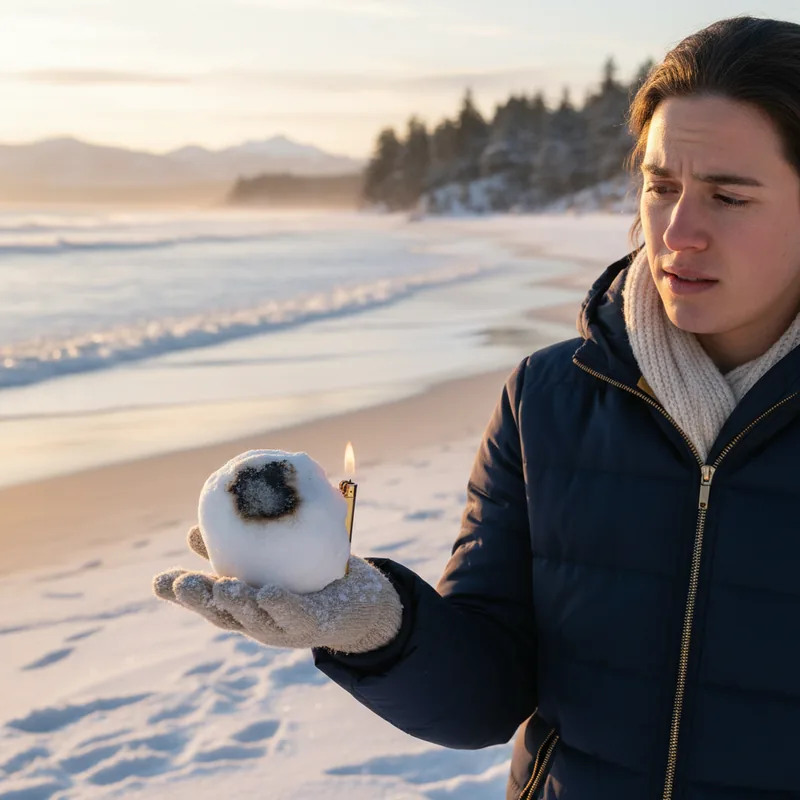
Imagine scrolling through your feed, seeing a video of someone holding a snowball, a lighter flame dancing against its surface. Instead of melting into a puddle, the snow turns black, emits a strange odor, and seems to shrink without dripping a single drop. Your first thought? "Wait, what? Is snow... fake?" This exact scenario unfolded recently, sparking widespread confusion as council members in Memphis and countless others online shared their disbelief. The short answer: no, snow is very much real. But the phenomenon these videos capture is genuine, and understanding it reveals exactly what people are getting wrong about winter's most common, yet surprisingly complex, precipitation.
The Viral Mystery Unpacked
The story often begins with a specific video, much like the one posted by Memphis council member Yolanda Cooper Sutton. Her husband holds a flame to a snowball, expecting it to melt into water, but it doesn't. Instead, it seems to scorch, smelling like burning plastic. Fellow council member Pearl Eva Walker reportedly echoed the sentiment, suggesting the snow was "man-made." These aren't isolated incidents; after major snowstorms blanket the US, similar videos pop up everywhere. It's easy to see why this would spark suspicion. We expect ice to melt into water when heated, right?
But here's the thing: these videos aren't hoaxes. They're not AI-generated, nor are people deliberately trying to trick anyone with prop snow. They document precisely what happens when you introduce a flame to real, actual, fell-from-the-sky snow. The core of what people are getting wrong isn't that the snow is fake, but rather a fundamental misunderstanding of how snow interacts with heat. Snow, it turns out, can be remarkably counterintuitive.
The Science of Snow's Strange Behavior
So, if it's real, why does it act like plastic? The answer lies in a few fascinating scientific principles.
The Sublimation Effect
First, snow is mostly air--about 90-95% of it, in fact. This means there's far less water than you might assume in a packed snowball. But the main event here is sublimation. Think of sublimation as a solid skipping the liquid phase entirely, changing directly into a gas. When you hold a flame to snow, especially tightly packed snow, a significant amount of it instantly turns into water vapor, without ever becoming a liquid puddle in your hand (NOAA, 2023). This is also why a snowman can slowly disappear over days, even if the temperature never rises above freezing. You can see a similar effect with dry ice, which is solid carbon dioxide that sublimates into a fog rather than melting into a liquid.
Snow is also incredibly porous. When a snowball *does* melt, the water is often pulled inward through capillary action, filling the tiny air pockets within the snow mass. This can make it seem like less water is produced than expected. It's a bit like how a sponge absorbs water; the liquid doesn't just drip off immediately. If you've ever seen frost disappear from a windowpane on a cold, sunny day without melting, you've witnessed deposition, the reverse of sublimation.
Understanding what people are getting wrong about snow's behavior under heat helps demystify the disappearing act. The snow doesn't vanish because it's artificial; it vanishes because it's transforming into an invisible gas.
The Scorch Marks and Strange Smell
What about those black scorch marks? The flame from a lighter or match comes from burning fuel--butane or wood/paper. As this fuel combusts, it produces carbon soot. When this soot hits the cold surface of the snow, it condenses, creating those dark marks (Chemical Society, 2022). The snow itself isn't burning; it's simply collecting the byproducts of the lighter's flame. You can easily test this: real snow doesn't catch fire.
And the dreaded "burning plastic" smell? That's typically the odor of butane from the lighter not fully combusting, or the mercaptans--odorants sometimes added to butane so we can actually smell it--reacting to the cold surface. These chemical smells are easily mistaken for burning plastic, especially when combined with the visual of black soot. If you use a candle, which burns wax rather than butane, you'll notice the absence of this "plastic" smell, further confirming the source isn't the snow itself.
Try This Yourself
You can replicate this phenomenon to amaze your friends or simply satisfy your own curiosity:
- Grab some fresh snow and pack it into a tight snowball. A denser surface helps the soot adhere better.
- Apply a flame from a standard butane lighter for a few seconds. Notice the immediate scorch mark.
- Observe how little water drips, and how the snow appears to shrink or "disappear."
- Pay attention to the edges of the scorch mark; this is often where any melted water is drawn towards the center of the snowball.
- For contrast, hold another snowball in your bare hand. You'll quickly find it melts into actual water, debunking the "fake snow" theory firsthand.
The Myth of Engineered Snowstorms
Now, let's consider the idea that "they"--the government, some shadowy organization--could create a fake snowstorm. It's true that artificial snow exists. Ski resorts use snow-making machines to cover trails during lean winters, and you can even buy personal snow machines. But the challenge here is one of scale, which is often what people are getting wrong about weather control conspiracies.
Artificial snow is made by spraying pressurized water into freezing air. Covering a few ski trails is one thing; blanketing an entire city or state is another entirely. Industrial snow-making machines are incredibly water-intensive, using hundreds of thousands of gallons to create an acre-foot of snow (Hydrology Journal, 2021). To cover, say, a 25-square-mile town with six inches of snow would require billions of gallons of water, thousands of loud snow-guns, and an astronomical amount of fuel and money. It wouldn't fall from the sky; it would shoot out of machines, making it impossible to miss.
Another idea, cloud seeding with silver iodide, is also expensive and its effectiveness is still debated by scientists. While it might slightly enhance existing precipitation, no one can reliably make it snow on command, let alone orchestrate a massive, undetectable fake blizzard. The sheer logistics and cost make these grand weather manipulation schemes utterly implausible.
Beyond the Flakes: Cultivating Critical Thinking
Humankind's collective actions, like global climate change, certainly alter weather patterns. But we can't control the weather with precision or secrecy. The snow falling from the sky is real, made of frozen water crystals, just as it always has been. It's a powerful lesson in what people are getting wrong when faced with seemingly contradictory evidence.
This entire "fake snow" saga highlights a crucial habit for our daily lives: critical thinking. In an age flooded with information, the ability to pause, question, and seek explanations beyond the immediate, sensational claim is invaluable. Routinova champions habits that enhance clarity and productivity, and few habits are more essential than the disciplined pursuit of understanding. When something seems too strange to be true, it often reveals a deeper, more fascinating scientific principle at play, rather than a grand conspiracy. Cultivating this habit helps us navigate misinformation, make better decisions, and ultimately, live more informed and productive lives.