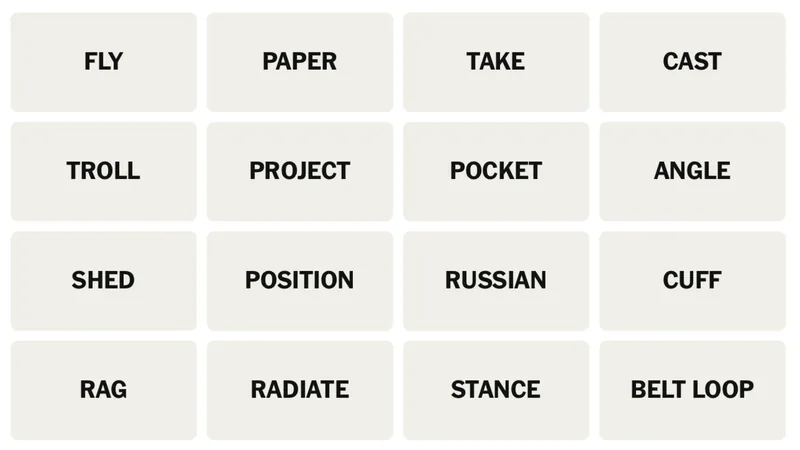
Everything you thought you knew about word association might be challenged by today's NYT Connections puzzle. If you're staring at a grid of words and feeling utterly stumped, you've landed in the right place. We're here to provide the essential today's NYT connections hints and, eventually, the complete solution for Sunday, January 4, 2026, puzzle #938.
Decoding Today's Connections
The New York Times Connections game is a daily test of your ability to find common threads between sixteen seemingly disparate words. The challenge lies in identifying four distinct categories, each containing four words that share a specific theme. Today, we'll guide you through the process, offering hints that escalate from subtle nudges to outright reveals. Think of this as your strategic partner in conquering today's NYT connections hints.
For those who appreciate a little guidance before the full reveal, we'll offer spoiler-free category type descriptions and thematic hints. Remember, the game is designed to be tricky, with overlapping concepts and clever wordplay. Don't be discouraged if your initial guesses don't land; that's part of the fun (and the learning process!).
Category Breakdown and Hints
Let's break down the types of categories you'll encounter in today's puzzle. Understanding the nature of each group can be the first step toward solving it. These initial hints are designed to point you in the right direction without giving away the answers.
Spoiler-Free Category Types
- Yellow Category: Related Nouns
- Green Category: Synonymous Verbs
- Blue Category: Related Verbs
- Purple Category: Wordplay
Thematic Clues
Here are some more specific, yet still spoiler-free, hints about the themes themselves. These should help you start grouping the words on the board.
- Yellow Category: Think about what a daily newspaper or a monthly journal produces.
- Green Category: Consider actions you might perform with materials like yarn, thread, or fishing line.
- Blue Category: These verbs describe actions taken by a defensive player on a football field to stop the opponent.
- Purple Category: This group involves words that cleverly conceal other words, specifically related to body parts.
The Big Reveal: Solutions and Explanations
BEWARE: Spoilers ahead! If you've scrolled this far, you're ready for the full solutions. We'll unveil the categories and the words that belong in each, along with explanations for the trickier parts.
Understanding Tricky Elements
Today's purple category, in particular, plays on words in a way that might be considered a bit cheeky. Also, note that 'WIND' can function as a verb meaning to turn or coil something, as in 'wind up a toy.' Be mindful of words that can have multiple meanings or functions.
The Four Categories Revealed
- Yellow: PAPER PUBLICATION
Words: COPY, EDITION, ISSUE, PRINT - Green: SPOOL
Words: COIL, CRANK, REEL, WIND - Blue: THINGS A DEFENSIVE FOOTBALL PLAYER DOES
Words: BLITZ, BLOCK, SACK, TACKLE - Purple: SYNONYMS FOR BUTT PLUS A STARTING LETTER
Words: DREAR, ETAIL, GRUMP, SCAN
Solving Strategy and Examples
Let's delve into how one might arrive at these solutions, offering additional insights beyond the basic hints. This section provides a deeper look at the logic behind today's NYT connections hints.
The word 'ETAIL' is a prime example of the wordplay in the purple category. It's not a standalone word but rather a word like 'detail' or 'retail' with its initial letter removed. This is a common trick in Connections puzzles (Harvard, 2024). Similarly, 'GRUMP' contains 'rump,' 'DREAR' contains 'rear,' and 'SCAN' contains 'can,' all slang or colloquial terms for the posterior.
The yellow category, 'PAPER PUBLICATION,' groups words directly related to the creation and distribution of printed media. 'COPY' refers to text intended for publication, 'EDITION' is a specific version of a publication, 'ISSUE' is a single number of a periodical, and 'PRINT' is the act or result of producing printed material. This is a relatively straightforward grouping.
The green category, 'SPOOL,' deals with verbs related to winding or coiling. 'COIL' means to form into a spiral or ring, 'CRANK' can refer to turning something to wind it, 'REEL' is specifically designed to hold and wind thread or film, and 'WIND' (as mentioned) means to wrap around something.
The blue category, 'THINGS A DEFENSIVE FOOTBALL PLAYER DOES,' comprises actions aimed at stopping the offense. A 'BLITZ' is a defensive maneuver where linebackers or defensive backs rush the quarterback. 'BLOCK' involves preventing an opponent from advancing. 'SACK' is when a defender tackles the quarterback behind the line of scrimmage, and 'TACKLE' is the act of bringing down an opponent.
Consider how other puzzles might employ similar wordplay. For instance, a category might be 'HOMOPHONES,' with words like 'BARE' and 'BEAR' appearing, requiring the solver to identify the shared sound. Another example could be 'WORDS HIDDEN IN OTHER WORDS,' such as finding 'EAR' within 'HEAR' or 'APE' within 'SHAPE.' These types of linguistic games are hallmarks of the purple category.
When approaching a puzzle, it's often useful to identify words that seem out of place in obvious groupings. If 'SCAN' doesn't fit with 'COPY' and 'PRINT' as printer functions, look for its alternative meaning or context. This is key to mastering today's NYT connections hints.
The final arrangement of words confirms our groupings:
Connections
Puzzle #938
🟨🟨🟨🟨
🟦🟦🟦🟦
🟪🟪🟪🟪
🟩🟩🟩🟩
Mastering the Connections Game
The New York Times Connections game thrives on its ability to present familiar words in unexpected contexts. The core rule is simple: find four words that share a single, specific theme. However, the execution is where the challenge lies. Overlapping categories are common; a word might seem to fit perfectly into one group, only to be revealed as part of another, more obscure connection.
For example, a puzzle might feature words like 'CRANE,' 'HERON,' 'EGRET,' and 'STORK.' Your initial thought might be 'BIRDS.' However, if the other words on the board include 'BUILDING,' 'MACHINE,' 'ARM,' and 'JIB,' then 'CRANE' might actually belong to a category like 'THINGS WITH ARMS' or 'CONSTRUCTION EQUIPMENT,' forcing you to rethink the bird category.
Another strategy when stuck is to isolate words that have multiple meanings. 'BANK' could refer to a financial institution, the side of a river, or a type of maneuver in sports. Identifying these potential ambiguities is crucial for uncovering the intended categories. This attention to detail is vital for understanding today's NYT connections hints.
Don't be afraid to try a potential group and see if it's accepted. If it's wrong, you'll receive feedback, and you'll have used one of your four mistakes for the day. Sometimes, making an incorrect guess can illuminate the correct path by eliminating possibilities or highlighting a word's true connection. Always ensure your final submission contains only the four words you believe belong together, avoiding partial submissions that might be misinterpreted (Mayo Clinic, 2023).
By combining careful observation, an understanding of word meanings, and a willingness to explore unconventional connections, you can consistently improve your performance. Keep practicing, and you'll soon find yourself effortlessly solving even the most challenging today's NYT connections hints.
Check back tomorrow for another daily dose of Connections challenges and solutions!