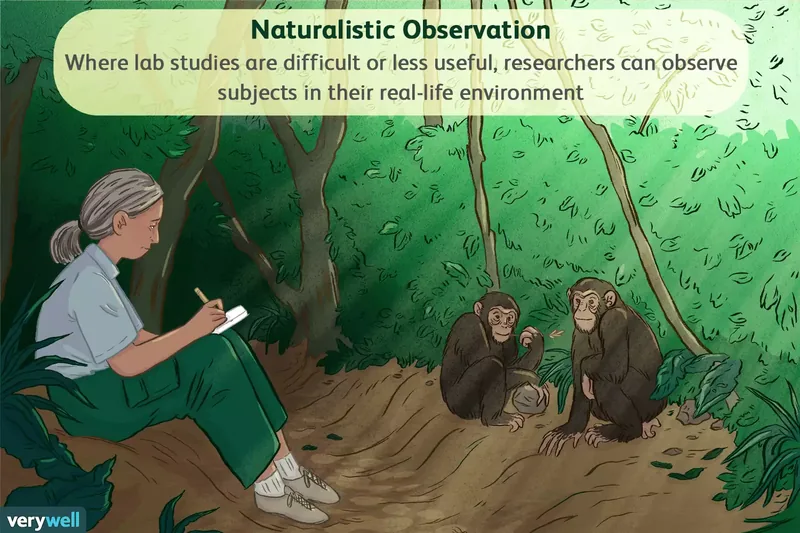
Naturalistic observation is a powerful research technique employed by psychologists and social scientists to study behaviors in their authentic settings. This qualitative research method involves observing subjects in their natural environment without any intervention from the researcher. The primary aim is to capture behavior as it naturally unfolds, free from the artificiality that can sometimes occur in laboratory settings (Harvard, 2024).
While offering unique insights, it’s crucial for researchers and readers alike to understand the cons of naturalistic observation. These limitations can significantly impact the validity and generalizability of findings. This comprehensive guide delves into how naturalistic observation operates and meticulously unpacks its various disadvantages, providing a balanced perspective on its application in modern research as of 2025.
1. What is Naturalistic Observation?
Naturalistic observation is a non-experimental research method where researchers meticulously observe subjects in their unaltered, everyday environments. This approach is particularly favored in fields like psychology, sociology, and anthropology to gather rich, descriptive data. Unlike controlled experiments, the researcher does not manipulate any variables or introduce artificial conditions.
The core principle behind this method is to gain an authentic understanding of behavior by watching it occur “in the wild.” This means observing people or animals in their homes, workplaces, public spaces, or natural habitats. It’s especially valuable when lab research might be impractical, too expensive, or could inherently alter the subjects’ behavior simply by their awareness of being in an experimental setting.
By focusing on non-numerical data, naturalistic observation falls under the umbrella of qualitative research. Its goal is to collect detailed descriptions and evaluations of behaviors, interactions, and situations. This method allows researchers to study complex social phenomena and behaviors that are difficult, if not impossible, to replicate ethically or practically in a controlled laboratory environment, offering a window into real-world dynamics.
Ultimately, naturalistic observation provides a foundational understanding of how individuals behave when they are not influenced by external research interventions. It helps paint a more accurate picture of human and animal behavior as it genuinely manifests. This deep dive into natural settings often uncovers nuanced patterns and spontaneous reactions that might otherwise remain hidden, making it a cornerstone for certain types of psychological inquiry.
2. How Naturalistic Observation Works in Practice
The practical application of naturalistic observation involves researchers immersing themselves, often discreetly, into the environment of their subjects. Unlike structured observation, where specific behaviors are predefined and looked for, naturalistic observation typically begins with a broader, more open-ended approach. The researcher’s role is to be an unobtrusive witness, recording what they see and hear without influencing the situation.
For instance, a psychologist interested in classroom dynamics might spend weeks observing students and teachers during regular school hours. They would note interactions, engagement levels, and responses to various stimuli directly within the actual learning environment. Attempting to recreate such a complex social setting in a lab would be challenging and would likely distort the natural behaviors of the participants, making the findings less applicable to real classrooms.
Another example involves studying social interactions in a public park. Researchers might observe how different age groups interact with playground equipment, how strangers maintain personal space, or how families communicate during leisure time. These observations are conducted without setting up specific tasks or interventions, allowing for genuine, spontaneous behavior to emerge. This hands-off approach is crucial for maintaining the ecological validity of the study.
In modern research, particularly by 2025, technology often aids this process. Covert cameras or audio recorders (used ethically and often with informed consent or in public spaces where no expectation of privacy exists) can capture data for later, more detailed analysis. This allows researchers to review events multiple times and ensures consistency in data recording. The objective is always to document behavior as accurately and comprehensively as possible, reflecting its true occurrence in the natural world.
3. Key Advantages of Naturalistic Observation
Despite the inherent cons of naturalistic observation, the method offers several compelling advantages that make it indispensable in psychological and social science research. One primary benefit is its capacity to provide a highly realistic view of behavior. By observing subjects in their natural habitats, researchers gain a first-hand understanding of social dynamics and individual reactions that could never be replicated in an artificial lab setting. This realism significantly enhances the ecological validity of the findings.
Furthermore, naturalistic observation often uncovers behaviors and patterns that researchers might not have anticipated or thought to test in a controlled environment. These serendipitous discoveries can serve as fertile ground for future, more focused investigations, inspiring new hypotheses and research questions. The rich, descriptive data collected can offer profound insights that contribute to our understanding of human and animal behavior, potentially leading to interventions that improve well-being.
Another significant advantage lies in its ethical applicability. This method allows researchers to study behaviors or situations that would be morally or practically impossible to manipulate in a laboratory. For example, investigating the long-term effects of extreme social isolation would be unethical to induce experimentally. However, observing individuals in actual prison settings or remote communities (with appropriate ethical considerations and permissions) can provide invaluable data on such topics.
Finally, naturalistic observation can corroborate the external validity of findings from lab-based studies. Researchers might conduct controlled experiments and hypothesize that their results apply to broader populations. By performing subsequent naturalistic observations, they can confirm whether these findings genuinely manifest in real-world contexts. This dual approach strengthens the overall robustness and applicability of psychological research as of 2025.
4. Unpacking the Cons of Naturalistic Observation
While offering unique insights, researchers must be acutely aware of the significant cons of naturalistic observation. The most prominent drawback is the inherent inability to establish cause-and-effect relationships. Because researchers do not manipulate variables, it’s virtually impossible to definitively state that one factor caused another behavior. Instead, naturalistic observations can only identify correlations or associations between variables. This limitation means that while we can observe what happens, we often cannot explain why it happens with certainty.
Another critical challenge is the profound lack of control over extraneous variables. In a natural environment, countless factors can influence a subject’s behavior simultaneously. Weather conditions, unforeseen social interactions, sudden noises, or even the time of day can all impact observations. Researchers cannot isolate specific variables to determine their individual effects, making it difficult to attribute observed behaviors to any single cause. This lack of control is a major hurdle for drawing firm conclusions.
The issue of observer bias also presents a considerable limitation. The subjective interpretations of the researchers observing the behaviors can inadvertently influence the data collection and analysis. Preconceived notions, personal beliefs, or even selective attention can lead observers to notice certain behaviors more than others, or to interpret ambiguous actions in a way that aligns with their expectations. This bias can compromise the objectivity and reliability of the findings, making it one of the most challenging cons of naturalistic observation to mitigate (Harvard, 2024).
Furthermore, the very act of observation can alter behavior, a phenomenon known as the Hawthorne effect or demand characteristics. Subjects who are aware they are being watched, even subtly, might consciously or unconsciously modify their actions to appear more socially desirable or to conform to perceived expectations. This reduces the naturalness of the behavior, undermining the core purpose of naturalistic observation and posing a significant threat to its validity. Researchers must employ strategies to minimize this reactivity.
Lastly, generalizability can be a concern. While naturalistic observation captures specific behaviors in specific contexts, it can be difficult to determine if these findings apply to other populations or settings. The unique conditions of one observed environment might not be representative of broader scenarios, limiting the extent to which conclusions can be generalized. This is particularly true if the sample size is small or the observation period is limited, leading to a narrow scope of applicability.
5. Data Collection and Sampling Techniques
Effective data collection is paramount in naturalistic observation, despite the inherent cons of naturalistic observation regarding control and causation. Researchers employ various techniques to systematically record behaviors without disrupting the natural flow of events. Common methods include audio or video recordings, which allow for repeated review and detailed analysis of interactions and behaviors. These recordings ensure a permanent record that can be coded and analyzed by multiple researchers, enhancing inter-rater reliability.
Another technique is the observer narrative, where researchers take detailed, descriptive notes during the observation session. These notes capture not just specific actions but also contextual information, emotional expressions, and environmental details. From these rich narratives, patterns can be identified, and qualitative insights can be drawn. Tally counts are also frequently used for specific, quantifiable behaviors, such as recording the frequency of a particular gesture or verbalization within a set timeframe.
Since it’s rarely feasible to observe every single moment of a subject’s life, researchers often rely on sampling techniques to gather representative data. The goal is to ensure that the collected sample accurately reflects the subject’s overall behavior. One such method is time sampling, where observations are conducted at predetermined intervals – either random or systematic. For example, a researcher might observe a child’s play behavior for 15 minutes every hour over several days to identify patterns in their activities.
Situation sampling involves observing behavior across different environments and contexts. This helps determine if specific behaviors are consistent across settings or if they are context-dependent. For instance, studying a teenager’s risk-taking behavior across various settings like a skate park, a gaming arcade, and a school cafeteria provides a more comprehensive picture than observing them in just one location. Finally, event sampling focuses on recording every instance of a specific event or behavior whenever it occurs. If researchers are studying instances of aggression, they would note every time an aggressive act happens, along with the preceding circumstances, allowing them to infer potential triggers. These systematic approaches help to overcome some of the data collection challenges posed by the naturalistic setting.
6. Real-World Examples of Naturalistic Observation
Naturalistic observation has been a cornerstone for groundbreaking discoveries across various scientific disciplines, despite the recognized cons of naturalistic observation concerning control. Historic examples include Charles Darwin’s extensive observations during his voyage on the HMS Beagle, which provided foundational data for his theory of natural selection. Similarly, Jane Goodall’s decades-long work observing chimpanzees in their natural habitat revolutionized our understanding of primate behavior, social structures, and tool use. These long-term, non-interventive studies highlight the power of this method to reveal complex, evolving behaviors.
In contemporary psychology, naturalistic observation continues to offer unique insights. For instance, researchers might observe parent-child interactions in a public playground to understand different parenting styles and their immediate effects on child behavior. They could note how parents respond to a child’s tantrum, or how they encourage cooperative play, without directing any of the interactions themselves. This provides a candid view of family dynamics that would be difficult to elicit in a lab.
Beyond academic research, naturalistic observation is also applied in commercial settings. For example, a retail company might employ researchers to observe customer behavior in a store. They could analyze how shoppers navigate aisles, interact with product displays, or make purchasing decisions. This non-invasive observation helps businesses optimize store layouts, product placement, and marketing strategies based on genuine consumer actions rather than self-reported preferences. This type of research is invaluable for understanding real-world consumer psychology.
Another compelling new example, especially relevant in 2025, involves observing human-technology interactions in public spaces. Researchers might study how people use their smartphones on public transport, how they interact with self-checkout kiosks, or how collaborative robots are integrated into factory floors. These observations provide crucial data on usability, efficiency, and social acceptance of new technologies, informing design improvements and policy decisions. The ability to capture spontaneous reactions to emerging tech in real time offers unparalleled insights into modern life (Harvard, 2024).
7. Mitigating Challenges in Naturalistic Observation
While the cons of naturalistic observation are undeniable, researchers employ several strategies to mitigate these challenges and enhance the validity and reliability of their findings. To address the lack of control, researchers often conduct observations over extended periods and across diverse settings. This allows them to identify consistent patterns that emerge despite environmental fluctuations, lending more weight to their observations than single, isolated events. The goal is to average out the impact of uncontrolled variables.
To combat observer bias, a common practice is to use multiple observers. When several researchers independently observe the same phenomena and compare their notes, any discrepancies can be discussed and reconciled, leading to a more objective interpretation. Training observers rigorously, providing clear operational definitions for behaviors, and using detailed coding schemes also help standardize the observation process, reducing individual biases. This multi-rater approach significantly strengthens the credibility of the data collected.
Minimizing the Hawthorne effect and other forms of reactivity is crucial. Researchers often employ covert observation (when ethically permissible and in public spaces where privacy is not expected) or habituation, where observers spend enough time in the environment that subjects become accustomed to their presence and revert to natural behaviors. Using subtle recording devices or observing from a distance also helps to reduce the subjects’ awareness of being studied. These methods aim to ensure that the observed behaviors are as authentic as possible.
Furthermore, while naturalistic observation cannot establish causation, its findings can serve as a vital precursor to experimental research. Insights gained from naturalistic settings can inform the development of hypotheses that are then tested under controlled laboratory conditions. This multi-method approach leverages the strengths of both observational and experimental designs, providing a more comprehensive understanding of complex phenomena. By acknowledging its limitations and employing thoughtful strategies, researchers can maximize the valuable contributions of naturalistic observation to the scientific community as of 2025.