Ever wondered why some people seem to grasp new concepts faster, solve complex problems with ease, or excel across a wide range of subjects? It's not just luck or innate talent; it often comes down to something psychologists call general intelligence, or the 'g factor.' This isn't about being good at just one thing, but a broader mental ability that influences how effectively you process information and perform on almost any cognitive task. Understanding what is general intelligence can unlock insights into your own potential and how you navigate the world.
The Core Idea: What is General Intelligence?
At its heart, general intelligence, or the 'g factor,' is a theoretical construct representing a broad mental capacity that underlies performance on various cognitive tests. Think of it as the foundational horsepower of your brain. When psychologist Charles Spearman first proposed this idea in the early 1900s, he noticed a curious pattern: individuals who scored well on one type of mental test--say, vocabulary--often performed well on others, like mathematical reasoning.
He theorized that this wasn't a coincidence. There must be a common underlying factor, the 'g' factor, influencing performance across different cognitive domains. While specific abilities ('s' factors) exist for particular tasks (like playing the piano or speaking a foreign language), the g factor is believed to be the general mental energy that powers them all. Imagine a skilled athlete; they might be fantastic at basketball, but their overall athleticism (the 'g' factor) also helps them pick up other sports more quickly than someone who isn't athletic.
Beyond One Dimension: Types and Components of Intelligence
While Spearman's g factor is a powerful concept, intelligence is rarely that simple. Over time, researchers have proposed more nuanced models. One significant development came from Raymond Cattell, who suggested two main types of intelligence:
Fluid intelligence (Gf): This is your ability to reason and solve novel problems independently of acquired knowledge. It's about thinking on your feet, adapting to new situations, and seeing patterns. Think of it as the raw processing power of your brain.
Crystallized intelligence (Gc): This refers to the knowledge and skills you've accumulated throughout your life. It's the vocabulary you've learned, the facts you know, and the strategies you've developed from experience. This type of intelligence tends to increase with age as you gather more information.
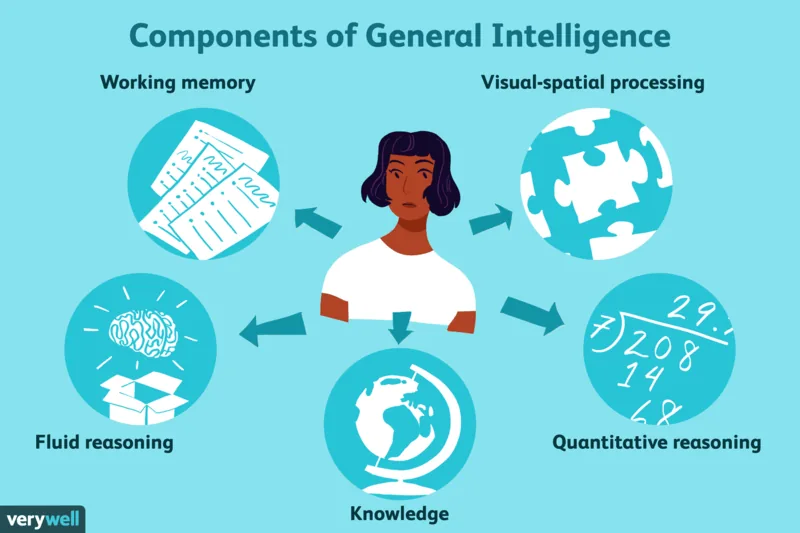
Modern intelligence tests often aim to measure not just a single 'g,' but several key components believed to contribute to it. These typically include:
- Fluid reasoning: The ability to handle new and abstract problems.
- Knowledge: Your accumulated understanding of the world, akin to crystallized intelligence.
- Quantitative reasoning: Your capacity to work with numbers and mathematical concepts.
- Visual-spatial processing: How well you can manipulate visual information, like navigating a map or assembling furniture.
- Working memory: Your ability to hold and manipulate information in your mind for short periods, crucial for tasks like following multi-step instructions.
These components work together, painting a richer picture of cognitive ability than a single score might suggest.
How is General Intelligence Measured?
So, how do we put a number on something as complex as general intelligence? This is where IQ (Intelligence Quotient) tests come into play. Tests like the renowned Stanford-Binet and the Wechsler Adult Intelligence Scale (WAIS) are designed to assess various cognitive abilities and provide a composite score that estimates an individual's general intelligence.
These tests typically present a series of tasks--ranging from verbal comprehension and logical puzzles to pattern recognition and memory challenges. The performance across these diverse tasks is used to calculate an IQ score. While scoring systems can vary, a score of 100 is generally considered the average. Scores above 130 are often considered indicative of giftedness, while scores below 70 might suggest intellectual disability.
It's important to remember that an IQ score is a snapshot, not a definitive label. It measures specific cognitive abilities that are believed to correlate with general intelligence, but it doesn't capture creativity, emotional intelligence, or practical wisdom (Gottfredson, 1997).
The Real-World Impact of Your G Factor
Understanding what is general intelligence isn't just an academic exercise. Research consistently shows that an individual's g factor has significant implications across various aspects of life. It's a strong predictor, though not the sole determinant, of success in several key areas.
Academic Achievement: Higher general intelligence is consistently linked to better performance in school. Students with higher g factors often find it easier to learn new material, understand complex concepts, and perform well on standardized tests (Tikhomirova et al., 2020). For instance, a student who quickly grasps the nuances of quantum physics might also be adept at learning a new programming language, thanks to a strong g factor.
Career Success: The complexity of a job is a major factor. In highly complex roles, such as those in engineering, medicine, or strategic management, a higher general intelligence is a significant asset, correlating with better job performance, higher salaries, and faster career progression (Lang & Kell, 2020). Imagine a software architect who can not only code but also design intricate, scalable systems--that broad problem-solving ability is a hallmark of a strong g factor.
Health and Longevity: Perhaps surprisingly, studies have found correlations between higher general intelligence and better health outcomes, including lower risks for certain chronic diseases like heart disease and stroke, and even increased longevity (Kanazawa, 2013; Kajantie et al., 2012). The reasons are complex, possibly involving better health behaviors, earlier detection of issues, or even shared genetic factors.
Financial Well-being: There's also a link between higher IQ scores and higher earning potential. This is often mediated by factors like educational attainment and occupational choice, but the underlying cognitive abilities play a role. Someone adept at financial planning, understanding market trends, and managing complex investments likely benefits from a strong g factor.
Challenges and Alternative Perspectives
Despite its influence, the concept of a single general intelligence factor hasn't gone unchallenged. Some psychologists argue that it oversimplifies human cognitive abilities. L.L. Thurstone, for example, proposed that intelligence is composed of several independent primary mental abilities, such as verbal comprehension, number facility, and perceptual speed. He believed people could excel in some areas while being average or low in others, without a unifying 'g' factor.
Later, Howard Gardner revolutionized the discussion with his theory of multiple intelligences. Gardner proposed that intelligence isn't a single entity but exists in various forms, including linguistic, logical-mathematical, spatial, musical, bodily-kinesthetic, interpersonal, intrapersonal, and naturalistic intelligences. For example, a skilled dancer might possess high bodily-kinesthetic intelligence, while a diplomat excels in interpersonal intelligence, neither necessarily scoring exceptionally high on traditional IQ tests.
While modern research often points to an underlying general mental ability contributing to many cognitive tasks, it's crucial to acknowledge that IQ scores and the g factor are not the whole story. Factors such as motivation, emotional intelligence, environmental influences, educational opportunities, and sheer perseverance play equally vital roles in shaping an individual's life outcomes (Glanagan & Dixon, 2014).




/GettyImages-1041037930-5c805635c9e77c000115122c.jpg)