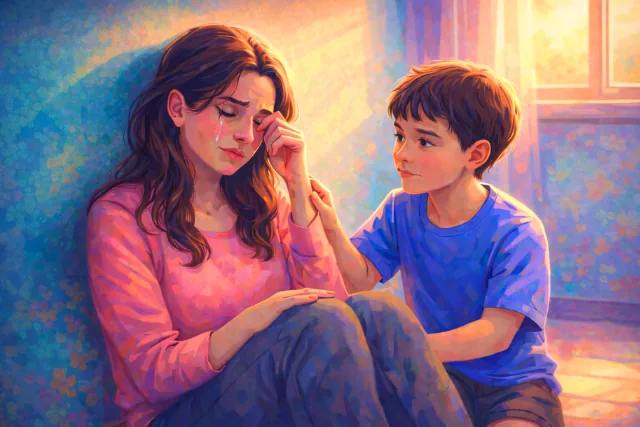
The first time my children saw me truly cry wasn't during a scraped knee or a lost toy. It was Christmas morning, 2021. My oldest was sixteen, my youngest twelve. Presents had been opened, and the air should have been thick with joy. Instead, I turned away, my back to them, tears welling. My mother, whose own emotional struggles had cast a long shadow over my life, was in a psychiatric hospital again. The sheer exhaustion of her recurring crisis, the helplessness, had finally broken through my carefully constructed dam. I tried to whisper, “I’m fine,” even as the tears streamed down.
Then, something shifted. They didn't recoil. They didn't look confused. Instead, both my sons walked toward me and wrapped me in a hug. No fear. Just love. Pure and steady. In that moment, an old, deeply ingrained belief began to crack: the idea that my pain was somehow dangerous to the people I loved most. For years, I’d strived to be the opposite of my mother, to shield my children from the emotional burden I’d carried. I thought hiding my sadness was protection. I was wrong. My children didn’t need protection from my humanity; they needed connection to it.
The Unintended Message of Hiding Pain
The true impact of my guardedness became starkly clear in late 2023. My younger son, observant and direct, made an observation that landed like a soft truth: “You’re the sad one,” he said, “and Dad is the mad one.” It stung, not because it was cruel, but because it was accurate. After that Christmas, I’d retreated, attempting to stuff my feelings back down. But my son, and likely his brother too, had been sensing my sadness all along. It wasn't in the tears I managed to hide, but in the subtle shifts of my energy, the quiet heaviness that settled on my face, the moments I’d stare blankly, lost in thought, needing them to call my name multiple times to bring me back. He knew something was there, asking, “Are you okay, Mommy?” time and again.
This realization hit me hard: there was no point in concealing my inner world if my children could already feel its undercurrents. Children are incredibly intuitive. They pick up on tension, sadness, and strain long before words are spoken. When we present a facade of constant “fine-ness,” they sense the dissonance. What I began to understand is that without context, they are left to fill in the blanks themselves. They might assume my sadness is their fault, or a problem they need to fix.
For instance, think about a time you’ve been visibly stressed about work. If you just sigh heavily and retreat to another room without explanation, your child might worry they did something wrong to upset you. They might internalize that stress, thinking, “Mommy is mad at me.” But when you can offer a simple, age-appropriate truth—“Mommy is feeling a bit worried about a work project right now, but it has nothing to do with you”—you provide context. You show them that adults have feelings, that these feelings are real, and crucially, that they are not responsible for them.
Unveiling Vulnerability Builds Connection
Before this shift, my children saw me as the strong, capable one, the problem-solver. By hiding what I perceived as weakness, I inadvertently denied them a fuller picture of who I am. I never showed them that I, too, have feelings that matter, not just theirs. This realization was a mirror reflecting a painful truth: the very experience of feeling unseen, which I’d carried from my own childhood, was something I was inadvertently replicating with my own kids. How could they truly see me if I only presented a curated version? How could we forge deep connection if they only related to my composure, never to the deeper, more vulnerable parts of my inner world?
The change wasn't instantaneous. It took years of therapy, introspection, and conscious effort to unlearn the habit of suppression. Slowly, I began to allow more of my authentic emotional landscape to be visible. I cried more freely. I stopped retreating to hide my tears.
My youngest son, who is autistic and shares a particularly deep bond with me, initially struggled with this new openness. A few months ago, watching me cry, he expressed his concern: “I want to make you feel better, but I don’t know how.” I reassured him, “You don’t have to fix anything. Just let me be me, and I’ll let you be you. That’s the best gift we can give each other.” His awkwardness softened into acceptance, a quiet understanding passing between us.
Later, during a flight landing back home, the sadness returned. I didn’t want to be back; the place no longer felt like home. Without a word, my son hugged me tightly as I cried. After a few minutes, I exhaled and said, “Thank you. I feel better now.” He had simply offered his presence, a powerful act of connection.
Seeing Strength in Vulnerability
Perhaps the most profound moment came a month later, in the car. A song on the radio triggered a wave of sadness, a pang of missing someone. I told my son, “I’m okay, honey. The song just reminds me of someone and makes me sad. I just need to get it out, and then I’ll be okay.” Even then, a part of me felt self-conscious, worried about his judgment. Instead, he said something that stopped me in my tracks: “I wish I could cry like that. You’re strong.”
His words were a revelation. I laughed, a little teary, and responded, “I get it, honey. We’ll get you crying again eventually.” I realized he had absorbed some of the ingrained societal messages that many boys receive early on: that tears are a sign of weakness, that feelings should be suppressed. It would take time to unlearn, both for him and, in some ways, for me too. He saw my tears not as a failure, but as courage. This contrasted sharply with my own lifelong equation of crying with weakness. I had always believed that true strength meant holding it all together, remaining composed, and hiding the difficult parts.
His perspective opened a new conversation. He confessed he found it hard to cry anymore, that it felt stuck in his throat. He hadn't had a good cry since he was thirteen. It made me reflect on the immense energy so many of us expend resisting our own feelings. I used to believe that being a good parent meant being unshakable, that my strength lay in shielding my children from my grief, overwhelm, and breaking points.
Now, I believe children need honesty more than performance. They need to understand that difficult feelings are not dangerous, that sadness can pass through a space without becoming their burden, and that love endures even when life gets tough. I once feared my tears would make my children feel less safe. What I know now is that when held with honesty and care, those tears can teach something powerful: that being fully human is not a weakness, and that connection often deepens the moment we stop pretending we have nothing to feel. It's about showing them it's okay to be imperfectly human, together.