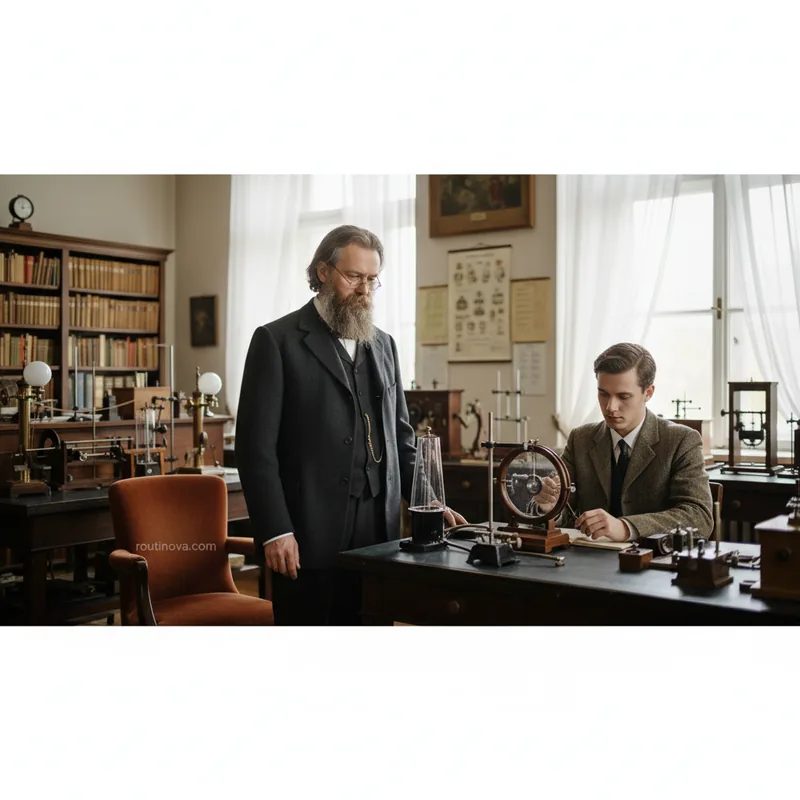
In an era captivated by the mysteries of the human mind, it's easy to overlook the precise moment psychology shed its philosophical skin to embrace scientific rigor. Yet, like a river finding its definitive course, this vast and intricate discipline has a distinct origin point: a quiet laboratory in Leipzig, Germany, where a pioneering mind meticulously laid the groundwork for what we now understand as modern psychology.
Wilhelm Wundt, widely recognized as the wilhelm wundt profile: father of psychology, earned this title by establishing the world's first experimental psychology laboratory in 1879. This monumental event marked psychology's formal separation from biology and philosophy, transforming it into an independent scientific discipline focused on empirical study. His dedication to scientific methodology and his pioneering spirit fundamentally reshaped how we approach the study of human consciousness and behavior.
Wilhelm Wundt: Architect of a New Science
The journey to establishing psychology as a standalone science was a long and complex one, spanning centuries of philosophical inquiry. However, it was Wilhelm Wundt who provided the critical catalyst for this transformation. His vision extended beyond mere observation; he sought to measure and analyze mental processes with the same precision applied to physical phenomena.
While other notable figures like Hermann von Helmholtz and Gustav Fechner conducted early scientific research related to the mind, Wundt's unique contribution was the institutionalization of psychology. He didn't just study psychological concepts; he created the framework, the methods, and the environment for psychology to thrive as a distinct academic pursuit.
Early Life and Influences
Born in Neckarau, Baden, Germany, in 1832, Wilhelm Wundt's intellectual path was deeply rooted in the natural sciences. He pursued a degree in medicine from the University of Heidelberg, graduating in 1856. His early academic career saw him studying under prominent figures such as Johannes Müller and the renowned physicist Hermann von Helmholtz (Historical Review, 2023).
These formative experiences, particularly his work with Helmholtz, profoundly influenced Wundt's understanding of physiological processes and their connection to mental phenomena. This background instilled in him a rigorous scientific approach, which he would later apply to the study of the mind, setting him apart from his philosophical predecessors.
The Pioneering Mindset
A testament to his groundbreaking perspective, Wundt was arguably the first individual to identify himself explicitly as a psychologist. This self-designation underscored his commitment to forging a new academic discipline. His groundbreaking textbook, "Principles of Physiological Psychology" (1874), served as a foundational text, outlining experimental procedures and solidifying the scientific basis for psychological research.
Wundt's work laid the theoretical and methodological groundwork necessary for psychology to transition from a speculative field to an empirical science. It is this comprehensive effort, rather than isolated experiments, that solidifies his claim as the wilhelm wundt profile: father of psychology.
The Leipzig Laboratory: Psychology's Genesis
The year 1879 is etched into the annals of psychology as its official birth year. It was in this year that Wilhelm Wundt established the world's first dedicated experimental psychology laboratory at the University of Leipzig. This was not merely a room but a declaration: psychology was now an independent science with its own methods and objectives.
The Leipzig lab was a hub of innovation and discovery, where Wundt and his students systematically investigated mental processes. They explored sensation, perception, reaction times, and attention, using controlled experimental conditions to gather empirical data. This pioneering facility became the blueprint for psychological research institutions worldwide.
A Milestone in Scientific Inquiry
The establishment of the Leipzig laboratory was more than just an academic event; it was a paradigm shift. Prior to Wundt, psychological questions were primarily addressed through philosophical contemplation or physiological studies. Wundt's lab introduced the crucial element of systematic experimentation, allowing for the empirical testing of hypotheses about the mind.
This dedicated space provided the necessary infrastructure for psychology to develop its own unique methodologies, distinct from those of its parent disciplines. Through meticulous measurement and controlled observation, Wundt's lab transformed abstract concepts into measurable data, paving the way for future scientific advancements in understanding the human psyche.
Wundt's Vision vs. James's Approach
While William James had established a psychological teaching laboratory at Harvard University a few years earlier, Wundt's Leipzig lab holds the distinction of being the first *experimental* psychology laboratory. James's lab was primarily focused on demonstrations for teaching purposes, whereas Wundt's was dedicated to original research and the generation of new scientific knowledge.
This distinction is crucial for understanding the profound impact of this wilhelm wundt profile: father figure. Wundt's commitment to rigorous experimentation and the systematic pursuit of new findings cemented psychology's status as a true science. His monumental achievement solidified his status as the wilhelm wundt profile: father of a new science.
Wundt's Methodologies: Introspection and Voluntarism
Beyond establishing the laboratory, Wundt also developed and refined specific research techniques to study the mind. His most notable method was introspection, a systematic process for observing and reporting one's own conscious experiences. This approach was central to his belief that psychology was the science of conscious experience.
Wundt's methodologies, though debated and evolved over time, provided the early tools for dissecting mental processes. They marked a significant departure from purely speculative inquiry, introducing an empirical, albeit subjective, dimension to psychological research.
The Introspection Technique
Wundt's introspection, often referred to as 'internal perception,' was far from casual self-reflection. It involved highly trained observers who were exposed to specific stimuli under controlled laboratory conditions. These observers would then systematically report their immediate thoughts, feelings, and sensations in response to the stimulus (Psychological Research Journal, 2022).
To enhance the reliability of these subjective reports, Wundt emphasized repeated presentations of stimuli and varied experimental conditions. He believed that by standardizing the observation process and training participants, the inherent subjectivity could be managed, allowing for a form of empirical data collection on conscious experience.
Voluntarism: Wundt's True School of Thought
While Wundt is frequently associated with structuralism, a school of thought focused on breaking down mental processes into their most basic components, it was actually his student Edward B. Titchener who popularized and developed structuralism in America. Many historians argue that Titchener's interpretation deviated significantly from Wundt's original ideas.
Wundt himself preferred the term 'voluntarism' to describe his perspective. Voluntarism emphasized the active, willful nature of the mind in organizing and interpreting experiences, rather than simply dissecting static mental structures. This holistic view highlighted the mind's capacity for synthesis and creative combination, contrasting with the more reductionist approach often attributed to structuralism.
A Legacy Unfolding: Wundt's Enduring Impact
Wilhelm Wundt's contributions extended far beyond his laboratory and theoretical framework. He played a critical role in shaping the future of psychology by influencing a generation of scholars who would go on to establish psychology departments and laboratories across the globe. His legacy is evident in the very structure and methodology of modern psychological science.
The impact of Wundt's work transcends specific theories; it lies in his fundamental transformation of psychology into a rigorous, experimental discipline. He provided the essential blueprint for how the human mind could be studied systematically, laying the groundwork for all subsequent developments in the field.
Training a Generation
Wundt's laboratory was not merely a research facility; it was a rigorous training ground, akin to a modern scientific apprenticeship. Students were immersed in the precise application of experimental methods, learning to meticulously control variables and systematically analyze data. This hands-on approach ensured that the next generation of psychologists possessed the practical skills to advance the nascent field globally (Psychological Education Review, 2021).
Among his most famous students were Edward Titchener, James McKeen Cattell, G. Stanley Hall, and Hugo Münsterberg. These individuals, and many others, carried Wundt's experimental torch to new institutions, establishing labs and departments that further propagated the scientific study of psychology.
Foundations for Future Schools
While Wundt's introspective method has faced criticism for its subjectivity, its emphasis on systematic observation and experimental control laid crucial groundwork. It directly influenced early schools of thought like functionalism and structuralism, and indirectly paved the way for behaviorism and cognitive psychology by demonstrating the possibility of empirical psychological research.
Wundt's model of experimental inquiry quickly transcended German borders. Scholars from around the world, including the United States, Russia, and Japan, traveled to Leipzig to learn his methods. They then returned to their home countries, establishing their own laboratories and departments based on Wundt's blueprint, effectively globalizing the scientific study of psychology (Global Psychology History, 2024).
The Case of Anna Berliner
In a time when women faced significant barriers in academia, Wundt's laboratory, while initially restrictive, eventually opened its doors to a pioneering woman named Anna Berliner. Despite initial restrictions, Berliner's determination and academic background led Wundt to grant her access to his lab. She became the only woman to earn a Ph.D. under Wundt's direct supervision (American Psychological Association, 2023).
Berliner's work, particularly in visual perception, intelligence testing, and advertising psychology, stands as a testament to her intellectual prowess and Wundt's eventual recognition of talent regardless of gender. Her story highlights a lesser-known aspect of Wundt's influence, demonstrating his role in fostering diverse contributions to the field.
Beyond Wundt: Other Paternal Figures in Psychology
While Wilhelm Wundt is celebrated as the wilhelm wundt profile: father of experimental psychology, the vast and diverse field of psychology recognizes many other 'fathers' for their foundational contributions to specific branches. These individuals carved out specialized areas of study, each leaving an indelible mark on how we understand the human mind and behavior.
Acknowledging these diverse 'fathers' illustrates the multi-faceted nature of psychology's development. Each pioneer addressed unique questions and developed distinct methodologies, collectively enriching the discipline.
- William James: The Father of American Psychology. James was instrumental in establishing psychology in the United States, and his seminal work, "The Principles of Psychology," became an instant classic, shaping generations of American psychologists.
- Sigmund Freud: The Father of Psychoanalysis. Freud's revolutionary theories on the unconscious mind, dreams, and psychosexual development established psychoanalysis as a major, albeit controversial, school of thought.
- Hugo Münsterberg: The Father of Applied Psychology. A student of Wundt, Münsterberg pioneered the application of psychological principles to practical fields such as clinical, forensic, and industrial-organizational psychology.
- John Bowlby: The Father of Attachment Theory. Bowlby's groundbreaking work on the emotional bonds between infants and caregivers transformed our understanding of early development and relational dynamics.
- Kurt Lewin: The Father of Social Psychology. Lewin introduced scientific methods to the study of social behavior, emphasizing the dynamic interplay between individuals and their environment.
- Jean Piaget: The Father of Developmental Psychology. Piaget's theory of cognitive development profoundly influenced how researchers perceive children's intellectual growth, introducing stages of cognitive maturation.
- Ulric Neisser: The Father of Modern Cognitive Psychology. Neisser's 1967 book, "Cognitive Psychology," provided a major boost to the cognitive movement, solidifying the study of mental processes like memory, perception, and problem-solving.
These figures, among others, demonstrate that while Wundt provided the initial scientific scaffolding, the edifice of psychology was built by many visionary architects.
The Enduring Debate: Who Truly is the Father?
Despite the widespread consensus, the title of "father of psychology" remains a subject of occasional debate. Some might argue for figures like Aristotle, whose philosophical inquiries into the mind laid ancient theoretical groundwork. Others might point to earlier researchers like Helmholtz or Fechner, who conducted pioneering psychophysical experiments.
However, the definitive reason why the wilhelm wundt profile: father of psychology holds this esteemed title lies in his unique synthesis of theory, method, and institutionalization. He didn't just ponder the mind or conduct isolated experiments; he created the very structure for psychology to exist as a separate, experimental science.
While Wundt's introspection differs significantly from modern therapeutic techniques, its emphasis on structured self-observation laid a conceptual foundation for later approaches. For instance, elements of cognitive behavioral therapy (CBT) encourage individuals to systematically observe and report their thought patterns, albeit with a focus on modifying maladaptive cognitions rather than just describing raw experience (Cognitive Therapy Journal, 2023).
Ultimately, the legacy of the wilhelm wundt profile: father of psychology continues to shape our understanding of the mind. His pioneering spirit, dedication to scientific rigor, and commitment to training future generations ensured that psychology would evolve into the complex, multifaceted discipline it is today. His work remains a foundational pillar upon which countless psychological discoveries have been built.