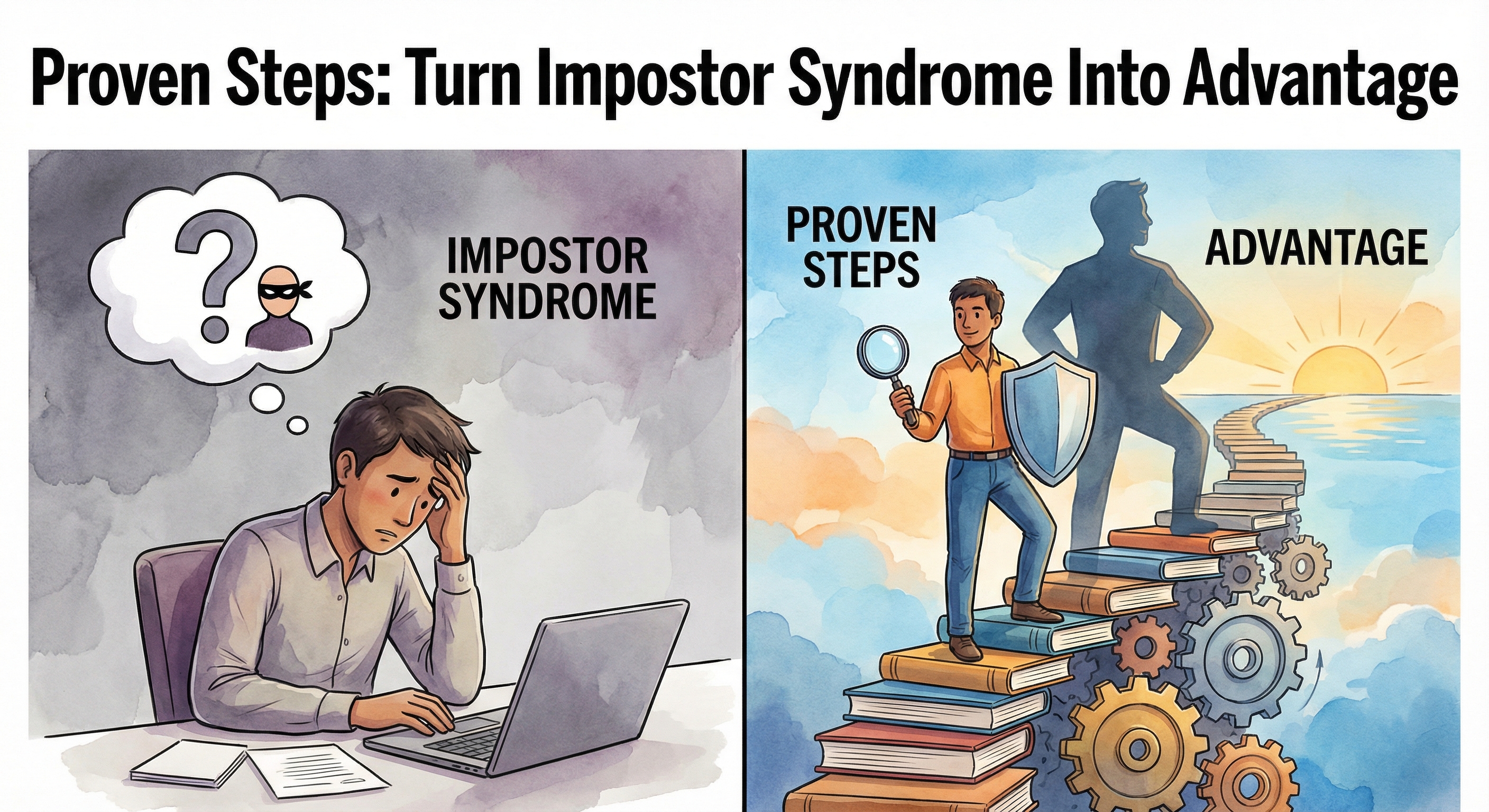
Unlock Your Potential: How to Turn Impostor Syndrome Into an Advantage
For too long, impostor syndrome has been viewed as a personal failing, a hidden secret that undermines confidence and performance. However, groundbreaking new research challenges this outdated perspective, revealing that self-doubt can actually be a powerful catalyst for growth, empathy, and better decision-making. By understanding its true nature and reframing our response, individuals and organizations can turn impostor syndrome into advantage, transforming perceived weakness into a strategic strength. This guide outlines how to leverage these insights for personal and professional development in modern workplaces.
What is Impostor Syndrome?
Impostor syndrome describes the persistent internal experience of feeling like a fraud, believing your achievements are due to luck or deception rather than genuine ability, despite clear evidence of competence. It's a feeling of intellectual phoniness that often accompanies success.
Key Points
- New research debunks four long-held myths, offering a fresh perspective on impostor syndrome.
- Impostor thoughts are temporary indicators of personal growth, not permanent character flaws.
- Embracing self-doubt can enhance empathy, collaboration, and improve decision-making by preventing overconfidence.
- Leaders should interpret impostor feelings as crucial signals about the psychological safety within their teams.
I vividly recall a conversation with a seasoned tech entrepreneur, a man renowned for launching multiple successful ventures. Over a quiet lunch, he confessed, "After every major product launch, I brace myself, convinced this is the time everyone will realize I just got lucky." This wasn't a novice; this was a highly accomplished individual grappling with the very same gnawing self-doubt we often associate with inexperience.
For years, we've pathologized this experience as "impostor syndrome," treating it as a personal defect needing eradication. However, recent groundbreaking research suggests we've fundamentally misunderstood this phenomenon. By correcting these misconceptions, we unlock not just relief, but a genuine, unexpected advantage.
Even global icons like NBA superstar Stephen Curry have publicly shared their struggles with impostor syndrome, highlighting its widespread presence. This has fueled a vast industry of self-help and workshops aimed at "fixing" the individual. But what if this entire premise is flawed, built on a series of fundamental misunderstandings?

Sean Martin, a professor at the University of Virginia's Darden School of Business, co-authored the new research challenging long-held myths about impostor syndrome. A comprehensive review published in the Academy of Management Annals, co-authored by Martin, Basima Tewfik of MIT Sloan, and Jeremy Yip of Georgetown, systematically challenges our previous understanding. Martin notes, "The definition of the term 'impostor syndrome' was all over the place. Many users weren't even referring to the same concept." (Martin et al., 2024)
The research team pinpointed four core myths that have skewed our perception. By debunking these, they unveil a far more nuanced, practical, and ultimately empowering perspective. This shift helps us turn impostor syndrome into advantage.
1. Understanding the True Nature of Impostor Feelings
Before we can leverage impostor syndrome, it's crucial to understand what it truly is and isn't. The conventional wisdom often mislabels it as a permanent psychological condition, a flaw to be cured. However, contemporary research, including insights from (Harvard, 2024) behavioral studies, emphasizes that these are transient "workplace impostor thoughts" rather than a fixed "syndrome." This redefinition is profoundly liberating, shifting the focus from an inherent defect to a manageable mental state. Recognizing that these feelings are temporary allows individuals to approach them with curiosity and analysis, rather than shame or fear. It encourages a growth mindset, where moments of self-doubt are seen as opportunities for learning and adaptation.
Consider a junior architect who, after designing a complex new building, feels a surge of anxiety, questioning if their vision truly holds up. This isn't a sign they are inherently unqualified; rather, it's a natural response to pushing their creative and technical boundaries. The feeling of being an impostor in this moment is a signal that they are operating at the edge of their capabilities, stretching into new, uncomfortable, yet ultimately rewarding territory. This perspective helps us appreciate how to turn impostor syndrome into advantage by reframing these moments as indicators of progress, not failure. It's about acknowledging the discomfort but not letting it define one's identity or competence. This foundational understanding is the first step in transforming a perceived weakness into a genuine asset for personal and professional development.
2. Debunking the Permanence Myth: Doubt as a Growth Signal
One of the most pervasive myths surrounding impostor syndrome is its perceived permanence - the idea that one "has" it as a chronic condition. However, cutting-edge research fundamentally refutes this. Sean Martin explicitly states, "They are thoughts, and you can experience them and then they can go away." This insight is incredibly empowering, transforming what feels like a fixed identity into a fleeting mental state. The very term "syndrome" inadvertently pathologizes a common human experience. Basima Tewfik's preferred term, "workplace impostor thoughts," more accurately frames these experiences as manageable, passing phenomena rather than ingrained personal flaws. This linguistic shift alone is a powerful tool for individuals seeking to turn impostor syndrome into advantage.
Think about career advancements: promotions are prime moments for impostor feelings to intensify. As Martin explains, "Promotion situations are ripe for feeling impostor thoughts because the higher and higher you go within an organization, yes, you are demonstrating competence, but more and more people are looking to you for direction." It's not a sign of inadequacy; it's an indicator that you are pushing your boundaries. For instance, a scientist leading a new research team for the first time might feel overwhelmed by the responsibility, questioning their leadership abilities despite their scientific brilliance. This doubt isn't a failure, but evidence they are navigating new, challenging terrain. In fact, Martin suggests that if you're moving up the ladder and not experiencing some self-doubts, you might actually be suffering from overconfidence. This reframing highlights that impostor thoughts are often signals of growth, competence, and operating at the forefront of your abilities. Embracing this temporary nature is key to converting self-doubt into a powerful motivator for continuous learning and adaptation.
3. Beyond Demographics: Impostor Thoughts are Universal
The second enduring myth, often deeply ingrained in corporate diversity discussions, is that impostor phenomenon disproportionately affects women or individuals from marginalized communities. While the seminal 1978 research initially focused on high-achieving women, subsequent comprehensive reviews have found surprisingly mixed evidence across various demographics. Tewfik, in her extensive research, has consistently noted, "I've never found there to be a significant gender difference." (Tewfik, 2024). This finding is seismic, suggesting that the primary trigger for impostor thoughts isn't primarily gender or identity, but rather the context and environment in which one operates. This universality underscores that anyone, regardless of background, can experience these feelings, making it a shared human experience rather than a niche affliction.
Martin's unpublished research further illuminates how contemporary work environments shape impostor thoughts. He found that for individuals prone to frequent impostor thoughts, the physical workplace can be particularly intimidating. While remote work offers a temporary reprieve from these feelings, it comes with its own set of challenges. "I fear that while that's true on the day to day, it might hinder the ability to close the gap and align expectations," Martin observes. If you lack regular, informal interactions with colleagues, you miss out on crucial corrective feedback that could dispel the false belief that others overestimate your capabilities. For example, a new graphic designer working remotely might constantly second-guess their designs, lacking the casual positive reinforcement or quick clarifications they would receive in an office. This isolation can exacerbate self-doubt. Understanding this contextual dependency is vital for both individuals and organizations to strategically turn impostor syndrome into advantage, by designing environments that foster open communication and provide regular, constructive feedback, thereby normalizing and mitigating these universal feelings.
4. Harnessing Doubt: Turning Self-Doubt into a Strategic Benefit
Perhaps the most liberating myth the research debunks is the assumption that impostor feelings are uniformly harmful. Our cultural narrative often pushes us to "overcome" these feelings, presuming they invariably lead to stress, anxiety, and diminished performance. However, the data reveals a far more nuanced, and often positive, story. Tewfik's groundbreaking research uncovered a stunning counter-narrative: employees who reported more frequent workplace impostor thoughts were often perceived as more interpersonally effective. The very doubt that causes someone to question their competence can paradoxically drive them to listen more intently, collaborate more genuinely, and proactively seek assistance and feedback from peers. This isn't about eliminating the doubt, but rather leveraging it to turn impostor syndrome into advantage by fostering stronger team dynamics and personal growth.
Martin further elaborates on this positive dimension: "If you perceive that people expect you to know things that you don't know, the shadow part of that idea is that the other people must think you're pretty great. They think you're good. And that actually is pretty fantastic." This perspective transforms the internal monologue of "I'm a fraud" into an external reality of "They see potential in me." Moreover, feeling like an impostor provides a crucial business benefit. Martin notes, "If there's anything that does seem to get in the way of excellent decision-making in organizations, it's overconfidence." By normalizing a healthy degree of doubt, a culture that destigmatizes impostor thoughts can actively combat the hubris that often leads to catastrophic business errors. For example, a project manager who frequently checks in with their team, asks clarifying questions, and seeks diverse opinions--driven by a subtle internal doubt about having all the answers--is far less likely to overlook critical details than an overconfident counterpart. This proactive, collaborative approach, spurred by a healthy self-awareness, is a clear demonstration of how to turn impostor syndrome into advantage for superior organizational outcomes.
5. Cultivating Psychological Safety: A Leader's Advantage
The final myth unravels the simplistic cause-and-effect chain we often assume: impostor thoughts directly lead to shame and failure. The review found that studies often fail to robustly support this direct link, and when they do, the results are mixed. This ambiguity opens the door to the positive pathways Tewfik identified, where impostor thoughts can lead to proactive relationship-building and enhanced collaboration. For managers and leaders, these implications are profound. If employees express impostor thoughts, it should be interpreted less as a sign of individual weakness and more as a critical signal about the prevailing workplace culture. Martin emphasizes, "If employees say they are experiencing impostor thoughts and are associating the feeling with negativity, that suggests they don't feel safe." (Martin, 2024). This insight fundamentally shifts the managerial imperative from individual "fix-it" solutions, like sending employees for resilience training, to a broader, more strategic audit of the team's psychological safety. It's about creating an environment where vulnerability is not only accepted but seen as a strength, allowing individuals to openly turn impostor syndrome into advantage.
Leaders become the crucial antidote in this new paradigm. When a leader demonstrates the courage to say, "I don't know," or openly shares a recent learning experience derived from a failure, they achieve two vital objectives simultaneously. Firstly, they powerfully role-model that being a "work in progress" is not only acceptable but expected. This normalizes the human experience of learning and evolving, directly combating the shame associated with impostor thoughts. Secondly, they tap into significant strategic benefits. This authenticity fosters a culture of high psychological safety, which, when coupled with high accountability--a concept inspired by Amy Edmondson's seminal work--creates an optimal environment for innovation and growth. For instance, a CEO admitting a past misstep in a company-wide meeting can instantly make every employee feel more comfortable admitting their own uncertainties, fostering an environment where problems are surfaced early and collaboratively solved. This leadership approach actively transforms the potential negative impact of impostor feelings into a collective strength, demonstrating a powerful way to turn impostor syndrome into advantage for the entire organization.
6. Actionable Strategies for Individuals to Thrive
For individuals actively grappling with impostor thoughts, this new framework offers immediate and profound relief. The first crucial step is to internalize the message that "People who are experiencing workplace impostor thoughts should recognize that this is not something that is going to last forever. It can pass," as Martin advises. This perspective alone can alleviate significant anxiety, transforming a seemingly insurmountable personal flaw into a temporary mental state. Moreover, understanding that these feelings often signal that "others think highly of you" is the ultimate reframe. That gnawing doubt isn't proof of your inadequacy; it's evidence that you're in a challenging role where people genuinely believe in your capabilities and potential. This shift in interpretation empowers you to turn impostor syndrome into advantage by converting self-doubt into a source of motivation and self-awareness.
To actively leverage these insights, consider these actionable strategies. Firstly, practice self-compassion. Instead of berating yourself for feeling like a fraud, acknowledge the feeling without judgment, understanding it as a normal response to growth. Secondly, seek out and engage with corrective feedback. If remote work limits casual interactions, proactively schedule brief check-ins with colleagues or mentors. A simple "How am I doing on X project?" or "Any blind spots I should be aware of?" can quickly align expectations and dispel exaggerated self-perceptions. Thirdly, lean into the interpersonal opportunities that doubt can present. Use your self-awareness to listen more intently in meetings, ask thoughtful questions, and collaborate more genuinely, thereby building stronger professional relationships. For instance, a new manager feeling overwhelmed might proactively schedule 1:1s with team members, not just to delegate, but to genuinely understand their perspectives and challenges, inadvertently building trust and demonstrating empathetic leadership. The goal isn't to eradicate the thought entirely, but to acknowledge it, learn from the opportunities it presents, and understand it as a normal, often beneficial, response to operating at the edge of your competence. The future of thriving professionals belongs not to those who never doubt themselves, but to those who recognize doubt as a temporary companion on the path to mastery, actively transforming it into a powerful tool for continuous learning and strategic engagement.