A recent survey by Tech Insights revealed that 68% of consumers anticipate groundbreaking innovation from major tech launches, yet only 15% feel those products truly deliver on their initial promise (Tech Insights, 2024). Sound familiar? It certainly does to me. I finally strapped on an Apple Vision Pro headset, two years after its much-hyped debut, and the experience felt less like stepping into the future and more like arriving at a party just as everyone's calling for Ubers. So, two years later, is the Apple Vision Pro worth it? For most people, the answer is a resounding 'not yet.' It's a device that showcases astonishing technological prowess, yet struggles to justify its existence in our daily lives, leaving many to wonder what, exactly, they're supposed to do with it.
The Vision Pro's Unmistakable Design: Astronaut Chic with a Catch
Let's talk aesthetics first. The Vision Pro's design is undeniably striking. The aluminum grey, the subtle orange accent, the bubbled-out faceplate - it all screams 'NASA moon mission.' This isn't just a gadget; it feels like a piece of serious equipment designed to transport you to another dimension. The single piece of rounded glass, serving as both camera lens and Eyesight display, is sleek. The aluminum alloy frame hugs your face, and the plush light shield snaps on with a satisfying magnetic click. The fit and finish are absolutely top-notch; nothing rattles, no button feels cheap. There's a substantial heft and solidness that reinforces its premium status.
But here's the thing: that premium heft comes with a literal weight. The Vision Pro weighs between 26.4 and 28.2 ounces, roughly the equivalent of an iPad Pro and a half. While the improved headband (in the newest version) and external battery do an admirable job of distributing the load, after an hour or two, depending on your neck muscles, you will feel it. That initial 'astronaut chic' vibe can quickly give way to a nagging awareness of something heavy strapped to your face. It's a subtle friction, but it's always there.
Groundbreaking Tech: A Glimpse of Tomorrow, Today
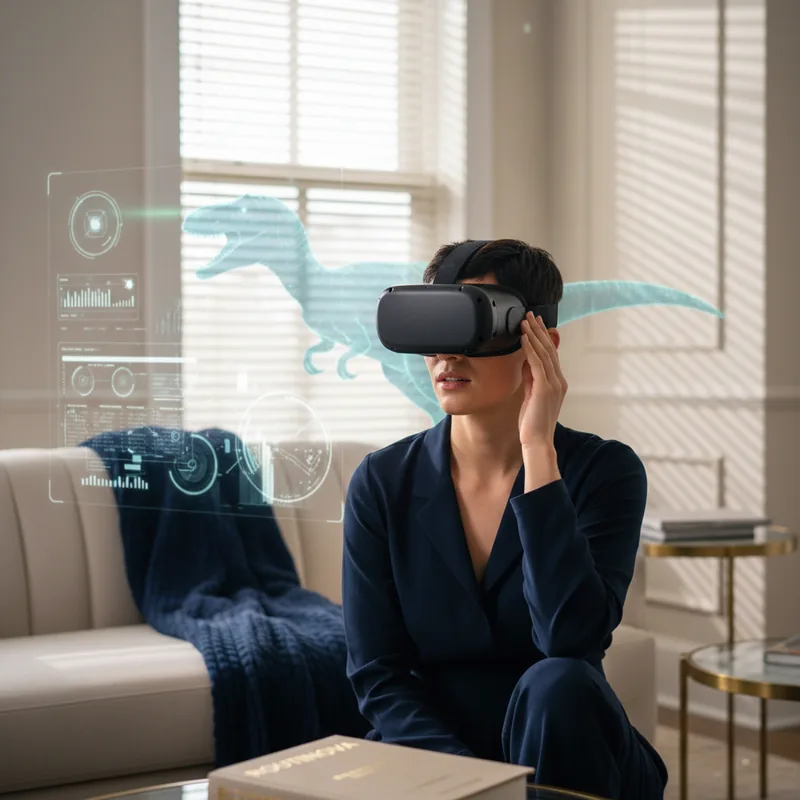
Forget the micro-OLED displays and the M2/R1 dual-chip architecture for a moment. What this tech does is truly mind-blowing. After a remarkably painless setup, my first stop was 'Encounter Dinosaurs,' a free app that ships with the device. Suddenly, a window to a prehistoric world opened in my living room. I was watching a dinosaur drama unfold on a 10-foot virtual screen, utterly captivated by its perfect definition, when a Rajasaurus stuck its entire head into my space. It made eye contact. Genuinely feeling like prey, I blurted out, 'holy crap,' and the creature reacted. The lighting matched my room, the sound was all around me. It felt entirely, terrifyingly real.
That moment was jaw-dropping. I was ready for a full-blown Jurassic adventure, but then the tech demo ended. It was a few minutes of pure dazzle, a tantalizing peek behind the curtain of what's possible. 'Encounter Dinosaurs' perfectly encapsulates the Vision Pro experience: it's a tease, a suggestion of space flight, only to find you're the third backup astronaut who might get to go to the moon, if Congress doesn't cut Apollo's funding first. But here's the real question: two years later, is this dazzling tech translating into practical, everyday value?
The underlying technology is simply phenomenal. The eye-scanning, gesture-based user interface, which operates without physical controllers, feels like you're operating a computer with your mind. It's fluid and intuitive. The spatial audio is pristine, creating an immersive soundscape that truly enhances the virtual experience. Integration with other Mac devices is seamless, as you'd expect from Apple. The definition and brightness of the graphics are flawless--no visible pixels, just pure, vibrant imagery. You can even use it to do things, which brings us to the core challenge.
Living in the Future: Work, Play, and the Reality Gap
Right now, I'm spatially computing. I have a wide-screen version of my laptop display floating before me, a music app open, and a live Olympic event streaming in another window. I'm combining my physical laptop screen with apps from the headset, arranging everything in my virtual space, navigating with my eyes and gestures. It all works, brilliantly. It feels like living in the future, yet that future is surprisingly exhausting. It's not just the headset's weight becoming more noticeable or the creeping eyestrain; it's the sheer maximalism of it all. Imagine trying to focus on a spreadsheet while a virtual cafe overlooking the Parisian skyline unfolds around you. It's too much for sustained work, and I often find myself craving a return to a simpler, less augmented reality.
For entertainment, the Vision Pro truly shines. Streaming movies and TV shows from major services is an experience as good as, if not better than, your home TV. Whether you're fully immersed in an NBA game or a Metallica concert (both genuinely amazing), or just scrolling TikTok, the colors are brilliant, and there's no hint of edge-blurriness. The dual micro-OLED displays create a virtual screen that's approximately 3660 x 3200 pixels per eye--better than 4K--on a display that can be as vast as a movie screen. For pure visual fidelity, it earns full marks.
Gaming, however, is a mixed bag. It's clear gamers weren't Apple's primary focus. While you can link the Vision Pro to your PC or Mac for more complex titles, there are no true 'AAA' games developed specifically for the device. There are some cool smaller titles, though. I was genuinely impressed with the recently released Retrocade, a collection of perfect ports of 1980s arcade games. You play them on virtual recreations of actual arcade cabinets, complete with reflections on CRT screens. It's a nostalgic delight, but it's also a little sad that the best gaming use of 2026's most advanced consumer technology is playing Frogger. Imagine a truly spatial puzzle game, like a virtual escape room that leverages the depth and gestures, or a dynamic strategy game unfolding across your physical room. The potential is immense, but two years later, is the app ecosystem catching up? The Vision Pro gaming section of the App Store remains a lonely place, filled mostly with glorified tech demos. The overall app landscape is sparse and largely forgettable, a missed opportunity given the hardware.
Augmented Reality: Where the Magic Fades
While full-immersion virtual reality is certainly possible, Apple's primary focus for the Vision Pro has always been augmented reality--real life, just with digital bells and whistles. But it's not truly augmented reality. You're seeing the world through cameras, with a field of view of 100° x 75°, roughly half of reality's natural field of vision. And the outward-facing cameras, while good, aren't nearly as sharp as the internal displays. So, 'reality' appears slightly blurry around the edges, while the 'augmented' digital elements are crystal clear. This creates a disorienting effect, a sense of fakeness that makes using the device feel unsettling and alienating, particularly when transitioning between augmented life and just, well, life.
That sense of artificiality, combined with the constant awareness of a heavy device strapped to your face, makes using the Vision Pro feel like a chore. It's the kind of device I'd pull out sparingly--to show off to a friend or perhaps for a long flight. I haven't yet seen a 'killer app' that overcomes the inherent friction enough to make me want to use it more often. I want augmented reality to be truly transformative, like a virtual interior designer app that lets you place furniture in your room with perfect scale and lighting, or a spatial cooking assistant projecting recipes onto your counter and guiding you through steps. I want the transcendent, something you couldn't experience any other way, to make the weight and digital claustrophobia feel worthwhile.
The Verdict: Two Years Later, Is It a Buy?
I'm still not entirely sure what the Vision Pro wants to be. It's advanced technology that lets you privately stream movies at incredibly high quality, play a few mildly diverting games, or get some work done in a novel way. Shouldn't that be enough? Perhaps. But if I had dropped $3,500 for a Vision Pro, I wouldn't be thinking, 'This was a wise use of my money.' It's not just the money, though; it's also the friction, the physical and mental effort required to engage with it.
So, two years later, is the Vision Pro still just an expensive, high-tech curiosity? For now, yes. The ecosystem hasn't developed as rapidly as the hardware demands, and the core problem of 'what do I do with this?' persists. While the dinosaur encounter offered a glimpse of truly magical augmented reality, that magic is fleeting. The future of AR likely lies in much lighter, more seamless smart glasses, a technology still years away from truly matching 'reality-reality' (Digital Futures Institute, 2023). Until then, I'll be waiting for the dinosaurs to come back, and hopefully, for a Vision Pro that feels less like a chore and more like the future it promises.