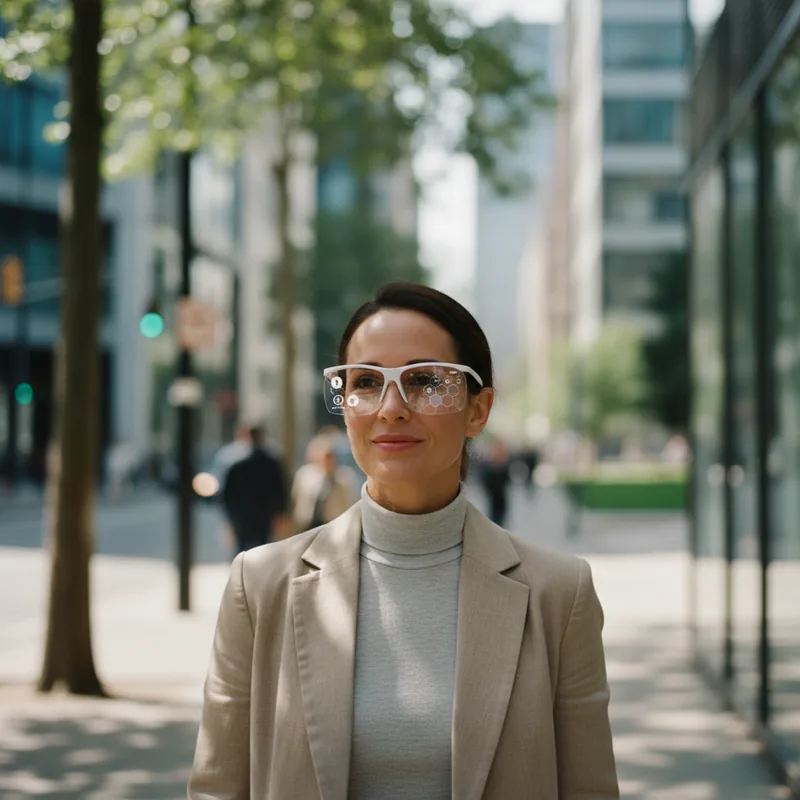
If you've been waiting for wearable tech to finally make sense, smart glasses are about to have their breakout moment. Industry analysts project sales will skyrocket from six million units in 2025 to twenty million by 2026, marking a critical inflection point where early-adopter gadgets transform into everyday essentials (Harvard Business Review, 2024). Whether you're eyeing audio-first frames, display-enabled specs, or full augmented reality overlays, the landscape is shifting rapidly.
CES Reveals the Immediate Future
The 2025 Consumer Electronics Show served as a launchpad for next-generation smart glasses, with established players and newcomers alike showcasing hardware that blurs the line between fashion and function. Four announcements particularly signal where the market is headed:
XReal 1S: The Power User's Choice
XReal has been pushing display-first boundaries since 2019, and their latest 1S model represents a significant leap. Powered by an onboard X1 chip, these glasses deliver a staggering 500-inch virtual screen with 3Dof augmented reality capabilities and a buttery-smooth 120Hz refresh rate. At $449, it's positioned as a premium productivity tool rather than a novelty. The monochrome display approach ensures the glasses remain lightweight while offering genuine utility for professionals needing portable screen real estate.
Even Reality G2: Stealth Intelligence
Perhaps the most fashion-forward entry comes from Even Reality, whose G2 glasses prioritize discretion. The integrated smart ring controller and contextual AI assistant provide conversation suggestions and notifications without drawing attention. The monochrome display is sharper than their previous G1 model, and critically, these don't scream "tech product." Available starting at $599, they're designed for professionals who want AI augmentation without sacrificing style.
RayNeo Air 4 Pro: Entertainment Focus
While some glasses aim for all-day wear, RayNeo's Air 4 Pro targets entertainment specifically. Dual Micro-OLEDs create a virtual 200-inch screen with HDR10 support, while Bang & Olufsen-tuned audio delivers premium sound. The Vision 4000 custom processor handles upscaling, making it ideal for streaming games and movies. At an aggressive $299 price point launching January 25th, these could democratize large-screen experiences for travelers and commuters.
XGimi Memomind: The Lifestyle Entry
Projector specialist XGimi's smart glasses debut focuses on all-day battery life and subtle design. The Memomind line offers three tiers: dual lens display, single lens display, and audio-only. Their AI-integrated monochrome display and lightweight frames suggest they're targeting the lifestyle market rather than pure productivity. Expected availability around March positions them as a spring contender.
The Big Tech Battle Lines
These CES reveals are just the opening salvos. The real disruption arrives when tech giants fully commit to the category.
Google and Samsung's Android Alliance
After pioneering the space with Google Glass, the search giant is returning in partnership with Samsung, Gentle Monster, and Warby Parker. Their dual-pronged 2026 strategy includes audio-first glasses leveraging Gemini AI for voice interaction, and display-enabled frames showing real-time directions and translations. This ecosystem approach could solve the fragmented user experience that plagued early smart glasses.
Apple's Quiet Pivot
Following the mixed reception to their Vision Pro headset, Apple is reportedly redirecting resources toward smart glasses. While unconfirmed, industry whispers suggest camera, microphone, and AI integration that could leverage Apple's ecosystem advantage. If true, this represents a strategic shift from immersive VR to ambient AR that users can actually wear in public.
Snap and Amazon's Specialized Plays
Snap's Spectacles evolution focuses on gesture-based AR interaction, allowing users to manipulate digital objects naturally. Meanwhile, Amazon is bypassing consumers entirely, equipping 400,000 delivery drivers with glasses designed to identify hazards and navigate to doorsteps. Both approaches validate the technology while targeting specific use cases.
Market Dynamics and Meta's Dominance
These developments directly challenge Meta's commanding 73% market share from 2025. Their success stemmed from making smart glasses feel both normal and futuristic through Ray-Ban and Oakley partnerships. With Meta Display and second-generation frames already in market, they're well-positioned to defend their turf--but the sheer volume of competitors entering 2026 creates unprecedented pressure.
The Phone Replacement Endgame
Here's the strategic reality: combining the best features from various smart glasses categories creates a device that could theoretically replace your smartphone while correcting your vision. That's the prize every company is chasing. The convergence of AI assistants, display technology, and audio input/output makes this plausible within the next few years.
However, smart glasses are about to face their most critical test: public acceptance. The technology is maturing, but social norms around wearing computers on your face remain a barrier. 2026 won't be the year everyone ditches their phones, but it will likely be remembered as the year smart glasses are about to cross from niche to normal. The question isn't whether this transformation happens--it's how quickly consumers embrace it.
For early adopters and tech enthusiasts, smart glasses are about to offer compelling reasons to upgrade. For the average consumer, the value proposition needs to be clear, fashionable, and affordable. The companies that solve this equation will define the next decade of personal computing.