The fantasy of mega-mansion ownership often eclipses the reality. Ever wondered what it's truly like living within the gilded gates of an $18 million estate? Beyond the glossy magazine spreads and aspirational social media posts, the experience is a complex tapestry of unparalleled luxury, surprising practicalities, and even unexpected psychological shifts. While many dream of limitless space and absolute privacy, the daily reality of inhabiting such a grand property presents a unique set of joys and challenges that extend far beyond mere financial considerations. This isn't just about square footage; it's about a lifestyle few ever encounter.
The Unveiling: A Week in Opulence
For one transformative week each year, I am fortunate enough to step into this extraordinary world, courtesy of a close friend who owns an $18 million mega-mansion. This isn't my primary residence, nor is it a property I could personally afford based on my current earnings. It belongs to someone whose annual income likely exceeds $35 million, placing them in a financial stratum where such an acquisition is a considered, albeit significant, investment rather than an impossible dream.
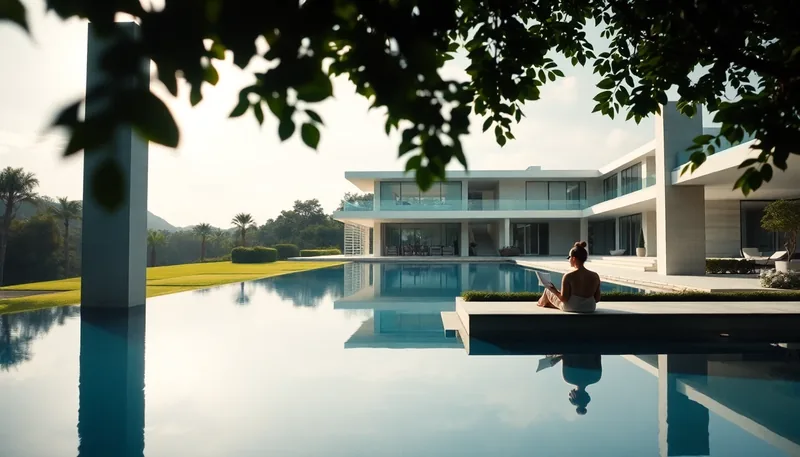
The property itself is a sanctuary, sprawling across acres of pristine land, offering absolute seclusion. Mornings might begin with a game of tennis on private courts nestled behind mature mango trees. Afternoons often involve a refreshing dip in the expansive pool, followed by a soak in the outdoor hot tub, easing any lingering tension. The sheer scale allows for a complete disconnect from the outside world, a luxury in itself that is increasingly rare in our interconnected society.
This annual retreat offers a rare glimpse into a life defined by extraordinary means. It allows for a firsthand exploration of what it's like living in an environment where every detail is curated, and every convenience is anticipated. For the sake of discretion and privacy, the images used to illustrate this experience are from properties of similar caliber and price points, reflecting the essence of the luxury encountered.
The Hallmarks of True Luxury
Understanding what it's like living in such a property means appreciating the meticulous design and unparalleled scale. The difference between an $18 million estate and a standard luxury home isn't just about size; it's about the bespoke details and the intentionality behind every element.
Exquisite Details and Craftsmanship
Upon entering, one is immediately struck by the sheer quality. Imagine ten-foot-high double doors, each eight inches thick, crafted from rare hardwoods. Every fixture, from the ambient lighting systems to the custom-textured wallpaper, exudes a sense of curated elegance. It's evident that a team of top-tier designers and architects meticulously selected every piece of furniture, every artwork, and every finish, creating a cohesive and breathtaking aesthetic (Luxury Institute, 2023). This isn't just decoration; it's a symphony of design.
Beyond the visible grandeur, these homes often integrate cutting-edge smart technology seamlessly. Advanced climate control systems, integrated soundscapes, and comprehensive security networks are not just features but intrinsic parts of the living experience. For instance, voice-activated controls manage everything from lighting scenes to window treatments, offering a level of convenience that redefines effortless living. This technological sophistication is a silent partner in the overall sense of ease and control.
The Primacy of Land and Privacy
While the interior space is undeniably grand, the true luxury at this price point lies in the land that envelops the property. There's a limit to how much indoor space one can truly utilize before it begins to feel excessive. What becomes paramount is the surrounding acreage, offering an unassailable sense of privacy. Lush landscaping, mature trees, and thoughtful border design ensure that the estate is a private island, shielded from prying eyes and external disturbances.
The serenity of walking through vast, manicured grounds, perhaps even in complete solitude and without clothing, is an experience of profound freedom. This level of privacy is not merely a convenience; it's a fundamental component of the owner's peace of mind and overall happiness. It's a deliberate escape from the constant hum of urban life, providing a genuine retreat.
The Astronomical Cost of Grandeur
The sticker price of an $18 million mansion is just the beginning. The ongoing expenses associated with maintaining such a property are staggering and often underestimated by those outside this echelon of wealth.
Full-Time Caretakers and Specialized Staff
Properties of this magnitude demand continuous attention. The mansion I visit employs a live-in couple who reside in a separate dwelling on the grounds. Their role as caretakers is comprehensive, encompassing everything from intricate gardening and pool maintenance to hot tub cleaning and driveway upkeep. Their presence ensures that the estate remains immaculate and functional year-round, a service for which they are compensated handsomely, often earning close to $100,000 annually in addition to free housing.
Beyond general caretakers, many ultra-luxury estates require a retinue of specialized staff. This might include a private chef, a dedicated security detail, a personal assistant, or even a landscape architect on retainer. For example, one owner of a similar property I know employs a full-time arborist to maintain their rare botanical garden and a dedicated IT specialist to manage their complex smart home systems. These additional personnel further escalate the operational costs, turning a home into a small, highly specialized enterprise.
The True Annual Expenditure
Estimating the annual cost of ownership for such an estate can be sobering. For the property in question, the expenses easily approach $500,000 per year. This figure typically breaks down into significant categories: the caretakers' salaries, substantial annual property taxes (which can easily exceed $230,000 for an $18 million property in many desirable locations), utility bills that can reach $60,000 annually for heating, cooling, and power across vast spaces, and a dedicated maintenance budget of at least $110,000 for unforeseen repairs, upgrades, and general upkeep (National Association of Realtors, 2024). This doesn't even account for insurance, which for a property of this value and often in high-risk areas like beachfronts, can be exorbitant. These figures underscore why owning a vacation property of this scale is only advisable for those who can comfortably afford a dedicated property management team.
Adapting To and Beyond Vast Spaces
One might assume that living in an enormous house would feel sterile or wasteful. The reality, however, is often surprising, both in how quickly one adapts and how readily one readjusts to smaller environments.
The Goldfish Effect: Growing into Your Environment
My own home in San Francisco, at 3,200 square feet for a family of four, feels perfectly adequate. Yet, during our stays, we quickly acclimated to the sheer scale of the mega-mansion, where the living and dining room area alone spans 3,000 square feet, and the entire house approaches 9,000 square feet. It's akin to the "goldfish effect," where one expands to fill the available space. The initial awe gives way to a comfortable familiarity, and navigating the grand hallways and cavernous rooms becomes second nature.
Interestingly, the return to our comparatively modest home never feels like a letdown. The human capacity for adaptation is remarkable. We seamlessly readjust to our 300-square-foot living room, finding comfort and efficiency in its smaller footprint. The primary element we genuinely miss is not the interior volume, but the expansive outdoor space and the profound privacy it affords. For families with children, vast grounds offer an unparalleled playground, fostering an active and unconstrained childhood.
The Desire for a Larger Family or More Guests
The sheer emptiness of a mega-mansion can be striking. Despite getting used to the space, one might find themselves wishing for more family members to fill it. The sprawling grounds seem to call for more children to play hide-and-seek, more laughter echoing through the grand halls, and more loved ones gathered around the massive dining table. The idea of increasing the "utilization" of the house often translates into a desire to share its bounty, inviting close relatives and friends to partake in the experience. An empty room after empty room, leading to a grand master suite, can evoke a sense of loneliness, highlighting that even in immense luxury, human connection remains paramount.
The Paradox of Underutilization
Perhaps one of the most surprising aspects of mega-mansion ownership, particularly for vacation properties, is the inherent underutilization. The dream of constant escape often clashes with the realities of busy lives.
Vacant for Months on End
When our week-long stay concludes, there's a pang of regret, not just for leaving an amazing place, but for the knowledge that it will likely sit vacant for months. Between the owner's primary residence, their other properties, and their vacation club memberships, this $18 million estate is often uninhabited for eight to nine months of the year. This phenomenon is common among the ultra-wealthy, who often own multiple residences across various locales, making it logistically challenging to fully utilize each one.
My friend openly laments this underutilization, expressing a genuine desire for the property to be enjoyed more frequently. This sentiment often leads to a generous sharing of the estate with friends and family, finding satisfaction in knowing that others are experiencing the joy and tranquility it offers. This altruistic approach to luxury property ownership highlights a unique aspect of extreme wealth: the ability to derive pleasure from providing experiences to others, even if one cannot personally be present.
The True Wealth Divide
The ownership of such a property offers a stark realization of the vast chasm in wealth distribution. Conventional financial wisdom suggests spending no more than 3-5 times one's annual gross income on a primary residence. To comfortably afford an $18 million primary home, an individual would need an annual income of at least $3.6 million. For a vacation property, the advice is even more conservative: limit its value to no more than 10% of one's net worth due to ongoing costs and infrequent use. This implies a net worth of at least $180 million to own an $18 million vacation property without it becoming a significant burden. These figures illuminate the extraordinary financial foundation required to sustain such a lifestyle, revealing that true wealth exists on a scale far beyond what most people imagine.
Interestingly, my children, after experiencing both the mega-mansion and our 90% less expensive vacation condo at a resort, often express a preference for the condo. While the mansion offers immense private space, the resort environment provides a broader array of activities and social opportunities, proving that sometimes, the sheer scale of luxury can be overshadowed by variety and communal engagement.
Privacy and Its Unseen Shadows
Crucially, what it's like living in a mega-mansion often boils down to the unparalleled sense of privacy. This is, for many, the ultimate luxury, yet it comes with an unexpected psychological cost.
The Ultimate Escape from the World
For those who navigate demanding careers and public lives, the ability to retreat to a property where the only disturbances come from loved ones is invaluable. Imagine lounging on your deck without the fear of neighbors' prying eyes, or swimming in your pool in complete solitude. The absence of external noise - no incessant remodeling sounds, no traffic hum - creates an environment of profound peace and quiet. This level of seclusion allows for a complete mental reset, a true escape from the relentless pace of modern life. You don't realize how "on top of each other" we are until you experience this kind of profound isolation (Journal of Environmental Psychology, 2022).
The novelty of 20-foot ceilings, state-of-the-art washlet toilets, and the sheer volume of living space eventually fades into the background. What truly endures and is deeply missed upon departure is the utter tranquility and the freedom from external intrusion. It's a return to a primal state of being, unobserved and unburdened.
The Unsettling Side of Seclusion
However, this very isolation, while a primary draw, harbors a significant downside: the potential for a disastrous home invasion or simply the unsettling feeling of being utterly alone. Driving back to the estate after dinner, navigating the long, private winding road, one can't help but imagine worst-case scenarios. The two private electronic gates, requiring a stop and a code entry, suddenly feel less like security measures and more like points of vulnerability in the dark.
The sheer remoteness means that any incident could go unnoticed for days. The vastness of the house itself can become a source of paranoia. A creak in the night, a shadow glimpsed through a window - the active imagination can transform a peaceful sanctuary into a setting for a horror flick. As any aficionado knows, with interior lights on, residents are often blind to what lurks outside, amplifying the sense of unease. This psychological burden, the constant low hum of "what if," is a rarely discussed aspect of ultra-private living.
For those with an active imagination or a predisposition to anxiety, living in a mega-mansion might prove more unsettling than serene. There's a certain comfort in the proximity of neighbors, in the simple ability to borrow a cup of sugar or seek assistance. This communal aspect is entirely absent in extreme seclusion. Yet, for others, the trade-off is entirely worth it, especially when the property is not a primary residence and the burden of maintenance falls to others.
The Endless Pursuit and Financial Realities
The human desire for "more" is a powerful, often insatiable force, even at the highest echelons of wealth. Owning an $18 million mansion, for some, is merely a stepping stone.
The Escalation of Desire
A curious phenomenon observed among the ultra-wealthy is the rapid recalibration of aspirations. After several years of owning an $18 million property, some individuals inevitably begin to eye $30 million, $50 million, or even $100 million estates. The desire for greater luxury, more unique features, or even more expansive grounds can be a relentless pursuit. This endless cycle highlights a profound truth: wealth, in itself, does not guarantee contentment, and the pursuit of material possessions can often lead to an ever-moving goalpost.
It's a stark reminder that true satisfaction often stems from internal factors rather than external acquisitions. For those contemplating such a purchase, it's crucial to understand the immense income and net worth required to sustain such a lifestyle without it becoming a gilded cage. It demands not just hard work and significant risk, but also a considerable amount of luck.
Beyond the Primary Residence
Perhaps the most astonishing revelation about the $18 million mansion I visit is that it isn't even the owner's primary residence. Their main home is valued at over $20 million, suggesting a net worth comfortably in the nine-figure range. This fact alone speaks volumes about the scale of wealth that exists and the multi-layered approach some individuals take to their property portfolios. It underscores that for a select few, an $18 million estate is simply one piece of a much larger, more complex financial and lifestyle puzzle.
Ultimately, what it's like living in a mega-mansion is a complex tapestry woven with threads of unparalleled luxury, profound privacy, immense financial commitment, and surprising psychological nuances. It's a world where dreams are realized, but also where new desires are born, and the quiet hum of isolation can sometimes be as loud as the silence itself.