The path to fitness often feels like a high-speed highway, yet many of us are just learning to drive. Workout videos promise a guided journey, but for absolute beginners, keeping up can feel like an impossible feat. The good news is that building a workout habit doesn't require perfection; it simply requires starting, and knowing how to follow any workout video, even if you're an absolute beginner, is more accessible than you might think. The secret lies in smart modifications and a focus on your personal progress, not the instructor's pace.
Mastering Foundational Movements at Your Pace
Many beginner workout videos feature fundamental bodyweight exercises that can still be challenging. Instead of feeling defeated, learn to adapt them to your current strength level. This adaptive mindset is crucial for understanding how to follow any workout video effectively.
Adapting the Squat
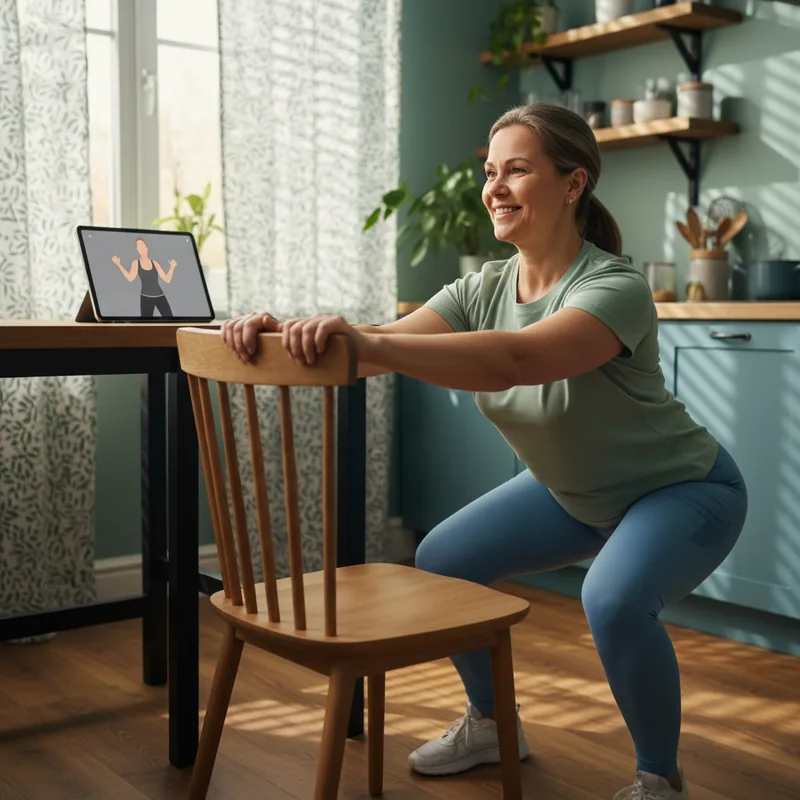
The squat is a cornerstone movement, but going all the way down might not be possible initially. Rather than skipping it, try these modifications:
- Chair Squats: Sit down into a sturdy chair and stand back up. This provides a natural depth limit and support.
- Wall Squats: Lean your back against a wall and slide down until your knees are bent, holding the position. This builds isometric strength.
- Assisted Squats: Hold onto a countertop, the back of a chair, or even a resistance band anchored to a sturdy object, using it for balance and support as you lower yourself. (Harvard Health, 2023)
Remember, it's perfectly fine to squat only as low as you comfortably can. Your range of motion will improve over time with consistent practice.
Conquering the Push-Up
Push-ups are another common beginner exercise that can feel out of reach. The key to progression is adjusting the incline. The higher your hands are, the easier the push-up becomes:
- Wall Push-Ups: Stand a few feet from a wall, place your hands on it at shoulder height, and lean in, pushing yourself back.
- Countertop/Table Push-Ups: As you get stronger, move your hands to a lower surface like a kitchen counter or a sturdy table.
- Chair Push-Ups: Progress further by using a stable chair. This incline progression is often more effective than knee push-ups, as it helps you practice maintaining a straight plank position with your entire body.
Modifying Other Bodyweight Exercises
Don't let any movement intimidate you. If a plank is too hard on your wrists or core, try an incline plank with your hands on a sturdy countertop. For lunges, use a wall or chair for balance, focusing on controlled movement rather than deep range. If flexibility is an issue for stretches, use a towel or strap to extend your reach, gently pulling your limbs into position.
Adapting Resistance and Pace to Your Level
Understanding how to follow any workout video with weights means knowing your options, and pacing yourself is vital for sustainable progress.
Creative Weight Alternatives
Dumbbells are great, but you don't need them to start. Many household items can serve as effective weights:
- Small Weights: Water bottles (half-liter is about 1 lb), cans of soup, or even a pair of socks filled with rice can add light resistance.
- Medium Weights: Larger water bottles, wine bottles, or milk jugs offer more challenge. You can also fill tote bags with books or multiple water bottles for customizable weights.
- Resistance Bands: These are an excellent, versatile tool for adding resistance to almost any exercise, from squats to bicep curls, and are often more accessible than dumbbells.
If even these feel too heavy, start with literally nothing. Make fists and go through the motions. Your muscles will still engage, and you'll build the mind-muscle connection. Progress to light objects as soon as you feel ready.
Pacing Yourself Through Any Video
It's easy to feel pressured to match the instructor's pace. However, your goal is to work out at your current level of fitness, not to replicate a performance. If a video calls for 30 seconds of an exercise but you can only manage a few reps, do what you can, then rest for the remainder of the time. (Mayo Clinic, 2024)
This adaptive mindset is key to how to follow any workout video, from high-intensity to low-impact. It's perfectly fine to pause the video, take extra breaks, or perform fewer reps. The consistency of showing up and moving your body, even if modified, is far more important than completing every single rep perfectly.
Navigating Specific Workout Styles and Finding Your Flow
Different workout styles present unique challenges, but the principles of modification remain constant. The journey of learning how to follow any workout video is ultimately about self-discovery and building momentum.
Adjusting Cycling Workouts
For high-energy cycling classes, the instructor might call out specific resistance or speed numbers. As a beginner, ignore the numbers. Instead, focus on your perceived exertion. If the instructor looks like they're on an easy ride, adjust your resistance so you feel like you're on an easy ride. If they're working hard but not struggling, match that feeling. (American Council on Exercise, 2023)
The goal is to feel challenged but not overwhelmed, ensuring you can maintain the workout without burning out too quickly. This approach applies to any cardio-based video; listen to your body's signals above all else.
Choosing Your Starting Point
Feeling overwhelmed by choices? Start literally anywhere. There's no single "right" workout to begin with. Maybe you try a cardio dance video and discover you dislike dancing. That's valuable information! You've still moved your body, and now you know to pivot to something else, like a strength training or yoga video.
The beauty of video workouts is the vast variety available. Don't be afraid to bounce between videos until you find something that resonates. Bookmark videos that seem fun but slightly out of reach, and revisit them weekly. You'll be amazed at your progress. The most important step is simply to begin, and once you've started, the momentum will carry you forward.