Did you know that 65% of people are visual learners? This means that what we see often impacts our understanding and memory far more than what we read. For professionals and creators alike, the ability to quickly generate compelling visuals isn't just a nice-to-have; it's becoming a necessity. But when two of the leading AI platforms, Claude and ChatGPT, roll out significant visual tool updates, how do they stack up?
Claude Design: Tailored for Professional Workflows
For a while now, Claude has been the go-to for text and code-based AI tasks. But recently, Anthropic expanded its capabilities with Claude Design, a suite of tools aimed squarely at business and enterprise users. Think less about generating whimsical pictures of cats on skateboards and more about creating tangible assets like project slideshows, interactive prototypes, and professional one-pagers. This move solidifies Claude's position as a powerful partner for teams already leveraging its coding prowess.
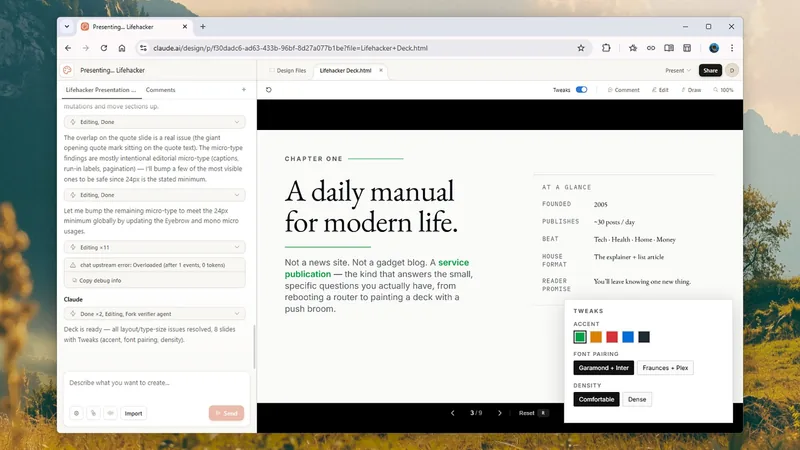
The core idea behind Claude Design is to streamline visual content creation for business needs. You can feed it existing codebases, documents, or images to establish a style, or simply provide a text prompt. I decided to test this by asking Claude to build a slide deck showcasing the value of Lifehacker. Using a few screenshots as a stylistic guide, Claude Design then asked clarifying questions about the desired mix of text and images, and the length of the presentation. Watching the AI 'think' and build the graphics in real-time was fascinating.
When the final deck was presented, the polish was impressive. A standout feature is the post-creation editing capability. I was able to easily tweak the accent color, fonts, and slide density with just a few clicks. I even requested further edits via prompts and used drawing tools directly on the visuals to indicate changes. For instance, when I tasked it with creating an iPhone app mock-up for a Lifehacker news app, the design was remarkably on-brand, with only minor graphical glitches. The ability to iterate visually is a significant advantage.
This focus on an integrated, professional workflow is clear. Claude Design feels slick and intuitive, much like its coding counterpart. While individual users might find simpler tools sufficient for basic needs, for companies looking to integrate AI into their design and presentation workflows, Claude Design appears to be a robust solution. It's designed to work alongside tools like Claude Code, creating a more cohesive AI-assisted professional environment (Anthropic, 2024).
ChatGPT Images 2.0: Broad Appeal and Enhanced Generation
Meanwhile, ChatGPT, already a major player in AI image generation, has rolled out a significant update: Images 2.0. OpenAI promises a substantial leap in accuracy, consistency, and instruction following, making complex tasks more achievable and images more 'intentionally designed'. This upgrade targets a broader audience, encompassing both consumer and business use cases.
Creating images with ChatGPT remains straightforward: describe what you envision. The platform has been used to generate intricate 'Where's Waldo?' scenes, scientific infographics, and mock magazine covers. I tested it by requesting a comic strip about Lifehacker, which it produced in minutes. The results were amusing, though I noted some inconsistencies - the desk rearranged itself, and the coffee got hotter between panels, showcasing a playful, sometimes unpredictable, nature of the AI (OpenAI, 2024).
I also asked ChatGPT to mock up two Lifehacker magazine covers. While they looked realistic and lacked obvious errors, they possessed a certain generic quality. It felt like the AI had averaged out countless magazine covers from its training data, resulting in something technically correct but lacking unique editorial flair. This is a common trait in AI-generated imagery that aims for broad appeal.
Unlike Claude Design, ChatGPT Images 2.0 isn't built for complex, multi-step outputs like slide decks. While you could theoretically generate individual slides or app mock-ups, the limitations in consistency and post-generation editing are more pronounced. ChatGPT excels at generating distinct, often one-off, pieces of AI art.
The updated model also shows improved ability to pull real-world information. I tested this by asking for a cartoon map of Middle Earth (which, copyright-consciously, wasn't an exact replica of Tolkien's work) and an informative diagram of upcoming sports tournaments. Both yielded impressive visual results, demonstrating its capacity for both creative interpretation and factual representation. This versatility makes it a strong contender for a wide range of creative tasks (OpenAI, 2024).
When considering alternatives, the Gemini AI tools integrated into Google Workspace come to mind. Like Claude Design, they allow for loading reference materials and refining designs through follow-up prompts, and exportable to various formats. However, ChatGPT's direct image generation, especially with the 2.0 update, offers a more immediate and perhaps more artistically flexible experience for standalone visual creation.