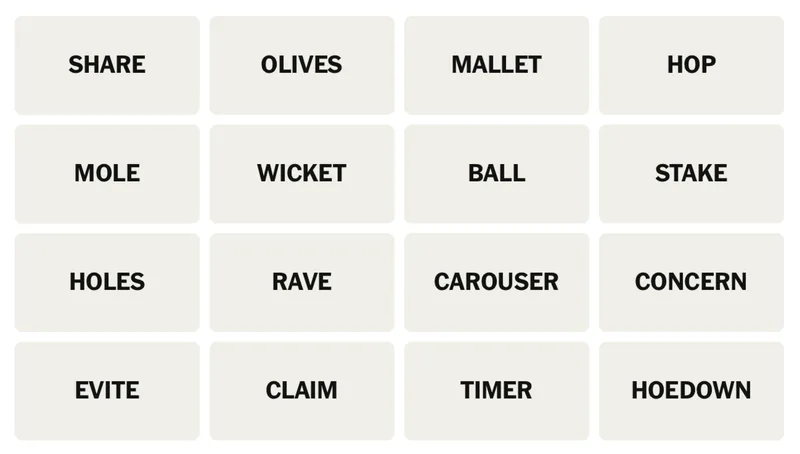
The daily ritual of solving NYT Connections has evolved from casual pastime into a sophisticated exercise in pattern recognition--a cognitive workout that sharpens your ability to see hidden relationships in everyday language.
The Cognitive Art of Connections
Today's NYT Connections hints aren't just about finding four words that share a theme; they're about training your brain to navigate linguistic ambiguity. Each puzzle presents 16 seemingly random words, but within them lies a precise architecture of meaning waiting to be decoded. The challenge mirrors how we process information in daily life--separating signal from noise, recognizing subtle connections, and avoiding the trap of obvious associations.
Research from cognitive science suggests that puzzles like Connections activate the brain's pattern-recognition networks, similar to how we make strategic decisions under uncertainty (Harvard, 2024). The yellow category typically represents the most straightforward connection, while purple categories often employ wordplay or cultural references that require lateral thinking.
Strategic Framework for Daily Solving
When approaching today's NYT Connections hints, implement this three-phase strategy used by expert solvers:
Phase 1: Initial Scan
First, read all 16 words without pressure. Don't jump to conclusions. This initial exposure allows your subconscious mind to begin making connections while your conscious mind observes. The most common mistake is forcing early groupings--instead, let the patterns emerge naturally. I've seen players waste their first guess on "obvious" connections that later prove to be red herrings, like grouping words that share a letter pattern but lack deeper semantic ties.
Phase 2: Pattern Mapping
Look for these common category types:
- Synonym groups (words with similar meanings)
- Fill-in-the-blank (words that complete common phrases)
- Thematic collections (items from the same domain)
- Wordplay categories (puns, homophones, or cultural references)
Consider how today's NYT Connections hints might be structured. For instance, if you see words like "current," "length," "mass," and "time," your first instinct might be to group them as synonyms. However, they're actually units of measurement in physics--a classic example of how Connections rewards deeper knowledge over surface-level associations.
Phase 3: Elimination Testing
Before submitting any group, test it against all remaining words. Ask: "Could any other word from the board fit into this category?" If the answer is yes, your grouping is likely incorrect. This elimination process is crucial--each category must contain exactly four words with no alternatives.
Decoding the Color-Coded Difficulty
The puzzle's color system represents more than just difficulty--it reflects the cognitive load required to solve each category. Yellow categories demand the least mental effort, often relying on straightforward vocabulary knowledge. Green introduces mild complexity, while blue and purple categories require sophisticated reasoning.
Understanding the color hierarchy transforms how you approach each puzzle. Instead of solving randomly, you can strategically target categories based on their cognitive demands.
The Yellow Approach
Yellow categories typically represent the most direct relationships. When you see today's NYT Connections hints suggesting an inexperienced theme, words like "fresh," "new," "naive," and "budging" might emerge. These categories reward vocabulary breadth and common associations.
Navigating Green and Blue
Green categories often introduce specialized knowledge or cultural references. Blue categories demand precision--think scientific measurements, technical terms, or specific domains. The key is recognizing when you're dealing with a category that requires external knowledge versus one that relies purely on linguistic relationships.
Mastering Purple Challenges
Purple categories represent the pinnacle of Connections creativity. They often involve wordplay, puns, or phrases where the target word appears in a specific context. For example, a category might be "Words that follow 'quick'"--requiring solvers to think of "silver," "sand," "fix," and "study" as completing compound terms rather than standalone words.
Advanced Pattern Recognition Techniques
Expert solvers develop an intuition for recognizing category types. Here are three patterns that frequently appear in today's NYT Connections puzzles:
The Double-Meaning Trap
Many words in Connections have multiple meanings, and the puzzle exploits this ambiguity. "Current" might seem like a synonym for "new," but in a scientific context, it's a measurement unit. "Mint" could suggest freshness, but it's also a term for money. The most successful solvers maintain mental flexibility, holding multiple interpretations simultaneously.
The Cultural Reference Pattern
Some categories require knowledge of literature, film, or history. A purple category might reference famous characters, movie titles, or book genres. When you encounter obscure words or phrases that don't fit obvious patterns, consider whether they might be part of a cultural touchstone you're familiar with.
The Idiom Completion Pattern
Fill-in-the-blank categories test your knowledge of common expressions. Words that seem unrelated individually might all complete phrases about time, money, or relationships. The trick is identifying the missing word that ties them all together.
Building Your Solving Muscles
Like any skill, Connections mastery improves with deliberate practice. Here's how to structure your daily sessions for maximum improvement:
- Time your solves without sacrificing accuracy. Track how long it takes to identify each category
- Review your mistakes immediately after revealing answers. Understanding why you missed a pattern is more valuable than getting it right
- Study the puzzle architecture by examining completed puzzles. Notice how categories are balanced and how red herrings are placed
- Practice lateral thinking with word association games outside of Connections
The Psychology of Pattern Recognition
Recent studies in cognitive psychology reveal that our brains are wired to seek patterns, even when none exist--a phenomenon called apophenia. Connections cleverly exploits this tendency by placing words in proximity that suggest false connections. The most successful solvers learn to override this instinct and demand rigorous evidence for each grouping.
This mental discipline translates directly to real-world decision-making. Whether you're analyzing market trends, evaluating job candidates, or planning a project, the ability to distinguish genuine patterns from coincidental ones is invaluable (Mayo Clinic, 2023).
Avoiding Common Pitfalls
Even experienced solvers fall into predictable traps. Here's what to watch for:
The Premature Commitment
Resist the urge to submit your first grouping. The puzzle's design often includes multiple words that could plausibly fit into several categories. Wait until you've identified at least two potential groupings before committing.
The Overthinking Loop
Conversely, don't analyze endlessly. If you're stuck after 10 minutes, consider stepping away. Fresh eyes often reveal patterns that were invisible during intense focus.
The Category Bias
Don't assume today's NYT Connections hints will follow yesterday's pattern. Each puzzle stands alone, with its own unique architecture. What worked yesterday might lead you astray today.
Leveraging Daily Hints Effectively
When using today's NYT Connections hints, treat them as strategic guides rather than solutions. A good hint should point you toward the right category type without revealing the exact grouping. For example, "related to currency" suggests you should look for money-related terms, but doesn't specify which four words belong together.
The most effective approach is to use hints only when you're truly stuck, then apply your own reasoning to complete the category. This maintains the puzzle's cognitive benefits while preventing frustration.
The Evolution of Connections Strategy
As the NYT Connections puzzle has grown in popularity, solvers have developed increasingly sophisticated strategies. Early players relied on brute-force trial and error, but modern approaches incorporate:
- Statistical analysis of word frequency and category patterns
- Linguistic theory to understand semantic relationships
- Game theory principles to optimize guessing strategies
This evolution mirrors how we approach complex problems in professional and personal life--moving from intuitive guesses to systematic analysis.
Conclusion: Mastering the Daily Puzzle
Today's NYT Connections hints are more than just clues--they're invitations to engage with language in a structured, thoughtful way. By developing a systematic approach, recognizing common patterns, and learning from each puzzle, you transform a daily game into a genuine cognitive enhancement tool.
The skills you build through Connections--pattern recognition, lateral thinking, and strategic elimination--apply far beyond the puzzle board. They're the same skills that help you navigate ambiguity, make better decisions, and find creative solutions to complex problems.
Start with today's puzzle, apply these strategies, and watch your solving abilities evolve. The patterns are there; you just need to learn how to see them.