Imagine trying to teach a child to tie their shoes. Do you offer a sticker every single time they make progress, or only after they've successfully completed the task? The answer hinges on understanding how schedules of reinforcement work, a foundational concept in psychology that explains why some behaviors stick and others fade.
At its core, operant conditioning teaches us that consequences shape behavior. Reinforcement makes a behavior more likely to repeat, while punishment makes it less likely. But the magic isn't just in the reward itself; it's in when and how often that reward appears. This is where reinforcement schedules become crucial.
The Science Behind Behavior Shaping
Schedules of reinforcement are essentially the rules of the game for learning. They dictate precisely when a specific behavior will be rewarded. This timing can dramatically influence how quickly a behavior is learned, how persistent it becomes, and how resistant it is to disappearing altogether.
Think about it: if you knew you'd get a bonus every single time you completed a report, you'd probably finish them quickly. But what if bonuses were unpredictable? You might still finish reports, but perhaps with a different pace or level of urgency. This difference is the power of how schedules of reinforcement are applied.
Whether it's in training a pet, motivating employees, or even encouraging yourself to stick to a new habit, understanding these principles offers a powerful toolkit. The goal is always to strengthen a desired behavior, ensuring it becomes a reliable part of your repertoire.
When Every Action Counts: Continuous Reinforcement
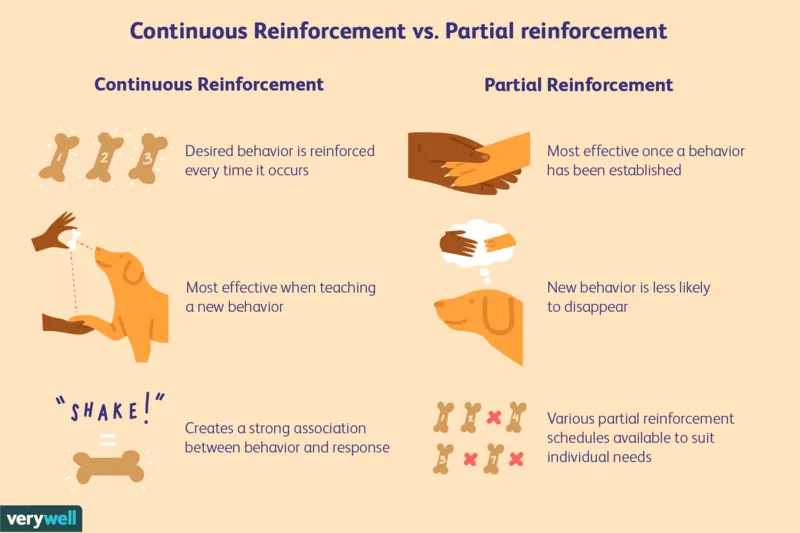
The simplest approach is continuous reinforcement. Here, the desired behavior is rewarded every single time it occurs. This method is incredibly effective when you're first teaching a new skill or behavior.
Imagine teaching a dog to fetch. In the initial stages, you might reward them with a treat and praise every time they bring the ball back. This consistent, immediate reward creates a strong association between the action (fetching) and the positive consequence (treat and praise). It helps the learner quickly grasp what is expected.
This schedule is like a clear, direct instruction manual for behavior. It's excellent for building a solid foundation, ensuring the target behavior is understood and performed reliably. However, it's often not sustainable in the long run.
Making Habits Stick: Partial Reinforcement
Once a behavior is well-established, switching to a partial reinforcement schedule can be much more effective for long-term maintenance. Instead of rewarding every instance, you reward only some of them.
Think back to the dog fetching. Once they reliably bring the ball back, you might start rewarding them only every few fetches. This doesn't mean the behavior stops; in fact, it often becomes more resilient. Behaviors learned under partial reinforcement are famously more resistant to extinction--meaning they're less likely to disappear when the rewards eventually stop.
There are four main types of partial reinforcement schedules, categorized by whether they're based on the number of responses (ratio) or the amount of time passed (interval), and whether that number or time is fixed or variable.
Fixed-Ratio (FR): Reward After a Set Number of Actions
With a fixed-ratio schedule, reinforcement is delivered only after a predetermined number of responses. For example, a factory worker might be paid for every 10 widgets they assemble.
This often leads to a high rate of response, but you might see a brief pause in activity immediately after the reward is given, as the individual anticipates the next required response count. It's predictable, which can be motivating, but the pause can be a drawback.
Variable-Ratio (VR): The Thrill of the Unknown
Variable-ratio schedules are perhaps the most powerful for maintaining behavior. Reinforcement is delivered after an unpredictable number of responses. Think of a slot machine: you don't know which spin will win, but the possibility keeps you playing.
This schedule produces very high, steady rates of responding because the individual is constantly motivated by the chance of an upcoming reward. In a workplace, this could be like receiving unexpected praise or a small bonus for consistently good performance over an unspecified period. Customer loyalty programs, where rewards are earned after an unpredictable number of purchases, also operate on this principle.
Fixed-Interval (FI): Reward After a Set Time
Fixed-interval schedules provide reinforcement after a specific amount of time has passed, but only for the first response that occurs after that interval. For instance, a student might study harder as a test date approaches (a fixed interval) than immediately after receiving a good grade.
This can lead to a scalloped pattern of responding: high activity near the end of the interval, followed by a drop-off in activity immediately after reinforcement. It's like checking the mail more frequently as the usual delivery time nears.
Variable-Interval (VI): Steady Engagement Over Time
Variable-interval schedules reward the first response after an unpredictable amount of time has elapsed. This encourages a slow, steady rate of response. Imagine a manager checking in on their team periodically throughout the day, but at random times.
Because employees don't know exactly when the check-in will happen, they are more likely to stay engaged and productive throughout the day, rather than only ramping up right before a predictable check-in. This schedule is excellent for maintaining consistent effort.
When Rewards Disappear: Understanding Extinction
What happens when reinforcement stops entirely? This process is called extinction. The behavior gradually declines in frequency and intensity.
However, extinction isn't always a smooth fade. Sometimes, you might observe a response burst--a temporary increase in the behavior's intensity or frequency before it finally disappears. You might also see response variability, where the individual tries different behaviors to achieve the same outcome, sometimes leading to new, undesirable habits.
Variable schedules, due to their unpredictability, tend to make behaviors much more resistant to extinction compared to fixed schedules. If you only got paid for every 10 widgets (FR), you might stop working if the payment stops. But if you received rewards unpredictably (VR), you might keep going for longer, hoping the next response will be the one that gets rewarded.
Putting Schedules to Work
The principles of how schedules of reinforcement work are incredibly versatile. In education, a teacher might use continuous reinforcement to teach a new concept, then switch to a variable-interval schedule for participation to encourage ongoing engagement.
For parents, potty training often starts with continuous reinforcement (a treat for every successful potty trip). As the child gains confidence, this might shift to a fixed-interval schedule (reward after three consecutive successful days) or a variable-ratio schedule (reward after an unpredictable number of successful days).
In the professional world, recognizing employee achievements can be structured using these schedules. While immediate praise for a small win (continuous) is great for initial learning, surprise bonuses for consistent high performance (variable-ratio) can foster long-term dedication and reduce the risk of burnout or the behavior fading over time.
Even learning a complex skill like coding can benefit. Initially, every successful code compilation or bug fix might be celebrated (continuous). As proficiency grows, positive feedback might become less frequent but still unpredictable (variable-interval), keeping the learner motivated without constant external validation.
Choosing Your Reinforcement Strategy
Deciding which schedule to use depends heavily on your goal. For teaching a brand-new behavior, continuous reinforcement is usually the fastest route to understanding.
Once the behavior is learned, however, partial schedules are generally superior for maintaining it. They prevent satiation--where the learner becomes bored or uninterested in the reward because it's too frequent--and make the behavior more robust against setbacks.
In everyday life, most of our reinforcing experiences are partial and unpredictable. Think about checking your email or social media. You don't get a notification every single second, but the intermittent reward of seeing something new keeps you coming back. This highlights why understanding how schedules of reinforcement work is so powerful for shaping not just others' behaviors, but your own habits too.
By thoughtfully applying these principles, you can enhance learning, build resilience, and foster more consistent, desirable behaviors in virtually any context.