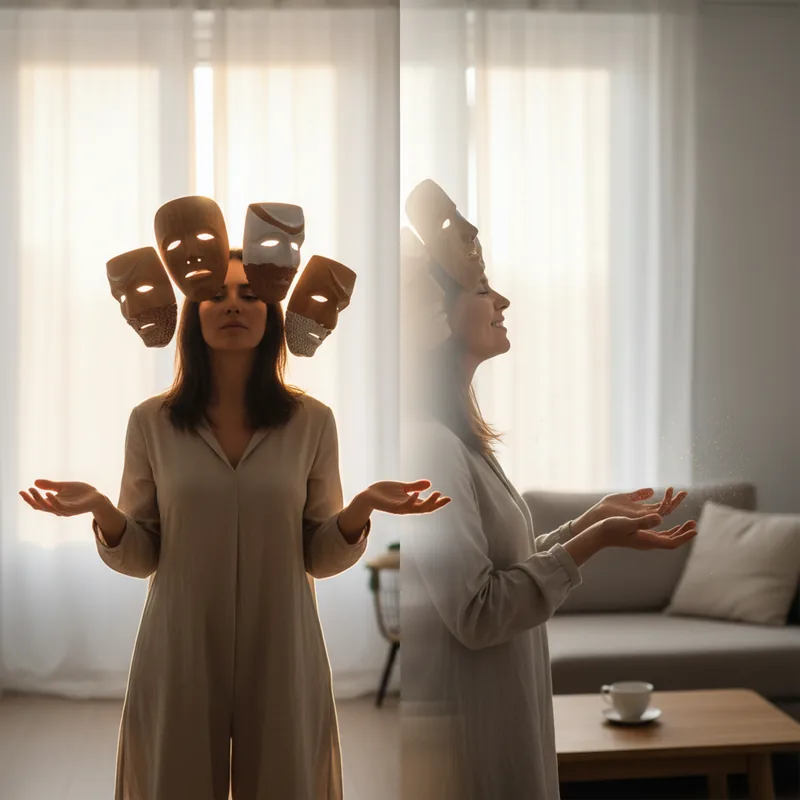
Do you ever feel like you're constantly performing, striving to meet an invisible standard that forever shifts just out of reach? That relentless pursuit of "good enough" can be exhausting, leaving you feeling profoundly empty, even when by all external measures, you seem to be succeeding. This isn't a sign of personal failure, but rather a common trap of external validation, and understanding why trying to be someone you're not is the first step towards genuine peace.
For many of us, the quest for external approval begins surprisingly early, subtly shaping our sense of self before we even have the words to describe it. It whispers in the background, a quiet anxiety that if we stand out, something might be wrong with us. And if something is wrong, we simply aren't good enough.
The Early Echoes of "Not Enough"
I remember a vivid moment from kindergarten. My mom had bought me new navy-blue corduroy pants for a school event - a rare and important occasion. Yet, what truly imprinted on me wasn't the pants or the event itself, but the palpable tension I felt wearing them. I stood there, acutely aware, afraid the other kids would think I looked stupid. Afraid they wouldn't want to play with me. That being different, even in something so small, would mean I didn't belong.
That feeling became a quiet companion, shaping every choice. I never quite knew who I wasn't good enough for, or what elusive standard I was meant to uphold. So, instead of questioning the feeling itself, I dedicated myself to solving it. This is why trying to be someone else, someone 'better,' became my default, a desperate attempt to fill an unseen void.
As I grew, my strategies evolved. I tried becoming the funny guy, then the popular kid obsessing over appearance, then the bodybuilder, and eventually, the lone wolf with seemingly perfect routines and achievements. Each identity felt like a serious attempt, carrying the hope that *this* would finally be the thing that made me feel okay. None of them did. Every version worked for a while, until the sheer effort of maintaining something so fundamentally untrue became too heavy. And then, it would inevitably collapse.
After each collapse, the emptiness would return, often accompanied by a desperate need to numb myself. In my early years, it was food. Later, alcohol and drugs joined in. The feeling underneath--this crushing sense of not being allowed to simply exist--only intensified. The more I tried to escape it, the worse it became, each new persona more extreme, more convincing, more airtight than the last. Each collapse hit harder.
The Illusion of External Validation
Eventually, a dark belief took root: the problem wasn't what I was doing, but who I was. That no matter how hard I tried, I would always come up short. It was a terrifying thought, suggesting that some people, perhaps myself included, were simply not built to be good enough. Even therapy, offering insights into childhood trauma like losing my dad early or being bullied, explained the pain but didn't loosen its grip (Psychology Today, 2022).
Then, in my mid-twenties, I met my girlfriend. For a time, the familiar feeling of inadequacy faded. I felt lighter, more secure. But as I truly began to love her, a new, terrifying fear emerged: that she would see who I *really* was and leave. That she'd realize I was a fraud, and our relationship would become just another entry on a long list of proof that I wasn't worth staying for.
This fear seeped into everything. My studies suffered, my work felt heavy. I clung to small anchors like eating well and staying active, not for health, but for the illusion of control. Then we moved to Thailand. On the surface, it was exciting, but underneath, I was utterly exhausted. I hadn't admitted it then, but I'd been pretending for a long time--pretending I could handle the stress, the uncertainty, the pressure to keep functioning.
Once we arrived, something in me simply gave out. Without consciously deciding to, I let go of the last routines that had kept me stable. The feeling of not being good enough surged, stronger and faster than ever. I became convinced my girlfriend would leave for someone better, that my work would discover my inadequacy and replace me. This is why trying to be perceived as perfect can lead to profound internal disconnect.
This fear became my new normal. I stopped wanting to do anything. Thinking felt hard, getting out of bed impossible. From the outside, it probably looked like laziness. From the inside, I was using every ounce of energy just to keep pretending I didn't believe the worst about myself. I stayed like that for almost a year, a prisoner to an imagined audience.
Reclaiming Your Authentic Self
Then, during a vacation home, I sat alone and looked back at the year. Something finally became impossible to ignore: almost every decision I had made--my job, where I lived, how I spent my time--had been made for someone else. Not a specific person, but an imagined audience, a version of life that looked acceptable, respectable, safe. I hadn't chosen those things because I wanted them; I'd chosen them because I thought they proved I was worthy of existing.
This pattern was everywhere. I'd stayed friends with people I didn't truly like, dated people I wasn't aligned with, and worked in fields that never felt right. Even my interactions were shaped by who I thought I needed to be, not who I was. I remembered a small childhood detail: I loved reptiles, even had snakes. But once I learned people thought kids with snakes were weird, I sold them. Not long after, I became afraid of snakes myself. This is why trying to be someone you're not ultimately starves your true identity, causing you to abandon pieces of yourself (Journal of Personality and Social Psychology, 2021).
Consider other ways this manifests: taking a high-prestige job you secretly despise just to impress your family, curating an impossibly perfect social media persona that leaves you feeling more isolated, or constantly saying "yes" to requests you dread, all to avoid disapproval. In each instance, we give up pieces of ourselves in exchange for approval, and every time, the feeling of not being good enough tightens its grip.
What slowly became undeniable was this: while the initial seeds of inadequacy might have been sown by early experiences, I was the one diligently watering them. By constantly trying to live up to what I *thought* others wanted, I never lived in a way I could genuinely respect myself. I started to see that I wasn't failing because I was incapable, but because I kept shaping my life around being approved of. I didn't suddenly feel better after realizing this. Nothing was cured. But something fundamental shifted.
Living a Life That's Truly Yours
This new understanding spurred quiet, unassuming changes that didn't look impressive from the outside. I left a job I hated. I returned to working on something that actually mattered to me. I started taking care of my health again--not to perfect myself, but to give my days structure and enjoyment. Many people disapproved. My choices looked risky, my income dropped. I was encouraged to take a more traditional path.
But for the first time, my life started to feel like *mine*. The fear of not being 'good enough' still whispers, sometimes as anxiety, sometimes as panic. But it no longer dictates my narrative. It has receded from the driver's seat to mere background noise, a testament to understanding why trying to be someone else was never the answer.
I can sleep at night. I look forward to waking up. When I'm unsure about a decision, I no longer ask whether it will make me look acceptable. Instead, I ask if it moves me toward a life I can stand behind--and, crucially, who I'm really doing it for (Brown, Daring Greatly, 2012). For a long time, my biggest fear was that I wasn't good enough. Now, my greatest fear is living a life that isn't truly mine.