Everything you've been told about digital detoxes might be missing one crucial element: actual, tangible resistance. I've tried every software trick in the book - home screens stripped bare, grayscale mode activated, even scheduled downtime. For a while, these digital nudges felt like progress, but in reality, they were as effective as hiding a bag of chips in a high cabinet. Technically an obstacle, sure, but a single tap of 'Ignore Limit' and the temptation was back in full force.
The core issue is that the key to unlocking endless scrolling is always right there, literally in your pocket. It turns out I needed something more substantial, a physical barrier, to truly shift my screen time habits. This is where a small device called Brick finally made a difference.
How Brick Creates a Physical Barrier
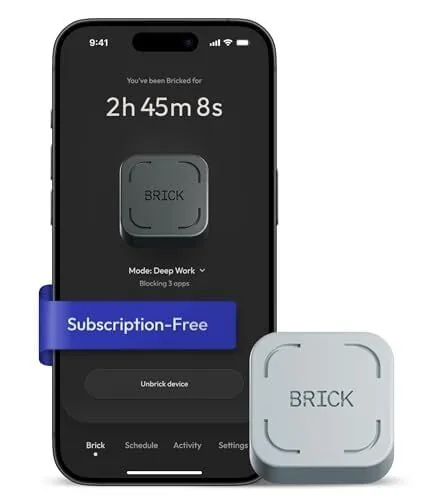
Brick is essentially a small, NFC-enabled fob, about the size of an AirPods case, that pairs with a simple app. The setup is straightforward: you open the app, select the apps or websites you want to block (or conversely, choose only the ones you want to access), give your session a name like 'Work Focus' or 'Sanity Saver,' and then tap your phone to the Brick to activate the blockade.
That's it. To disable the block and regain access to everything, you have to physically retrieve the Brick and tap your phone to it again. The device thoughtfully includes five 'emergency unbricks' accessible through the app, which I appreciate having, though thankfully, I haven't needed to use them yet. It's a simple yet powerful mechanism that forces a deliberate action.
Why This Physical Approach Actually Works
Here's the fundamental flaw in most digital solutions: they ask you to rely on willpower precisely when you're at your weakest. By the time you're staring at the 'Ignore Limit' prompt, you've already succumbed to the initial urge to pick up your phone. You're already deep in the habit loop. This is a common pitfall, similar to trying to stick to a diet when the cake is sitting on your kitchen counter.
Brick fundamentally changes the physicality of the problem. Instead of relying on in-the-moment self-control, it compels you to make a commitment before the urge strikes. It enforces that intention through physical separation, not sheer force of will. This aligns perfectly with behavioral science, which consistently shows that designing your environment beats relying on willpower almost every time (Behavioral Economics, 2022). I just needed a $59 piece of hardware to finally internalize that lesson.
I'll admit, the irony isn't lost on me. I invested a significant amount of money in a sophisticated smartphone, only to spend more money to deliberately limit my use of it. It's a testament to how deeply ingrained screen time habits can become. Yet, the cost of my attention and time feels far more valuable than the price of the Brick. It's a one-time purchase, with no subscriptions or hidden fees, and it has already proven its worth by helping me reclaim focus. It's frustrating it took me this long to find a solution that actually works, but the results are undeniable.
This physical barrier finally helped me break free from the endless scroll. It's not about deprivation; it's about intentionality. Think of it like needing a designated spot for your keys to avoid frantic searches, or putting your running shoes by the door to make that morning jog less of an option and more of a certainty. These small environmental changes, reinforced by a physical object, create the necessary friction to support better habits. For me, this physical barrier finally provided the consistent structure I needed.