Navigating the daily New York Times Connections puzzle can be a delightful mental workout. For Wednesday, April 22, 2026, puzzle #1,046, you might find yourself pondering the connections between seemingly disparate words. If you're seeking today's NYT Connections hints and the ultimate answer, you've come to the right place. We'll break down the categories, offer strategic tips, and reveal how each group of words fits together, ensuring you can conquer this word puzzle.
The Daily Challenge: What is Connections?
The New York Times Connections game presents a grid of 16 words, and your mission is to find four groups of four words that share a common theme. It's a test of vocabulary, lateral thinking, and pattern recognition. The categories range from straightforward groupings of nouns to more abstract concepts involving wordplay or homophones. Successfully identifying these groups is key to mastering today's NYT Connections hints.
Today's NYT Connections Hints: April 22, 2026
Before we dive into the solutions, let's explore some spoiler-free hints to guide your thinking for today's NYT Connections puzzle.
Category Types and Clues
Understanding the nature of each category can be a significant advantage. Here's a breakdown of the types of groupings you'll encounter:
- Yellow Category: Typically the most straightforward, often involving related nouns. For this puzzle, think about items found in a specific artistic studio.
- Green Category: This group often comprises similar verbs or actions. Consider what a boxer might do in the ring.
- Blue Category: This category frequently involves wordplay or nouns that can have multiple meanings depending on pronunciation. Think about how changing the sound can alter the meaning.
- Purple Category: Often the most challenging, this group might require you to complete a hyphenated phrase or a common two-part expression.
Specific Grouping Hints
Let's get a little more granular with hints for the themes themselves:
- Yellow: These are tools or materials essential for a particular craft.
- Green: Words associated with delivering a forceful blow.
- Blue: Nouns that can be pronounced differently, sometimes changing their meaning or origin, especially when used as proper nouns.
- Purple: These words can all follow the same common prefix to form a well-known phrase or term.
Remember, the goal of today's NYT Connections hints is to help you discover the connections yourself, but don't hesitate to use these clues as needed.
Navigating Tricky Words and Meanings
Some words in the Connections grid are designed to be tricky, playing on multiple meanings or common phrases. For example, GAME can complete a phrase describing a casual sporting event, like "pickup game." Similarly, READING might refer to the act of consuming a book, but it also names a town in Pennsylvania, often pronounced differently. The word SOCK, while commonly a noun, also functions as a verb meaning to strike forcefully. Understanding these dual meanings is crucial for solving today's NYT Connections.
The Solutions for April 22, 2026
Ready to see how it all comes together? Here are the revealed categories and their corresponding words for puzzle #1,046.
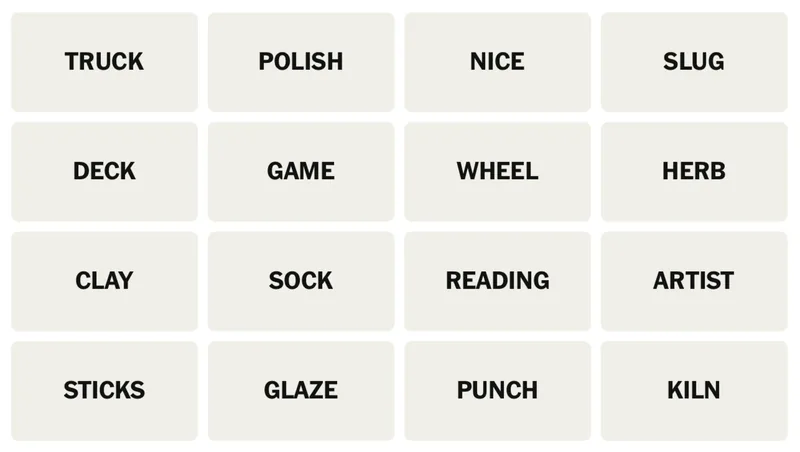
Yellow Category: POTTERY EQUIPMENT
This straightforward group consists of items essential for ceramic art:
- CLAY
- GLAZE
- KILN
- WHEEL
These words are all directly related to the process of making pottery (Pottery Equipment, as per the New York Times). A kiln is a type of oven used to fire clay, glaze is a coating applied to ceramics, and a potter's wheel is used for shaping clay.
Green Category: WALLOP
This group contains synonyms for hitting or striking:
- DECK
- PUNCH
- SLUG
- SOCK
These terms all describe a forceful blow. For instance, to "deck" someone is to knock them down, "punch" and "slug" are direct actions of hitting, and "sock" can also mean to hit hard. This aligns with the theme of "Wallop" (as per the New York Times).
Blue Category: WORDS PRONOUNCED DIFFERENT WAYS AS PROPER NOUNS
This category plays on words that have multiple pronunciations, often changing their meaning or usage, especially when capitalized:
- HERB
- NICE
- POLISH
- READING
For example, "herb" can be pronounced with or without the 'h' sound, and "Nice" is both an adjective and a city in France. "Polish" refers to something from Poland or the act of making something shiny. "Reading" is a common verb but also a place name. These words demonstrate how pronunciation and context are key (as per the New York Times).
Purple Category: PICK-UP ___
The most challenging category requires completing a common phrase with the word "pick-up":
- ARTIST
- GAME
- STICKS
- TRUCK
These words form phrases like "pick-up artist" (a term for someone employing seduction tactics), "pick-up game" (an informal sporting match), "pick-up sticks" (a children's game), and "pick-up truck" (a type of vehicle). This requires recognizing the common prefix that unites them (as per the New York Times).
Strategies for Solving Connections
When tackling today's NYT Connections hints and the puzzle itself, keep these strategies in mind:
Look for Overlapping Meanings: Words can often fit into multiple potential categories. Don't commit to a group until you're certain all four words exclusively belong together. For instance, "game" could relate to sports but also to a "pick-up game."
Identify Tricky Words: Pay attention to words that seem out of place or have multiple meanings. These are often the keys to the more complex categories. For example, recognizing "sock" as a verb is essential for the "wallop" category.
Utilize the Hints Strategically: If you're stuck, use the spoiler-free hints provided. They are designed to nudge you in the right direction without giving away the entire solution. Even understanding the *type* of category can be a huge help.
Consider Wordplay: The blue and purple categories often rely on puns, homophones, or phrases. If a group of nouns doesn't seem to fit, consider how the words might be used differently in speech or writing.
Don't Be Afraid to Guess (Carefully): While four mistakes end the game, making a calculated guess based on your strongest suspicions can sometimes reveal a category and help you narrow down the remaining words. This is a common tactic for players seeking today's NYT Connections hints.
By applying these strategies and understanding the nuances of wordplay, you can improve your performance on the NYT Connections puzzle daily. Check back tomorrow for more hints and solutions.