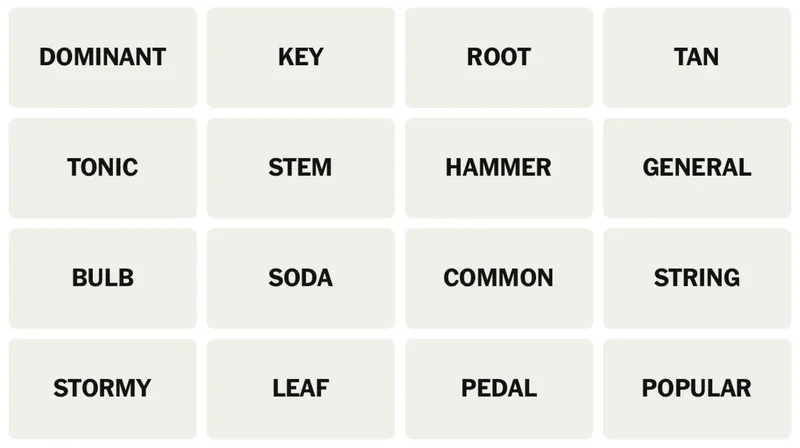
It’s Friday morning, and the familiar 4x4 grid of words stares back at you. You’ve got your coffee, your quiet moment, and the anticipation of cracking the latest New York Times Connections puzzle. But today, the words seem particularly elusive. You scan the 16 tiles, searching for those hidden threads that bind them together. If you’re looking for today’s NYT Connections hints and the eventual answer for Friday, April 17, 2026, you’ve come to the right place. Let’s unravel this puzzle, one category at a time.
Decoding Today's Connections
The beauty of the Connections game lies in its deceptive simplicity. What appears to be a straightforward word association exercise often hides layers of nuance and wordplay. Today’s puzzle, number #1,041, is no exception. Before we dive into the solutions, let’s explore the types of categories you’ll encounter and some initial, spoiler-free guidance.
Category Types and Initial Clues
Understanding the *nature* of each category is your first step. Think of it as knowing the rules of the game before you start playing. For today’s puzzle, the categories fall into these general types:
- Yellow Category: These often represent foundational elements, like parts of a larger whole.
- Green Category: This group typically consists of adjectives that describe a similar quality, often related to prevalence or dominance.
- Blue Category: Similar to the yellow, this grouping also focuses on parts of a whole, but perhaps a more specific or technical one.
- Purple Category: This is where wordplay often shines. It’s a collection of words that share an association, often as the second part of a common phrase or name.
As you look at the board, consider which words might fit these descriptions. For instance, do any words suggest growth or fundamental components? Are there adjectives that seem to echo each other? This initial sorting is key to making progress with today’s NYT Connections hints.
Unveiling the Themes
Now, let’s add a bit more context to those category types. These hints will guide you closer to the groupings without giving away the specific words just yet. Think of these as nudges in the right direction.
Hints for Today's Groups
- Yellow Category: Imagine things that expand and flourish. These are often found underground or on the surface, thriving with the right conditions. They literally grow bigger with water and sunlight.
- Green Category: These aren't niche descriptors. They speak to something widespread, influential, or widely accepted. Think of terms that signify being the most common or impactful – they’re decidedly not niche descriptors.
- Blue Category: This group relates to the mechanics and elements of creating music or sound. If you’re a musician, you’ll likely be familiar with these essential components. They are indeed parts of a piano, or at least instruments that share similar concepts.
- Purple Category: Picture a bustling bar or a casual get-together. What are common pairings or follow-ups to drink orders? These are the words a bartender is likely to hear a lot, often completing a well-known beverage name.
As you digest these hints, you might start seeing connections click into place. The interplay between the category type and the descriptive hint is where the magic of today's NYT Connections hints truly happens.
The Moment of Truth: The Answers
Alright, the moment you’ve been waiting for. We’re about to reveal the four categories and the words that belong in each. Remember, the puzzle is designed to be challenging, and sometimes a word can seem to fit multiple groups. That’s the fun of it!
Yellow Category: VEGETABLE PARTS
This group often starts as the most accessible. These are the fundamental components of many plants we eat. Think of the foundational elements that make up a vegetable:
BULB, LEAF, ROOT, STEM
Example: Just as a root anchors a plant and a stem provides structure, a leaf is crucial for photosynthesis, and a bulb stores energy for future growth. These are all distinct, vital parts of a plant.
Green Category: PREVAILING
This category deals with words that describe something widespread or influential. They suggest a state of being the most common or significant:
COMMON, DOMINANT, GENERAL, POPULAR
Example: A general election is one that's widely anticipated, while a popular trend sweeps through society. Something dominant holds sway, and a common occurrence is seen frequently.
Blue Category: PARTS OF A PIANO
This grouping dives into the mechanics of a musical instrument. These are the physical components that produce sound:
HAMMER, KEY, PEDAL, STRING
Example: When you press a key, a hammer strikes a string (in a grand piano), and the sustain pedal affects the resonance. Each is integral to the instrument's function.
Purple Category: SECOND HALVES OF DRINK NAMES
This is often the trickiest category, relying on common phrases and drink concoctions. These words complete well-known beverage names:
SODA, STORMY, TAN, TONIC
Example: You might order a vodka soda, a dark and stormy, a black and tan, or a gin and tonic. These words are the iconic second halves of popular drink orders.
How the Puzzle Was Solved
The strategy often involves identifying potential groupings and testing them. For example, recognizing STEM, BULB, LEAF, and ROOT as parts of a plant is a strong start for the yellow category. Similarly, words like TONIC and SODA might initially suggest beverages, but then realizing they fit perfectly with STORMY and TAN as second words in cocktail names unlocks the purple group.
The musical terms HAMMER, KEY, PEDAL, and STRING clearly point to the blue category. This leaves DOMINANT, GENERAL, COMMON, and POPULAR, which are all descriptors for widespread or influential concepts, forming the green category.
This systematic approach, moving from potential connections to confirmed groupings, is the essence of tackling today's NYT Connections hints and ultimately solving the puzzle.
Tips for Conquering Connections
The New York Times Connections game thrives on making you think outside the box. Here are a few strategies to keep in mind:
- Look for Overlap: Sometimes, a word might seem to fit into multiple categories. This is intentional. Don’t submit a group until you are confident all four words *exclusively* belong together. For instance, a word might seem like a type of food but is actually part of a group of artists.
- Identify the Odd Ones Out: If you’re struggling, focus on words that seem completely disconnected from any obvious theme. This can often be the key to unlocking a less apparent category. For example, if a word like “CLOSE” appears, consider if it relates to the painter, not just the action.
- Embrace the Hints: That’s why we’re here! Use the spoiler-free category types and thematic hints to guide your thinking. Sometimes, a small clue is all you need to see the pattern.
- Don't Fear Mistakes: You have four mistakes allowed. Use them to test hypotheses. If a group is wrong, the game eliminates those words from potential future groupings, which can be helpful.
- Consider Different Meanings: Words can have multiple meanings. A word like “GENERAL” could refer to a military rank, a broad statement, or a common consensus. Think about how these different meanings might apply to potential categories.
The goal is to find four distinct groups of four words. With practice, and perhaps a few daily hints, you’ll start to recognize the patterns and wordplay that make Connections so engaging. Keep playing, keep guessing, and enjoy the mental workout!
(Source: New York Times Games, 2026)