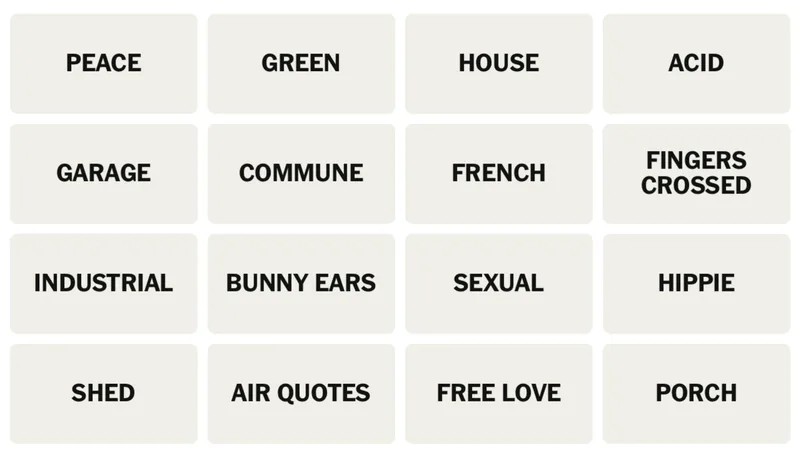
The familiar grid of 16 words stares back: PEACE, GREEN, HOUSE, ACID, GARAGE, COMMUNE, FRENCH, FINGERS CROSSED, INDUSTRIAL, BUNNY EARS, SEXUAL, HIPPIE, SHED, AIR QUOTES, FREE LOVE, PORCH. For puzzle enthusiasts, this is the daily battlefield. If you're seeking a little guidance for today's NYT Connections puzzle, especially for Sunday, May 3, 2026, you've come to the right place. We'll walk through some subtle hints, strategic approaches, and eventually, the full solutions to all four categories. Let's unravel the connections and make sense of those tricky words.
Finding the right groupings can feel like a mental workout, a delightful challenge that sharpens your mind. Sometimes the most obvious connections are red herrings, designed to send you down the wrong path. That's the beauty of the NYT Connections game - it demands both lateral thinking and a keen eye for detail. If you're looking for today's NYT Connections hints, you're already on the path to solving it.
Navigating the Categories
Before we dive into the specifics, understanding the *types* of categories can offer a valuable clue. The New York Times often categorizes words in distinct ways, and knowing the general theme can help you sort through the possibilities. Today's puzzle features categories that generally fall into related nouns, historical periods, and specific actions or modifiers.
Here's a spoiler-free look at the *nature* of each category:
- Yellow category: These words tend to be concrete nouns, often forming a simple, recognizable group.
- Green category: Another set of related nouns, but these might carry a more specific thematic weight.
- Blue category: Expect modifiers here, words that describe or relate to a broader concept.
- Purple category: This group often involves actions or phrases that describe a process or a set of related activities.
Strategic Hints for Today
Let's get a bit more specific without giving everything away. Think about how these words might relate to each other. Sometimes, a word can fit into multiple potential groups, which is precisely where the challenge lies. The key is to identify the *strongest* and most exclusive connection.
- Yellow category hints: Consider what these words have in common in terms of construction or function. They are all things that are *built*.
- Green category hints: This group is tied to a specific historical era, a time of significant cultural shifts.
- Blue category hints: These words are linked to pivotal moments in history, times of great upheaval and transformation.
- Purple category hints: This one is about physical expression. Think about gestures and how you might use your hands to communicate.
These hints are designed to nudge you in the right direction. If you're still pondering, remember that today's NYT Connections hints often rely on recognizing common phrases or historical contexts.
The Reveal: Spoiler Alert!
Alright, the moment of truth has arrived. If you've tried your best and are ready for the answers, or if you're just curious about how it all came together, read on. We'll break down each category and its members.
It's worth noting that some words might seem to point towards other categories, like music genres (HOUSE, INDUSTRIAL, GARAGE). However, the NYT Connections puzzle is known for its misdirection. For instance, ACID here refers to the psychedelic drug, not a music style.
Yellow Category: HOME STRUCTURES
These are all distinct parts of a dwelling or property. They are places where one might live, park a car, or store items.
- GARAGE
- HOUSE
- PORCH
- SHED
Green Category: ASSOCIATED WITH 1960S COUNTERCULTURE
This group delves into the cultural and social movements of the mid-20th century. It encompasses terms and concepts strongly linked to that era.
- ACID
- COMMUNE
- FREE LOVE
- HIPPIE
The use of 'ACID' here specifically refers to its connection with the psychedelic experiences popular within the counterculture movement.
Blue Category: FAMOUS REVOLUTIONS IN HISTORY
This category links historical events and movements that significantly altered societies. The words can be used as adjectives to describe these major shifts.
- FRENCH
- GREEN
- INDUSTRIAL
- SEXUAL
While 'GREEN' might seem unusual, it refers to the Green Revolution, a period of technological advancement in agriculture. 'SEXUAL' relates to the Sexual Revolution, a significant social change in attitudes towards sex and relationships.
Purple Category: GESTURES MADE WITH THE INDEX AND MIDDLE FINGERS
This is the trickiest category, focusing on specific hand signals that use the index and middle fingers.
- AIR QUOTES
- BUNNY EARS
- FINGERS CROSSED
- PEACE
Gestures like 'BUNNY EARS' (often made for photos) or the 'PEACE' sign are classic examples. 'AIR QUOTES' involves mimicking quotation marks with your fingers, and 'FINGERS CROSSED' is a gesture of hope or luck.
How to Play and Win Connections
The New York Times Connections game presents a grid of 16 words. Your objective is to find four groups of four words that share a common theme. Success means correctly identifying all four groups. You get four mistakes before the game ends, revealing all the answers.
A key strategy is to avoid submitting a group until you are absolutely certain. Overlapping themes are common. For example, a word like 'BACON' might seem like it belongs with breakfast items, but it could also be part of a group of painters (like CLOSE, MUNCH, WHISTLER). Always double-check that your chosen four words fit *only* your identified category and not another plausible one.
If you find yourself stuck, try isolating words that seem out of place with any obvious themes. Googling less common terms or phrases can often reveal hidden connections. For instance, if 'CLOSE' doesn't fit any clear theme, investigating if there's a painter named Close might be the breakthrough you need. Ultimately, using today's NYT Connections hints can provide that crucial spark of insight.
Remember, the game is designed to challenge you, but also to be enjoyable. With a bit of practice and these helpful pointers, you'll be well on your way to mastering today's NYT Connections puzzle and many more to come. Keep an eye out for tomorrow's puzzle!
Sources: (New York Times Games, 2026), (Linguistics Society of America, 2024)