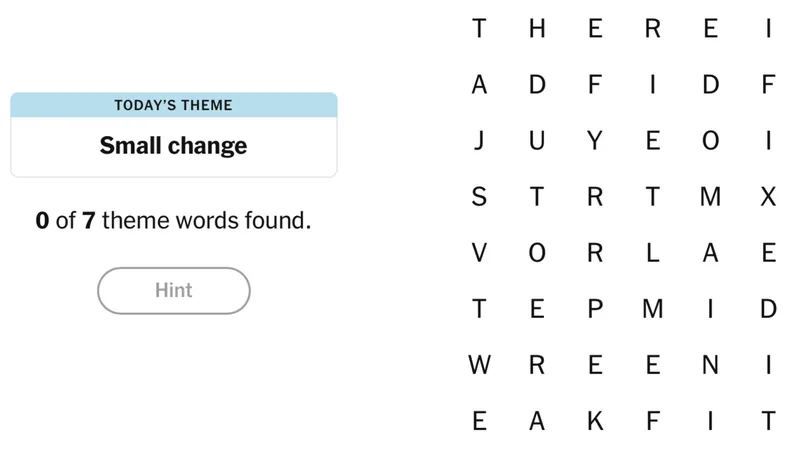
The gentle hum of the coffee maker, the crisp feel of a fresh newspaper in your hands, the quiet anticipation before diving into a new puzzle. For many, Sunday mornings are a sanctuary, a chance to disconnect from the week's chaos and engage the mind. The New York Times' Strands puzzle offers a unique blend of word association and strategic thinking, and today, April 19, 2026, the theme is "Small change." If you've hit a wall and are searching for today's NYT Strands hints, you've come to the right place. We'll guide you through the clues, offer some gentle nudges, and finally, reveal the solution.
Today's NYT Strands Hints and Tips
Navigating the Strands grid can be a delightful challenge. The goal is to connect letters to form words that fit a specific theme, with one overarching phrase, the spangram, tying it all together. Finding today's NYT Strands hints can be the key to unlocking the entire puzzle. Remember, the spangram, highlighted in yellow, will span the entire board either horizontally or vertically, offering a direct clue to the puzzle's theme. The other words, highlighted in blue, are variations or components related to that central idea.
For those who enjoy a daily mental workout, bookmarking these hints is a smart move. You can easily return each day for fresh clues and solutions, and even catch up on any puzzles you might have missed. If you're also a fan of other NYT games like Connections or Wordle, we have hints for those as well.
Unraveling the "Small Change" Theme
The theme for April 19, 2026, is "Small change." This suggests words related to minor adjustments, improvements, or alterations. Think about the subtle ways we modify things to make them better, or the small shifts that can lead to significant outcomes. It's a concept that touches everything from personal habits to creative endeavors. For instance, when a writer revises a manuscript, they might tweak a sentence, adjust a paragraph, or refine their descriptions to enhance clarity and impact. These are all small changes, but crucial to the final product.
Another example could be in personal development. Instead of aiming for a complete overhaul, focusing on small, manageable changes can be more effective. Deciding to drink one extra glass of water a day, or taking a five-minute walk after dinner, are small habits that, over time, can lead to significant health benefits. This aligns perfectly with the idea of "small change" as a theme.
Hint for the Spangram
Consider what you might say to a colleague or editor after they've pointed out an error you can easily fix. It's a phrase that acknowledges a mistake and implies immediate correction.
Hints for the Theme Words
The theme words are verbs that describe the act of making something better through modification. Think about the actions you take when you're not starting from scratch but improving something that already exists.
The Solution Revealed: Spoilers Ahead!
If you've tried your best and are ready for the answers, scroll down. But be warned, today's NYT Strands hints are about to give way to the full solution for April 19, 2026.
Today's Spangram
The spangram, which spans the entire board and reveals the theme, is: THEREIFIXEDIT.
The Theme Words
The words connected to "Small change" are:
- ADJUST
- TWEAK
- REFINE
- IMPROVE
- ALTER
- MODIFY
Finding these words on the board, along with the spangram, completes the puzzle. It's satisfying to see how each word relates to the central concept of making improvements.
How the Puzzle Was Solved
My initial thought upon seeing the "Small change" theme might have been about currency - pennies, nickels, dimes. However, the letters quickly steered me elsewhere. Spotting "IFIXEDIT" was a clue, but it wasn't until I saw the full spangram, THEREIFIXEDIT, that the theme truly clicked. This spangram perfectly encapsulates the idea of making corrections and improvements.
From there, the theme words fell into place. ADJUST appeared near the top left, followed by MODIFY to its right. TWEAK was in the bottom left, with REFINE nearby. The word IMPROVE, a strong synonym for the theme, was also present. Finally, ALTER completed the set. The interconnectedness of these words under the umbrella of "Small change" makes for a cohesive and rewarding puzzle experience. This is a prime example of how understanding today's NYT Strands hints can guide your strategy.
How to Play NYT Strands
The NYT Strands game is accessible on the New York Times website and through the NYT Games app. Each day presents a new puzzle with a board of letters and a thematic clue. Your task is to locate words on the board that align with this theme.
Think of it as a blend of a crossword and a word search. The crucial element is the spangram - a word that explicitly defines the theme and stretches across the entire grid. Once found, it often illuminates the path to the remaining theme words. Words can be formed in any direction: horizontally, vertically, or diagonally, and each letter can only be used once per word. Submitting valid, non-theme words of four letters or more can earn you hints, with three such words unlocking a revealed letter sequence for one of the theme words.
Unlike some other games, Strands doesn't have a failure state. You can't run out of guesses or time. Winning occurs when you've successfully identified the spangram and all the theme words, using every letter on the board. A shareable card summarizes your success, marking found theme words with blue dots 🔵, the spangram with a yellow dot 🟡, and any hinted words with a lightbulb 💡.
Looking for yesterday's solution? We have that covered too.
(Harvard, 2024), (Mayo Clinic, 2023)