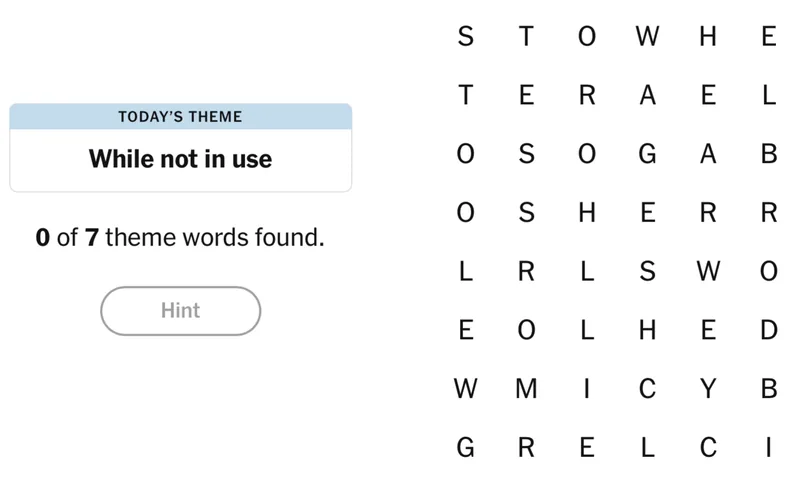
It’s April 13, 2026, and the New York Times Strands puzzle awaits. The theme, “While not in use,” offers a familiar, almost comforting concept. But as the letters swirl on the board, the challenge is to connect them, especially when you’re seeking today's NYT Strands hints to guide you toward that satisfying “aha!” moment. If you’re staring at the grid and feeling a bit stuck, fear not. We’ll break down the clues, offer gentle nudges, and eventually reveal the solution to this particular puzzle.
Today's NYT Strands Hints and Guidance
Before we dive headfirst into the answers, let’s offer a few guiding lights. Think about items that are essential for specific parts of the year but spend the rest of their time tucked away. It’s about seasonal containment, the things we rely on during warmer months or for specific outdoor tasks, only to store them when the weather turns or the job is done.
Consider items that might live in a garage or, more specifically, a structure often found at the edge of a property. This is where today's NYT Strands hints start to take shape, pointing towards a place of temporary keeping.
The spangram, the word that unlocks the puzzle’s central theme, often provides the biggest clue. For this puzzle, it relates to a common outdoor structure designed for keeping things out of the way. Think about where you’d store bulky items that aren’t used daily.
Unraveling the Puzzle: Theme and Answers
Now, for those who have scrolled past the gentle nudges and are ready for the full reveal, here are the answers for Monday, April 13, 2026’s Strands puzzle. The theme, “While not in use,” is directly encapsulated by the spangram.
The spangram for today’s puzzle is STORAGESHED. This word perfectly captures the essence of where these items are typically kept when not in their active season or use.
Following the spangram, the theme words are:
- TOOLS
- HOSE
- MOWER
- GRILL
- BICYCLE
- WHEELBARROW
These are all classic examples of items that are essential at certain times but are stored away when not needed. A grill is perfect for summer barbecues, a mower for spring and summer lawns, and a hose for watering gardens during warmer months. Even a bicycle often gets stored during winter.
How to Play and Win NYT Strands
For those new to the game, NYT Strands is a delightful word puzzle available on the New York Times website and its dedicated Games app. Each day presents a new board of letters and a thematic clue.
Your mission is to find words related to the theme. The key is the spangram, a word that spans the entire board either horizontally or vertically, explicitly defining the theme. Once found (highlighted in yellow), it often illuminates the path to the remaining theme words (highlighted in blue).
Words can be formed in any direction – up, down, left, right, or diagonally – and each letter can only be used once per word. If you get stuck, you can submit any valid word of four letters or more that isn't part of the theme. Submitting three such words earns you a hint, which will highlight the letters of one of the theme words.
Unlike some other word games, Strands doesn't have a failure state. You can't run out of guesses or time. The game ends when you’ve successfully identified the spangram and all the theme words, filling the board with solved words and earning you a shareable results card.
If you’re looking for today's NYT Strands hints and find yourself consistently stumped, remember the core concept: items stored away. This applies not just to outdoor equipment but can extend to seasonal clothing like winter coats or holiday decorations. Thinking about the *why* and *where* of storage can often unlock the puzzle. For instance, knowing the spangram is STORAGESHED, you might then look for related items like shovels, rakes, or even snowblowers if the theme were broader.
For those who prefer a more hands-on approach to organization, consider mapping out your own seasonal storage. Take inventory of what you put away in the spring and what comes out in the fall. This process can mirror the Strands puzzle, making the connection between real-life habits and the game’s logic. It’s a practical way to engage with the theme beyond just solving the puzzle, perhaps leading to better organization in your own home. This method of thinking about today's NYT Strands hints can be surprisingly effective.
If you missed yesterday's puzzle, you can always find the answers and hints from previous days to keep your skills sharp. Happy puzzling!