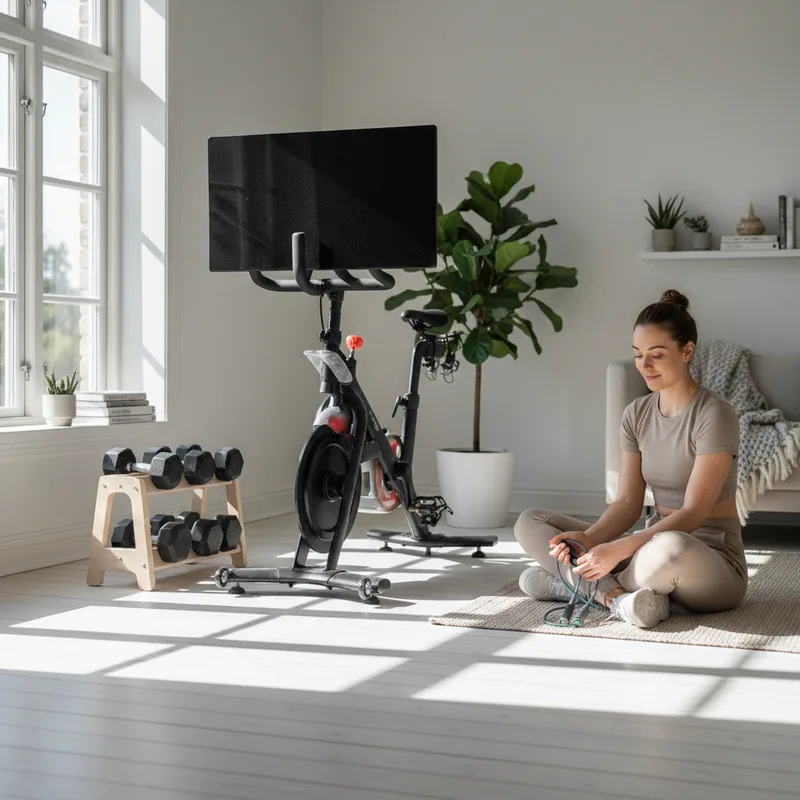
The promise is seductive: a personal trainer, a gym full of equipment, and a workout that adapts to your every rep, all condensed into a single screen on your wall. The future of fitness is here, and it's whispering your name. But after months of watching these sleek advertisements flood my social feeds, I've come to a firm conclusion: I won't be buying an AI home gym.
It isn't that the technology is flawed. In fact, the engineering is often brilliant. The issue lies in the fundamental equation of human behavior, cost, and the messy reality of staying consistent. The marketing promises a revolution, but for most of us, it might just be another expensive coat rack.
The Illusion of Revolution
Every fitness generation claims to be the last one you'll ever need. We saw it with Tae Bo in the 90s, Shake Weights in the 2000s, and the Peloton boom of the early 2020s. The pattern is predictable: a surge of hype, followed by a slow fade into the corners of our homes. The smart gym market, valued at $3.2 billion in 2024, is simply the latest iteration of this cycle.
According to a 2024 market analysis, the industry is projected to grow to $4 billion by 2030, but that growth masks a high churn rate. We treat fitness like a consumer electronic, expecting it to deliver results without the messy work of actually building a habit. But fitness is not software; it is a practice.
Consider the fate of two giants who bet on home convenience. Bowflex and American Home Fitness both filed for bankruptcy in 2024. Peloton, once the darling of the pandemic fitness boom, saw its revenue decline to $2.71 billion, a 2.8% drop, marking its fourth consecutive year of member attrition. When the hardware becomes obsolete or the company folds, your "revolutionary" gym turns into a very expensive paperweight.
The Math (Usually) Doesn't Work
Let's look at the numbers, specifically regarding one of the market leaders, Tonal. The hardware costs roughly $4,300, plus mandatory installation fees bringing the initial outlay to nearly $4,600. Then there is the subscription: approximately $60 a month to access the features you bought the machine for.
Over five years, the total cost approaches $8,200. Compare that to the average gym membership, which the Bureau of Labor Statistics reports is roughly $58 a month, or $3,480 over the same period. Even a premium Equinox membership, at around $200 a month, costs less than half the five-year total of a smart gym system.
To break even, you must use the device consistently for nearly eight years. That is a massive assumption regarding your attention span and the hardware's longevity. As fitness equipment tester Jose Guevara notes, these systems appeal to those who want a "done-for-you" solution, but the danger is that if the software support ends, "you're stuck with a product that doesn't function."
The Hidden Cost of Convenience
Beyond the financial ledger, there is a psychological cost to removing friction. We are sold on the idea of convenience, but convenience often undermines the very discipline we are trying to build. A 2023 study on habit formation by the American Psychological Association suggests that environmental cues and rituals are critical for long-term adherence. Leaving the house to go to a gym creates a distinct mental shift--a ritual of commitment.
When your gym is in your living room, the boundary between rest and work blurs. It becomes too easy to skip a session because you're tired, or to stare at the pile of laundry next to the machine. I spoke to a former owner of The Mirror, a connected fitness device, who sold it after six months. "The novelty wore off," she said. "I realized I was just standing in my messy bedroom looking at myself, when I could have been outside or at a class with other people."
There is also the loss of community. The silent camaraderie of a weight room, the casual advice from a spotter, or the energy of a group class cannot be replicated by an algorithm. As the Mayo Clinic has noted, social connection is a vital component of mental health, and the gym is one of the few places where incidental interaction happens regularly. I won't be trading that for a solitary screen.
What Traditional Gyms Still Offer
Let's not forget the sheer versatility of iron. A barbell and a set of weights are effectively immortal. They require no updates, no subscriptions, and no internet connection. A 2024 report from Harvard Health highlighted that resistance training with free weights engages stabilizer muscles differently than fixed-path machines, leading to better functional strength.
AI gyms rely on digital resistance or guided movements. While safe, they often lock you into a specific range of motion. Compare this to the freedom of a squat rack or the variability of a cable machine in a commercial gym. The argument that AI provides "better form correction" is valid, but it assumes that watching a screen is superior to a human trainer physically adjusting your posture or simply watching you lift.
Furthermore, the durability of commercial gym equipment is legendary. It is built to withstand thousands of users a day. A home smart gym is a delicate piece of consumer electronics. The sensors, cameras, and screens are points of failure that a simple dumbbell simply does not have.
The Human Element
The ultimate reason I won't be investing in a wall-mounted smart gym is that I don't believe technology can solve a motivation problem. We often look for hacks--better supplements, smarter algorithms, more engaging screens--to bypass the hard truth: working out is difficult, and consistency is harder.
AI can track your reps, but it cannot force you to show up when you are exhausted, stressed, or uninspired. That requires a different kind of technology: the internal machinery of discipline and habit. By outsourcing the "thinking" of the workout to an app, we risk losing the autonomy of learning how to train ourselves.
There is a profound satisfaction in understanding the mechanics of your own body, in tracking your progress on a notepad, and in pushing through a set simply because you decided to. It is raw, unoptimized, and deeply human.
The Final Verdict
AI home gyms are marvels of engineering. For a specific demographic--busy executives with disposable income, agoraphobic individuals, or tech enthusiasts--they may genuinely be the right choice. But for the average person seeking to build a sustainable lifestyle, they represent a high-risk, high-cost gamble on your own future interest.
The fitness industry thrives on the promise of a shortcut. But the path to health has remained unchanged for centuries: move your body, lift heavy things, and do it consistently. If you have the space and the money, and you know you will use it for a decade, then a smart gym might be a fine purchase.
But until then, I won't be trading my gym membership for a subscription model that costs as much as a car payment. I'll stick to the rusted iron and the community of sweat-soaked strangers. It's not high-tech, but it works.