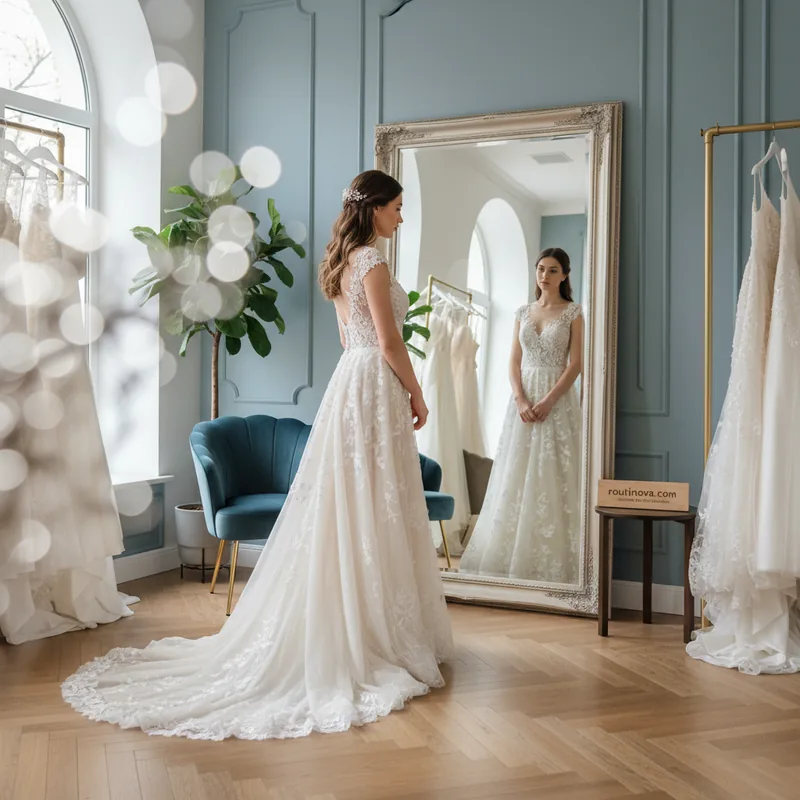
Have you ever stood before a mirror, dressed in something that felt *almost* right, yet not quite you? That moment, often experienced when trying on a wedding dress, holds a profound secret about authenticity. It's not about finding perfection or fitting a mold; it's about recognizing yourself. This powerful wedding dress metaphor reveals why true belonging comes not from changing who you are, but from embracing it.
The Moment of Recognition
Working part-time as a bridal stylist, I’ve witnessed countless moments of transition. Beyond the beauty of the gowns, what strikes me most is the quiet shift that happens in the dressing room. It’s not always about the most elaborate or conventionally stunning dress. Sometimes, a bride steps into a gown, and a stillness descends. Her posture softens. She doesn't speak immediately; she simply looks. It feels like a homecoming—a silent acknowledgment: “There you are.”
I've come to realize how much of my own life, and perhaps yours too, has been shaped by chasing that feeling. It's not just about finding the perfect dress; it's about finding the version of ourselves that feels undeniably true, especially in professional settings. We often carry a quiet question: “Will I be chosen?” Chosen for the promotion, the project, the leadership role. This underlying anxiety can subtly alter us as we observe what’s rewarded and who thrives, leading us to adjust our own traits.
We might soften our directness, amplify our agreeableness, or smooth our edges, believing this makes us more palatable, more likely to be selected. It can look like adaptability, and sometimes it is. Learning and growth are vital. But there's a crucial difference between refining yourself and abandoning your core self. I learned this distinction vividly while surrounded by wedding dresses.
Finding the Dress That Feels Like You
My mantra to brides is simple: “This room is full of beautiful gowns. Many will look incredible on you. The goal isn’t just finding a beautiful dress; it’s finding the one that feels like you.” Time and again, I hear, “I love it, it fits perfectly, but… it’s just not mine.” It’s a paradox: objectively good, yet misaligned. This realization has been a catalyst for introspection.
There have been periods in my career where I received praise—deemed capable, intelligent, with high potential. Yet, I often felt overlooked and undervalued. These moments would trigger a spiral of self-doubt: What am I missing? How do I need to change? Rejection rarely feels neutral; it can easily land as a verdict on our inherent worth, especially if we already harbor doubts about being “too much” or “not enough.”
Think about it: are you sometimes told you’re too direct, too sensitive, too ambitious, too quiet, too intense, or too idealistic? Or perhaps not strategic, polished, or assertive enough? When we internalize these critiques, we begin to edit ourselves. Imagine if a wedding dress, upon hearing it was “too detailed,” ripped out its lace. Or flattened its silhouette because it was “too dramatic.” It sounds absurd, yet many of us do precisely this in our professional lives.
We quiet our ideas, hold back challenging perspectives, shrink our ambitions to avoid intimidating others, or harden our softness to appear less naive. We preemptively edit ourselves to avoid perceived future rejection. Initially, this feels strategic. Over time, it becomes profoundly exhausting. Stepping away from your authentic nature creates a subtle disconnect, a sense that the success you achieve isn’t fully yours, leading to a lonely feeling of inauthenticity.
The Wedding Dress Metaphor: A Powerful Lesson
The wedding dresses offer a profound lesson: they do not question their design when deemed “not the one.” They don’t unravel in shame. They simply return to the rack, unchanged. Then, someone else enters—someone who has been searching for that exact neckline, that specific blend of structure and softness—and the recognition is instant. No convincing, no contorting, just resonance. This is the essence of the wedding dress metaphor: powerful in its simplicity.
What if confidence works the same way? What if it’s not about convincing every room of your worth, but about trusting that your unique way of thinking, leading, and creating has inherent value? This doesn't mean we stop growing or resist feedback. It means discerning between refinement and erasure, between expanding and abandoning ourselves. I’m still learning to catch myself when I start scanning rooms for cues on who to become, reminding myself that the goal is authenticity, not universal approval.
Being overlooked stings, and the desire to be chosen is deeply human. But reshaping ourselves to fit a perceived ideal costs far more than any rejection ever could. When we sand down our edges for broader acceptance, we gain temporary validation but lose our authenticity. And without authenticity, our potential for influential leadership diminishes significantly. Consider the example of a talented architect whose bold, unconventional designs are initially rejected by traditional firms; they might achieve more success and personal fulfillment by founding their own practice where their unique vision is valued.
The dresses don’t change; they exist as designed, understanding their unique value. What if we allowed ourselves that same steadiness? What if we stopped interpreting every “no” as inadequacy and saw it as redirection? Perhaps not being chosen in one room is protection for the space where you won't have to shrink. What if your sensitivity is discernment, your directness is clarity, and your depth is thoughtfulness? The very traits you've tried to tone down might be what make you the inspirational leader you are meant to be.
Confidence, I’m learning, is less about bravado and more about self-trust—the willingness to remain intact. The most radical shift is this: You don't need universal approval to be worthy. You don't need to edit yourself into something more palatable to be valuable. The most powerful act is to own your uniqueness and stop leading in ways that feel inauthentic and dampen your impact. As Brené Brown wisely said, “True belonging doesn’t require you to change who you are; it requires you to be who you are.” This is the core of the wedding dress metaphor: powerful and transformative.
Gentle Questions for Reflection
If you're questioning your worth or feeling the pressure to change, sit with these:
- What qualities have I softened or hidden because they felt “too much”?
- Which parts of myself feel most natural, and where do they feel most welcomed?
- Am I pursuing genuine growth, or am I subtly abandoning myself?
- Where might a recent rejection actually be a redirection?
- What would it look like to trust that my inherent design has purpose?
You don't need to become someone else to move forward. You may simply need to stand fully as you are, trusting that the rooms meant for you will recognize your reflection when they see it. This understanding is the true power of the wedding dress metaphor: powerful and liberating.
The wedding dress metaphor: powerful because it reminds us that our intrinsic value isn't dependent on external validation. Like the perfect gown, the right environment will recognize and celebrate who you truly are, without demanding you alter your design. It highlights that authenticity is not a weakness to be overcome, but the very source of our strength and influence.