Everyone’s heard the whispers: virtual reality is a bust. Another tech dream that crashed and burned, right? Billions lost, user bases that barely register, and promises of a sprawling metaverse that feel like a distant, awkward memory. But if you’ve ever felt a pang of disappointment watching the metaverse fizzle, you’re not alone—and you might be missing the real story. The truth is, is virtual reality really dead? The answer is a resounding no; it's simply evolving beyond the initial, overhyped vision.
The numbers certainly paint a grim picture. Meta's Reality Labs, the behemoth of the VR world, has hemorrhaged over $73 billion since its inception five years ago. This financial black hole has led Meta to divert resources, shifting focus towards smart glasses and AI. Even Apple, often seen as the market's next big player, managed to ship only 45,000 Vision Pro headsets in late 2025—a mere whisper compared to the 82.6 million iPhones sold in the same period (Bloomberg, 2026).
Mark Zuckerberg’s grand vision for Horizon Worlds, introduced in 2021 as a vast digital continent, now hosts a meager 200,000 active users. Compare that to the children’s game Roblox, which boasts over 380 million monthly active users, and the contrast is stark. This isn't for lack of quality hardware; by most accounts, both Meta's and Apple's headsets are excellent pieces of engineering. So, what’s going on?
The Metaverse Mirage and VR’s True Path
The initial sales pitch of a frictionless, legless, gravity-free vacuum of suburban-techno-capitalism might be gone—it turns out we didn’t want another world full of random people. But what’s quietly growing in its place is a bottom-up community, built by filmmakers, game developers, and everyday people, all creating a new way to belong. The question then becomes, is virtual reality really failing, or simply evolving into something far more sustainable and specialized?
This shift suggests that VR isn't destined to be a singular, all-encompassing metaverse, but rather a collection of powerful, niche tools. It’s a subtle but critical distinction, moving from a universal destination to a suite of personalized experiences. This is where the real innovation and growth are happening, away from the spotlight of corporate mega-projects.
Immersive Storytelling: A New Cinematic Language
“What we're all trying to do is build the Holodeck from Star Trek,” said Matt Celia, co-founder and creative director of Light Sail VR. His company has been producing VR films and video for a decade, with a catalog spanning concerts at Red Rocks to narrative VR series, and even an Emmy-winning immersion into Saturday Night Live's 50th Anniversary. “My belief in the medium is unshaken,” Celia told me. “I think this is the most authentic way to tell stories.”
Celia believes experiencing films in VR frees the viewer from the constant distractions of modern life. Your phone’s bright screen won't pull your attention, and your visible surroundings simply vanish. “When you make the conscious choice to put on a headset, to watch a piece of content and engage with it, it's actually transformative, almost meditative," Celia explained. It’s a level of focus traditional cinema struggles to achieve.
More than just a new way to show old movies, immersive film is a new medium being born, with filmmakers inventing a completely new language. Whether it’s a you-are-there, 360-degree view of Steve Martin’s SNL monologue, narrative VR series like Eli Roth's The Faceless Lady, or interactive documentary experiences like D-Day: The Camera Soldier, artists are using virtual reality to tell stories in ways previously unimaginable. Even the Sundance Film Festival now features a dedicated New Frontier program for immersive storytelling (Sundance Institute, 2023).
“We're all obsessed with this idea that we can live and breathe into a story,” Celia said. “That is what's driving us all to create these more and more immersive and impressive and impactful experiences.” This passion for deeper engagement suggests that is virtual reality really finding its stride in the creative arts?
Gaming in VR: The Evolution of Play
Visionary experiences are great, but most people buy VR headsets to play games. The news that Meta shuttered three of its AAA game development studios—Armature (Resident Evil 4 VR), Sanzaru (Asgard’s Wrath), and Twisted Pixel (Deadpool VR)—might suggest that VR gaming is on life support. Or, it could just be the growing pains of an industry figuring out what truly works in a new medium.
Virtual Reality game studio Resolution Games seems to have cracked the code. The company has grown consistently since 2015, selling millions of games despite a challenging environment. Their flagship title Demeo has earned critical raves and even forged a partnership with Wizards of the Coast for Demeo x Dungeons & Dragons: Battlemarked. This success demonstrates that focused, well-executed VR games can thrive.
“We are very conservative with our funds, and we're very resource efficient,” Tommy Palms, the CEO of Resolution, told me. “You have to be if you live in this space, where [there are] few hits and they don't typically make as much money as they would in other ecosystems.” This prudent approach is key in a nascent market, proving that sustainable growth is possible without chasing unrealistic blockbusters.
No game studio survives if the games aren’t good, and Resolution’s games are very good, often in ways that seem counter-intuitive to what we thought VR games would be. “A big grand virtual world, like Cyberpunk or Grand Theft Auto, but you’re inside it... now we know in reality, that's not a very comfortable experience, unfortunately,” Palms observed. The dream of simply porting existing game genres into VR often clashes with player comfort and engagement.
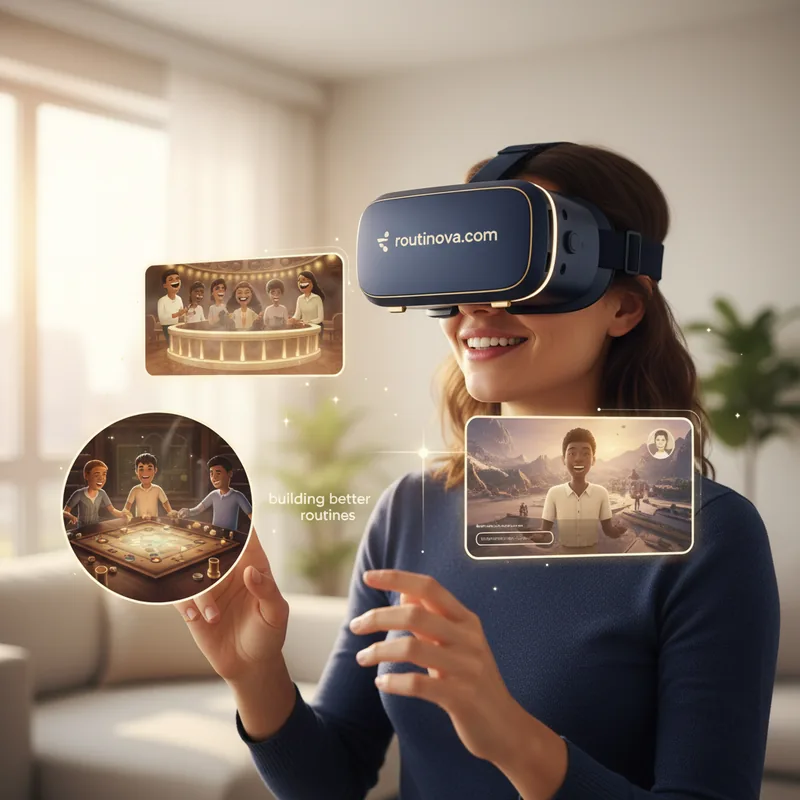
Instead of that sprawling immersive world, Demeo puts players at a game table in a virtual basement with their friends. You’re not in a dungeon; you’re a person playing a game about a dungeon. “It creates a much more social situation in general because it increases the chance for you to play with your friends,” Palms explained. “You're doing something together, solving a problem or focusing on something else, you're just with your friend.” This focus on shared, intimate experiences, rather than grand isolation, is a powerful lesson for VR game developers.
The Lonely Metaverse and the Power of Niche Communities
Speaking of friends, if Mark Zuckerberg’s original vision of the Metaverse was about anything, it was about bringing people together. “Feeling truly present with another person is the ultimate dream of social technology. That is why we are focused on building this,” Zuckerberg wrote in his Founder’s Letter in 2021. Central to that vision was Horizon Worlds, a digital ecosystem designed to draw a billion residents and hundreds of billions of dollars in digital commerce.
I recently checked in on Horizon Worlds, circa 2026, and it feels dead. But dead in a unique way. Tens of thousands of “worlds” have been created by both users and corporations—shiny, bright, and open to explore—but not many people seem interested. Randomly picking worlds is like walking around in an abandoned mall: stuff, but no people. If you're into “liminal spaces,” you will never run out. Still, like the headsets it's played on, Horizon Worlds is technically really good.
Take The Office World, an official recreation of Dunder Mifflin, right down to the desktop tchotchkes. You can walk into Michael Scott’s office, pull games up on his computer, sort mail for Schrute Bucks, or check out the warehouse downstairs. This world is filled with the kind of cleverly written fan-service details that should draw droves of The Office faithful to hang out and meet each other. But they don’t. During the half hour I spent there at 2:00 PM on a Tuesday, the population count never got above five people. It's lonely in there, like a water cooler with no co-workers around it.
I had a similar experience at Blumhouse Horrorverse, an atmospheric, shadowy forest clearing surrounded by spooky buildings. It’s filled with things to see and do for fans of Blumhouse properties like M3GAN, The Purge, and The Black Phone. You can play a game where you’re locked in a mansion with a player-controlled villain or search for hidden Easter eggs. But the woods were so quiet. The few people I encountered were either very young children—the “squeakers” that haunt every corner of Horizon Worlds—or first-timers who wandered around in silence before vanishing like ghosts.
Signs of Life in the Digital Ruins
I was about to call quits on my virtual safari, but I thought I'd check out one last world. A search for “over 18” (damn squeakers) brought up The Soapstone Comedy Club. I'm glad I visited. The spot is alive. There's a full schedule of upcoming stand-up shows, trivia, improv, and karaoke—and more importantly, there are people hanging out. Upon logging in, a friendly volunteer introduced herself, and before long I was chopping it up about life, online and off, with a bunch of new pals on the patio of a virtual comedy club.
“If you told me 10 years ago that I was going to be known as 'The Unemployed Alcoholic,' and I would own a pretend comedy club in a cartoon land, I wouldn't have believed you,” Aaron Sorrels, known as “TheUnemployedAlcoholic” online, told me. “And I sure wouldn't have believed I could sell my wife on the idea,” he added.
In recovery and unemployed, Sorrels watched that now-infamous Facebook Connect event in 2021 that launched the Metaverse, and rather than clowning on it because the avatars didn't have legs, Sorrel was inspired. “It sounds almost hokey,” Sorrels said, “but I heard about the Metaverse, specifically Horizon Worlds, and I was like, 'I got to get in there.'”
With no background in programming, Sorrels built Soapstone from the ground up, creating a career for himself, paid gigs for others, and more importantly, a place for people to belong, just like Zuckerberg envisioned. “I came in to build a comedy club, and what's ended up coming out of it is more than a comedy club. There's a community of people that have adopted The Soapstone as theirs,” Sorrels said. “It's not a corporate place, or someone else's place. This place belongs to them.”
“In the Soapstone, I can host shows, step on stage, or instantly connect with friends and family members who live thousands of miles away as if they were right here in the same room,” explained Soapstone Community Lead LollyDee. “It’s especially meaningful for people with anxiety, physical limitations, or those who live far from social hubs. For many of them, Soapstone Comedy isn’t just entertainment, it’s their social space and sense of community.” This vibrant, user-driven community is a stark contrast to the corporate-built ghost towns, proving that connection still thrives when it's organic.
The Real Future: Niche, Not Nirvana
So, is virtual reality really dead? Sorrels definitely doesn't think so. “There are dynamic and powerful things happening every day, every moment of every day in VR,” Sorrels said. “I think back on what I heard Mark Zuckerberg say four years ago... he said it was a 10-year process. We're not halfway through it yet.”
The loud, anarchic vibe of VRChat might be too much for some, but about 40,000 (mostly young) people use it to connect every day. Big Screen has a healthy user base of VR cinephiles checking out 2D and 3D movies. People are virtually beating each other up 24/7 in Thrill of the Fight 2. Even educational platforms like EngageVR are hosting virtual classrooms and corporate training sessions, proving the utility beyond entertainment (The New York Times, 2024). I could go on, but you get the picture: VR might not have broken big, but specialized communities are thriving in all corners of the metaverse.
In 2026, the “Next Chapter of the Internet” version of the Metaverse, where we would all live, work, and buy digital sneakers, is something of a ghost town. But a more sustainable, organic space is taking root. VR isn't a second world; it’s a group of specialized tools for specific passions—a private IMAX theater for the cinephile, a global open-mic night for would-be comedians, a tactical tabletop for D&D nerds. VR isn't everything to everyone, but it's something to someone, and there's nothing more alive than that. Ultimately, is virtual reality really on its way out? Not at all. It's just finding its true purpose.