You've probably heard the buzz: AI chatbots are no longer just for text. Claude, a leading AI assistant, has been expanding its capabilities with app integrations, promising to streamline your digital life. But when i tried Claude's new app connectors, the reality felt a little more complicated than the marketing suggests. While the potential is there, the execution leaves much to be desired, often feeling like a step sideways rather than a leap forward in productivity.
Unpacking Claude's Lifestyle Integrations
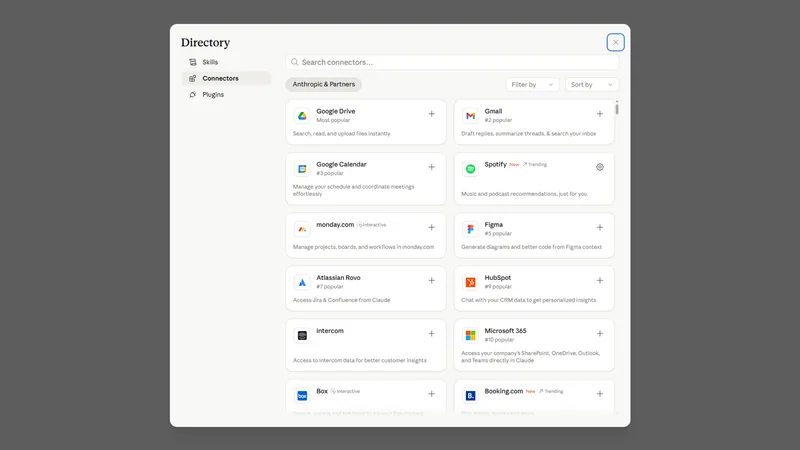
Claude's connectors, previously focused on work tools like Gmail and Slack, have now welcomed a host of lifestyle apps. Think Spotify, Uber, Tripadvisor, Audible, and even tax software like Intuit TurboTax. The goal, according to Anthropic, is to allow users to accomplish more directly within the Claude interface, mirroring the app store approach seen in competitors like ChatGPT. But do these plug-ins truly offer the convenience they claim? And is the experience genuinely better than just using the individual apps themselves?
Finding and adding these connectors is straightforward. Navigate to the connectors page within Claude, or click the '+' button on the prompt bar and select 'Add connector'. Each listing provides a clear description of its function. Once added, you don't need to explicitly select or @ mention a connector; Claude is designed to infer your intent based on your prompt. For instance, if you ask about a Spotify playlist, Claude should recognize the need to use the Spotify connector (Anthropic, 2024).
The first time you use a connector, you'll be prompted to grant permissions. This process mirrors other plug-in systems, where you review the access Claude will have to your linked app and confirm or deny the connection. Managing these permissions is also accessible via the '+' button, under 'Manage connectors'. For Spotify, you can independently control access to playback details, library search, and playlist creation, offering granular control over data sharing (Lifehacker, 2024).
Mixed Results from Real-World Testing
My experience when i tried Claude's new integrations was, frankly, a mixed bag. Starting with Spotify, I asked for the most popular Radiohead song, a query Claude got wrong. A subsequent request for an R.E.M. playlist of "hidden gems" yielded major hits like "Shiny Happy People," suggesting the AI's curation still has a way to go. While some playlist prompts for genres like chill-out jazz or '90s one-hit wonders worked reasonably well, the inability to play anything longer than a preview within Claude itself--requiring a jump to the Spotify app--diminished the convenience factor. Considering Spotify already offers AI-powered playlists, this integration felt like it added minimal value.
The Uber connector offered a glimpse of utility. It could provide estimated ETAs, pricing, and travel options for rides. However, it ultimately hands off the actual booking to the Uber app, making the convenience marginal. Similarly, the Wyndham Hotels and Resorts connector could compare pricing, reviews, and amenities like pools or gyms, showcasing AI's strength in summarizing information. Yet, the hesitation to fully trust AI with travel planning remains a significant hurdle for many users (Smith, 2023).
When i tried Claude's new AllTrails connector, it successfully helped me find local hiking options based on time, rating, and difficulty. The conversational interface made narrowing down choices more intuitive than navigating the app directly. However, like the others, it essentially presented embedded previews, not a fundamentally new experience. The AI added a conversational sheen, but the core functionality was already present in the dedicated app.
The Tripadvisor plug-in proved particularly disappointing. An attempt to look up reviews for a local attraction resulted in Claude displaying information for the wrong location, failing to find an accurate match, and advising me to check the Tripadvisor app directly. This experience, where i tried Claude's new connector and it failed, highlighted the current limitations. It felt like a half-baked solution, offering little more than a slightly more conversational way to access information that's readily available elsewhere.
Even with Audible, while Claude can summarize book plots or characters, you still need to use the Audible app for listening. This pattern emerged consistently: the integrations provide summaries or search capabilities, but the core experience remains tethered to the original applications. While i tried Claude's new integrations with a hopeful outlook, the current iteration feels more like a proof-of-concept than a robust productivity tool. The promise of doing more *inside* Claude is largely unfulfilled, leaving users to wonder if the added layer is worth the occasional frustration.