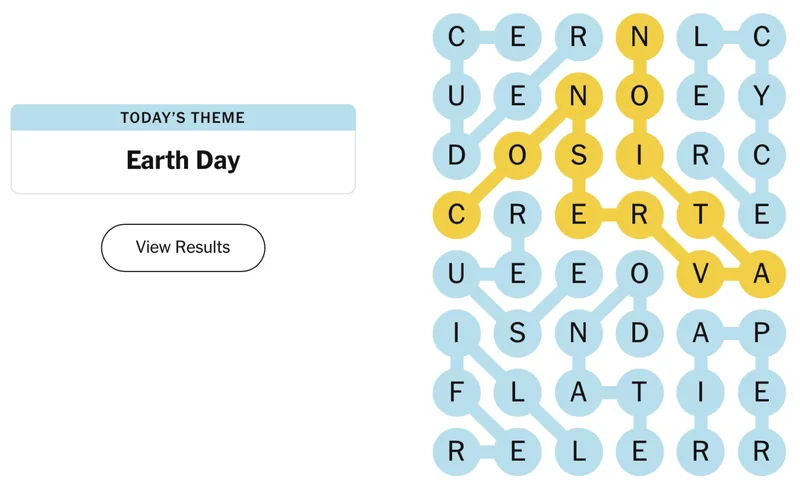
Did you know that the average person generates over 4 pounds of trash every single day? That's a staggering amount, and it's precisely why understanding concepts like conservation is more critical than ever. If you're diving into today's NYT Strands puzzle for Wednesday, April 22, 2026, and finding yourself stumped by the "Earth Day" theme, you've come to the right place. We'll guide you through the clues and ultimately reveal the solution.
Today's NYT Strands Hints & Answer: Earth Day
The New York Times Strands puzzle presents a unique challenge, blending word search elements with thematic clues. For those seeking today's NYT Strands hints, the goal is to uncover words related to environmental stewardship. The puzzle for April 22, 2026, centers around the vital theme of Earth Day, encouraging players to think about how they can contribute to a healthier planet.
Finding the spangram, the word that stretches across the entire board and encapsulates the theme, is often the key to unlocking the rest of the puzzle. Today, that pivotal word is CONSERVATION. Once you identify this, the remaining theme words typically fall into place more easily.
Unraveling the Earth Day Puzzle
The theme words for today's Strands puzzle are all actions we can take to live more sustainably. Think about the verbs associated with protecting our planet. If you're looking for today's NYT Strands hints, consider actions that minimize waste and maximize resourcefulness.
The theme words are:
- REDUCE
- REUSE
- REPAIR
- RECYCLE
- REFILL
- DONATE
These words represent a spectrum of environmentally conscious behaviors. For instance, REDUCE means consuming less, while RECYCLE involves transforming waste into new materials. Even simple acts like REPAIRing an item instead of discarding it contribute significantly to conservation efforts.
Here's a visual representation of the solved board:
Credit: Strands/NYT
How to Play and Win NYT Strands
The NYT Strands game, available on their website and app, challenges you to find hidden words on a letter grid based on a central theme. The spangram, a word that spans the entire board horizontally or vertically, is highlighted in yellow and offers a significant clue.
Words can be found in any direction--up, down, left, right, or diagonally--and each letter can only be used once per word. Correctly identified theme words are highlighted in blue. If you get stuck, submitting valid non-theme words (four letters or more) earns you credit towards a hint, which will highlight the letters of one of the theme words.
Unlike some other word games, Strands doesn't have a failure state. You can't run out of guesses or time. The game is won when all letters on the board have been used to form the spangram and all the theme words. A shareable card then displays your success, with blue dots for found theme words and a yellow dot for the spangram.
If you're looking for today's NYT Strands hints and solutions regularly, bookmarking this page is a good strategy. Understanding the mechanics helps, but sometimes a direct answer is what you need to keep your puzzle-solving momentum going. This is especially true when tackling themes like environmentalism, which can be broad.
Consider the interconnectedness of these actions. Reducing consumption naturally leads to less waste for recycling. Reusing items saves resources that would otherwise be used to create new ones. Even donating unwanted items gives them a second life, preventing them from becoming landfill fodder. These are the kinds of real-world applications that today's NYT Strands hints often echo.
For those who enjoy a mental workout paired with a nod to current events or themes, Strands offers a consistently engaging experience. It's a fantastic way to sharpen your vocabulary and critical thinking skills while engaging with relevant topics. If Earth Day has you thinking about your impact, these puzzle words serve as a great reminder of actionable steps.
Remember, the core of Strands is about connection--connecting letters to form words, and connecting those words to a central theme. Today, that theme is a call to action for our planet. Keep these environmental verbs in mind, and you'll find yourself well on your way to solving today's puzzle and perhaps even adopting some new habits.