Imagine slipping on a discreet piece of jewelry that silently tracks your health, optimizes your sleep, and whispers insights into your well-being. This is the promise of the smart ring - a vision of effortless, integrated health. But here's what's happening (and not happening) in 2026: this burgeoning market is less a sleek, futuristic landscape and more a chaotic battleground of lawsuits, feature overload, and unmet user desires. The journey of these tiny tech marvels has been anything but smooth, leaving many to wonder if their true potential will ever be fully realized.
The Unseen Battle: Patent Wars Shaping the Market
The smart ring landscape is currently defined by a contentious legal skirmish, primarily spearheaded by Oura. In a move that sent ripples through the industry, Oura successfully sued competitors Ultrahuman and RingConn, alleging infringement on a broad patent related to smart ring design. The International Trade Commission (ITC) sided with Oura, mandating that these companies cease U.S. sales by October 2025. While Ultrahuman complied, RingConn opted for a licensing agreement, paying royalties to keep its products on the market.
The patent in question describes smart rings in such general terms that it allows Oura to claim a wide array of devices violate its intellectual property. This aggressive stance has raised eyebrows, with many questioning how a relatively recent patent can dominate a product category that has seen innovation for years (Georgetown Law Review, 2024). This legal precedent has created a chilling effect, making it difficult for new players to enter the U.S. market without fear of litigation. For instance, a hypothetical startup, 'AuraFit,' with an innovative ring design, might hesitate to even launch in the U.S. due to the prevailing patent landscape, stifling competition before it even begins.
Oura hasn't stopped there, extending its legal reach to other prominent smart ring makers, including Noise (makers of the Luna ring), Amazfit, Reebok, and even tech giant Samsung. Samsung, ironically, had filed its own suit preemptively, asserting its designs did not infringe on Oura's, but this was dismissed as Oura had not yet initiated legal action against them. These ongoing legal battles mean that here's what's happening (and not happening) with many brands is less about innovation and more about navigating complex legal minefields.
The current market availability for some key brands reflects this legal turbulence:
- Oura: The Oura Ring remains a dominant force, unaffected by its own legal actions.
- Ultrahuman: Currently unavailable in the U.S., though there's a glimmer of hope. Ultrahuman has hinted at bringing its redesigned Pro ring, which features a different internal structure, to the U.S. legally.
- RingConn: Continues U.S. sales by paying royalties to Oura, ensuring its presence.
- Luna: Not available in the U.S. due to ongoing legal challenges. The company is reportedly pivoting to a smart band with similar software features.
- Samsung: The Samsung Galaxy Ring is still available in the U.S., with its legal status awaiting further developments.
- Amazfit: The Amazfit Helio Ring also appears to be available, though its future in the U.S. market remains under the shadow of Oura's legal pursuits.
Beyond the Hype: Where Smart Rings Truly Shine
Despite the legal wrangling, here's what's happening (and not happening) on the innovation front shows genuine progress. I've tracked this market since 2018, when early models like the Motiv ring (later acquired by Oura) offered a glimpse of minimalist fitness tracking, albeit with limitations in heart rate accuracy during workouts. Fast forward to today, and the technology has matured considerably.
Modern smart rings boast significantly improved heart rate accuracy, even during moderate activity, though detailed data analysis often remains confined to their companion apps. Blood oxygen sensing is now standard, battery life has extended, and design options have diversified, with many models shedding the internal sensor bumps that once made them less comfortable. In essence, smart rings have become sleeker, more accurate, and more user-friendly.
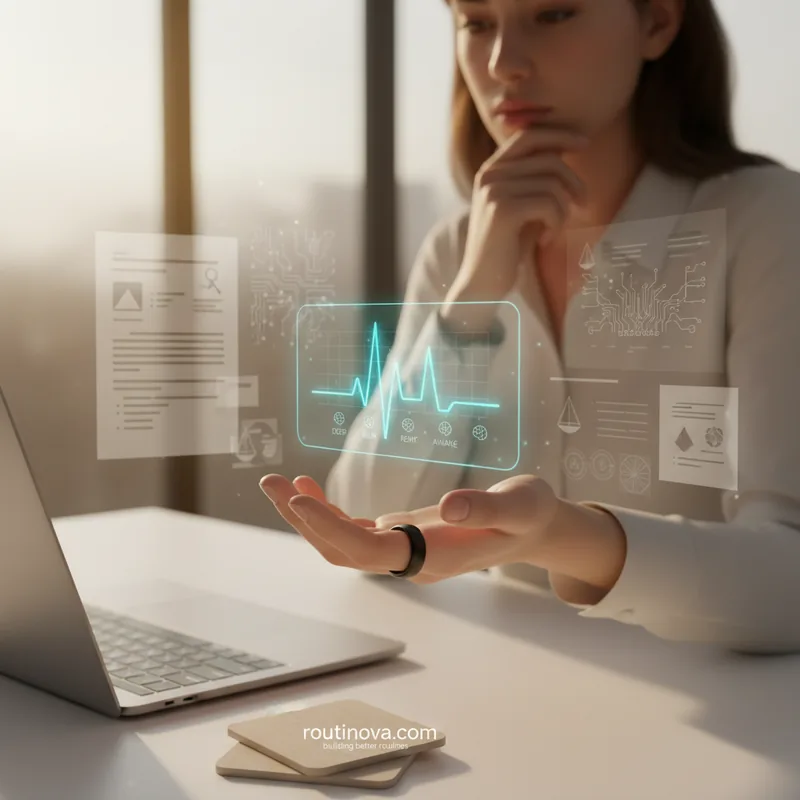
The true magic of a smart ring lies in its unobtrusive nature. Unlike smartwatches that demand attention with notifications and displays, a ring becomes an extension of you - like a wedding band. It's always there, silently collecting data, providing insights into your sleep, recovery, and overall readiness without conscious effort. For a busy parent, juggling work and family, the Oura ring's silent readiness score can be invaluable for deciding whether to push for an early morning workout or prioritize much-needed rest, all without needing to check a screen (Digital Health Journal, 2023).
Companies are also packing more features into these tiny devices. RingConn's upcoming models promise haptic alerts, while Ultrahuman's new ring integrates advanced diagnostics and even alarms. This evolution in hardware and software is impressive, yet it begs the question: is the user experience actually getting better, or simply more complicated?
The Persistent Hurdles: Why Rings Still Struggle
For all their advancements, smart rings still grapple with fundamental limitations. First and foremost, they are generally poor workout trackers. Their bulky nature can interfere with a proper grip during weightlifting or make activities requiring hand dexterity, like playing a musical instrument, uncomfortable. Imagine a professional musician, accustomed to the tactile feel of their guitar, finding a smart ring interferes with their dexterity, making it impractical for performance or practice.
The lack of a display is another significant hurdle. Users must rely entirely on a smartphone app to initiate or end workouts, or to review data. While auto-detection has improved, it's far from perfect, often misidentifying activities or tagging mundane movements as strenuous exercise. And while heart rate measurement has improved, the data often isn't as reliable or exportable as that from dedicated chest straps or advanced smartwatches.
Sizing also remains a perennial issue. Fingers naturally swell and shrink throughout the day and across seasons, making it challenging to find a single, consistent fit. Unlike a watch strap that can be adjusted, rings offer limited flexibility, requiring sizing kits and often only available in whole sizes. This can lead to an uncomfortable fit or inaccurate readings if the ring is too loose.
Finally, a critical, often-overlooked struggle is battery *lifetime*. Not merely how long a ring lasts between charges, but its total lifespan before the internal battery degrades beyond usability. I've personally experienced multiple Oura rings failing around the two-year mark. While companies are tight-lipped about battery longevity, this short lifespan is a common complaint among users. The romantic idea of exchanging smart rings as wedding bands, as seen on social media, often overlooks the practical reality of replacing an expensive piece of tech every few years (IEEE Spectrum, 2024).
The Feature Paradox: More Isn't Always Better
Despite the relentless march of innovation, the smart ring I valued most was the Oura Gen 2 (RIP, 2018-2021). Its appeal? Simplicity. It used infrared LEDs, meaning no distracting green glow at night. It focused purely on sleep and readiness, without the added complexity of workout tracking or a subscription fee. If I wanted detailed workout data, I used another device. It was beautifully ignorable, doing its job without demanding constant interaction.
However, the industry, driven by market forces, has pushed for more. Oura has transformed its ring into a multi-faceted device: a fitness tracker, a blood oxygen sensor, and even an integration point for continuous glucose monitors. This trend mirrors the broader tech landscape, where every social media app tries to be every other app, and every wearable attempts to swallow its competitors' features. This brings us to a critical question about here's what's happening (and not happening) in terms of genuine user value.
Do we truly want a smart ring to be an Apple Watch on our finger? The answer for many, including myself, is a resounding no. Yet, the business model dictates otherwise. Oura introduced a subscription in 2021 and, in 2025, even rolled out a 'Couple's Kit' in hopes of selling two $500 rings. Other companies, like Ultrahuman, counter Oura's subscription model by offering core features for free, but then entice users with a plethora of mini-subscriptions for advanced diagnostics or personalized insights. It's a race to add services that justify higher price points and recurring revenue.
This pursuit of additional revenue streams has led to some controversial offerings. Both Oura and Ultrahuman now offer panels of blood tests and recommend repeat testing. They've also partnered with continuous glucose monitor (CGM) makers, allowing users to track blood glucose through the ring's app. While invaluable for individuals with diabetes, this offering for those without a medical need has sparked debate, highlighting the industry's push into areas that may not align with the core promise of unobtrusive wellness tracking.
Looking Ahead: The Future of Finger-Worn Tech
The vision of an inexpensive, truly unobtrusive smart ring focused on core wellness insights seems increasingly distant. What I, and many users, desire may not align with a viable capitalist business model. However, there's still hope for the evolution of finger-worn technology. We need to see more variety in the U.S. market, fostering genuine competition beyond legal battles.
Innovation, like Ultrahuman's superpowered charging case, which extends battery life significantly, shows promise. Perhaps the future lies not in a single ring trying to do everything, but in specialized rings catering to specific needs. Imagine a smart ring specifically designed for elderly care, offering fall detection and emergency alerts, rather than a broad suite of fitness features. Or a minimalist ring focused solely on sleep quality for those battling insomnia.
Ultimately, here's what's happening (and not happening) will determine if smart rings evolve into indispensable tools or remain niche gadgets. The industry stands at a crossroads: will it succumb to feature bloat and patent wars, or will it rediscover the elegance of simplicity and truly valuable innovation that enhances our lives without overwhelming them?