Have you ever experienced a brief "afterimage" after glancing at a bright light, or momentarily "heard" the last few words someone said even if you weren't fully listening? These fleeting perceptions are a direct result of sensory memory, the very first stage of how your brain processes the world around you. So, what is sensory memory? It's an ultra-short-term memory system that allows you to retain raw sensory information--sights, sounds, touches--for mere fractions of a second after the original stimulus has ended. This rapid processing is crucial, acting as a vital filter that helps your brain decide which of the constant flood of sensory data is important enough to pay attention to and potentially store for longer.
Understanding Sensory Memory: The Brain's First Filter
Our environment constantly bombards us with an immense amount of sensory information. From the myriad colors and shapes we see to the symphony of sounds we hear, it's an overwhelming input. Sensory memory steps in as the brain's initial, automatic holding area for this data. It provides a momentary "snapshot" of the sensory world, allowing your cognitive system just enough time--typically less than three seconds--to recognize and make initial sense of the information (Haiyan & Dongjun, 2024). Without this brief retention, our perception of reality would be fragmented and chaotic.
Key Characteristics of Sensory Memory
- Limited Duration: Sensory memories are incredibly brief, lasting from a quarter of a second to a few seconds at most. They are almost immediately overwritten by new incoming sensory data.
- Vast Capacity: Despite its short duration, sensory memory can temporarily hold a tremendous amount of detail from the sensory experience.
- Automatic Processing: This form of memory operates without conscious effort or control. You don't decide to "remember" a sensory impression; it simply happens.
- Modality-Specific: Sensory information is stored according to its sensory modality. Visual data goes to visual sensory memory, auditory to auditory, and so on. This compartmentalization ensures each sense has its own temporary buffer.
- High Detail: The information held in sensory memory is raw and unprocessed, retaining a high level of detail from the original stimulus before interpretation occurs.
The Many Forms of Fleeting Perception
While often discussed as a single entity, sensory memory is further categorized based on the specific sense it serves. Each type handles different modalities and has its own characteristic duration, reflecting the varying needs of our perceptual system. Understanding what is sensory memory across these different forms highlights its nuanced role.
Iconic Memory: Visual Snapshots
Iconic memory refers to visual sensory memory, capturing a very brief, high-fidelity image of what we see. This visual impression typically lasts for a mere one-quarter to one-half of a second (Pratte, 2018). For instance, if you quickly glance at a complex painting, your iconic memory holds a momentary, detailed image of it before it fades. Another example is the brief trail of light you perceive when waving a sparkler in the dark, or the afterimage of a camera flash that lingers for a moment.
Echoic Memory: Auditory Aftertastes
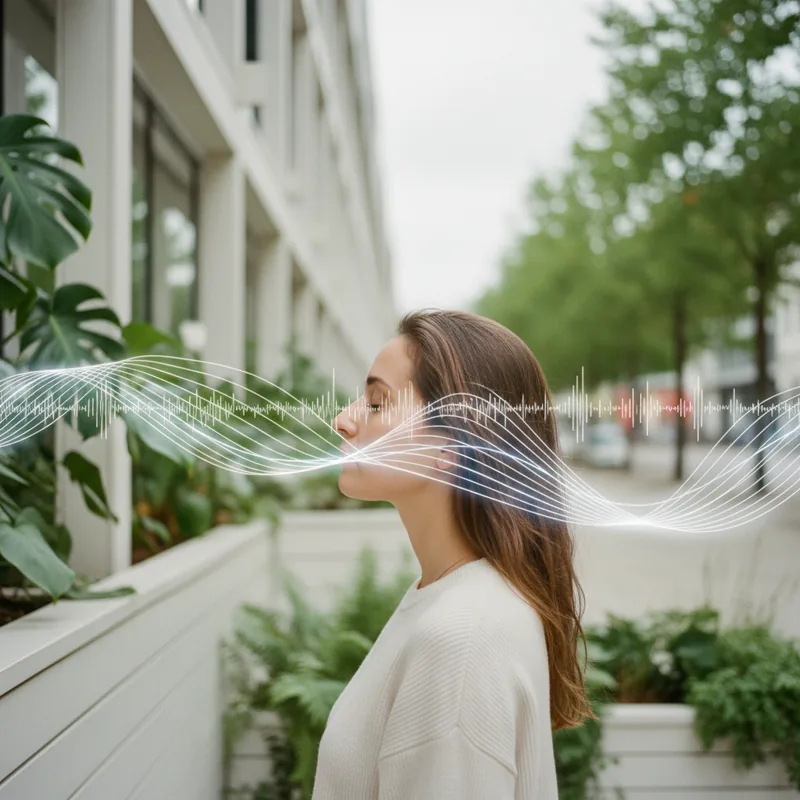
Echoic memory is the auditory counterpart, storing brief impressions of sounds. Similar to an echo, this memory can persist for a slightly longer duration, typically up to three to four seconds. This extended duration is crucial for processing spoken language, allowing us to comprehend entire sentences even if we didn't consciously focus on every word as it was uttered. Think of hearing the last few words of a conversation you weren't actively engaged in, or the brief ring of a phone that stops just as you register it.
Haptic Memory: Tactile Traces
Haptic memory is our tactile sensory memory, responsible for retaining brief impressions of touch. This type of memory lasts for approximately two seconds (Drewing & Lezkan, 2021). It enables us to briefly remember the sensation of something brushing against our skin, the texture of a fabric after running our fingers over it, or the momentary pressure of a friendly tap on the shoulder. These brief tactile traces are vital for interacting with our physical environment.
Why This Brief Memory Matters for Daily Life
Though incredibly short-lived, sensory memory is foundational to our conscious experience of the world. It's the invisible glue that binds discrete sensory inputs into a coherent, continuous stream of perception. Without it, our reality would feel disjointed and fractured, like watching a movie one still frame at a time or hearing music as a series of unrelated notes (Camina & Güell, 2017).
This automatic process smooths out our perception and allows the brain to establish crucial connections, enabling a multitude of everyday functions:
- Seamless Conversation: Echoic memory helps us process spoken words into meaningful sentences, allowing us to follow discussions without missing crucial information.
- Fluid Reading: Iconic memory ensures that our eyes can scan text, retaining enough visual information to recognize words and phrases as continuous units.
- Perceiving Motion: The rapid succession of visual inputs is smoothed by iconic memory, allowing us to see continuous motion rather than a series of static images.
- Recognizing Visual Scenes: It helps us integrate various visual elements into a recognizable scene, providing a stable understanding of our surroundings.
- Coherent Experience: Fundamentally, sensory memory ensures that our overall experience of the world is stable, coherent, and makes sense.
This subconscious filtering and holding mechanism serves as the initial gateway for attention, learning, and the transfer of information into short-term and ultimately long-term memory. It's a critical component in understanding what is sensory memory and its profound impact on cognition.
Pioneering & Modern Insights into Sensory Memory
Our scientific understanding of sensory memory has evolved significantly, thanks to groundbreaking research and continuous modern inquiry.
Sperling's Classic Experiments
The pioneering work of psychologist George Sperling in the 1960s provided crucial insights into the duration and capacity of iconic memory (Sperling, 1960). In his classic experiments, participants were briefly shown a grid of letters--for just 1/20th of a second--before the screen went blank. When asked to recall as many letters as possible, most could only report about four or five. However, many insisted they had seen more but the information faded too quickly to be reported.
Sperling then introduced a partial report method. After the letter grid disappeared, participants heard a tone (high, medium, or low) instructing them to report only the top, middle, or bottom row, respectively. He found that participants could accurately recall nearly all letters from the indicated row, but only if the tone was sounded within one-third of a second of the visual display. Beyond this brief interval, recall accuracy plummeted. This demonstrated that a large amount of visual information is indeed briefly available in iconic memory, but it decays incredibly rapidly.
Contemporary Understanding and Research
More recent research has expanded upon Sperling's foundational work, suggesting that sensory memory is far from a passive "snapshot" (Öğmen & Herzog, 2016). Instead, it's increasingly viewed as an active, continuous process that plays a dynamic role in predicting and interpreting incoming sensory information (Tripathy & Öǧmen, 2018). This contemporary perspective highlights its interactive nature with other cognitive functions.
Researchers are actively exploring how sensory memory influences and is influenced by processes such as perception (Jaffe-Dax et al., 2023), attention (Botta et al., 2019), and short-term memory. Studies also indicate that individual experiences and expectations can subtly modulate how sensory information is initially processed and retained (Ito et al., 2020), further deepening our appreciation for the complex role of what is sensory memory in shaping our conscious reality.