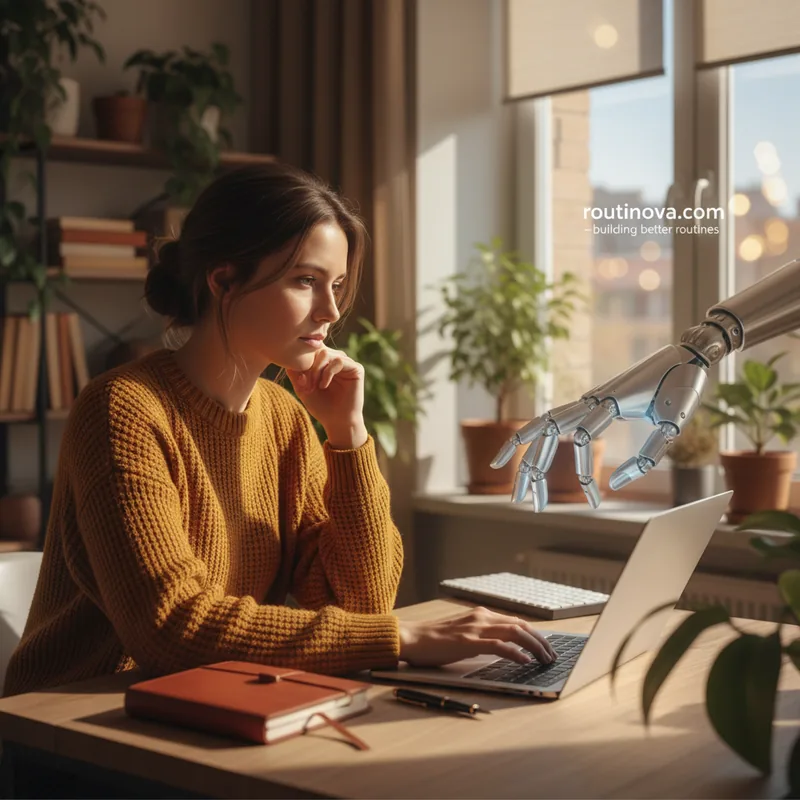
Have you ever paused to consider the true cost of convenience? In our fast-paced digital world, the allure of AI-powered email assistance is strong. Imagine offloading the drudgery of drafting messages, freeing up precious time for other tasks. While many readily embrace this technological shortcut, I find myself standing firm against it. For me, the reasons are deeply rooted in preserving not just my productivity, but also my essential human skills and the authenticity of my interactions. This is precisely why I'm never going to hand over my email composition to artificial intelligence.
The promise of AI-generated emails--quicker, more efficient, less taxing--seems almost irresistible. Yet, beneath the surface of this perceived efficiency lies a potential erosion of vital cognitive abilities and a subtle dehumanization of our daily communications. My concerns extend beyond mere technicalities; they delve into the very essence of human connection and intellectual autonomy.
The Erosion of Essential Cognitive Skills
Writing is more than just stringing words together; it's a fundamental act of thinking. As author David McCullough famously stated, "Writing is thinking." The deliberate process of choosing the right vocabulary, structuring a sentence, and articulating a coherent thought actively engages our brains. This mental workout, even for a brief email, hones our clarity of thought and precision of expression. If we outsource this fundamental cognitive exercise to AI, are we not risking the atrophy of this crucial skill?
Consider the nuanced act of crafting a sincere apology to a friend, or structuring a complex project update for a diverse team. These tasks demand careful consideration, empathy, and a deep understanding of context--qualities AI struggles to replicate authentically. Reports from early AI adopters suggest a growing reliance, where individuals find themselves struggling to articulate even simple thoughts without algorithmic assistance (University of Cambridge, 2023). This dependence is precisely why I'm never going to let a machine dictate my words, fearing the day I sit down to write and find my own mental gears grinding to a halt.
The Imperative for Authentic Connection
In an increasingly digital world, genuine human connection becomes even more valuable. Every email, regardless of its brevity or formality, is an interaction between people. When we allow AI to compose our messages, we introduce a layer of artificiality that can subtly diminish the sincerity and impact of our communication. Imagine receiving a heartfelt condolence message from a colleague, only to suspect it was drafted by an algorithm. The emotional resonance would be lost.
AI-generated content often suffers from a pervasive blandness--a generic "averaging out" of countless data points. This leads to messages that, while grammatically correct, lack personal voice, unique insights, or genuine empathy. A personalized thank-you after a difficult meeting, or a unique job application cover letter that genuinely reflects your personality, are far more impactful than algorithm-processed text. Studies show that human recipients can often detect machine-generated text, leading to a perception of reduced sincerity and trustworthiness (Journal of Applied Psychology, 2024). This erosion of trust is a significant factor in why I'm never going to compromise on the human touch.
Trust, Accuracy, and the Algorithmic Trap
Despite rapid advancements, AI models are still prone to errors, often referred to as "hallucinations." These can range from subtle inaccuracies to outright fabrications. When drafting an important email--be it a project pitch, a client inquiry, or a personal arrangement--the margin for error is often zero. Can we truly trust an AI to accurately recall a specific project deadline, or precisely summarize a client's nuanced needs without introducing costly mistakes?
The companies pushing AI-driven communication often overlook this critical flaw. While humans also make mistakes, we possess the capacity for critical self-correction, contextual understanding, and a deep knowledge of our relationships. An AI, on the other hand, operates as a black box of algorithms, devoid of personal context or genuine understanding of the people involved. Reports highlight that even leading AI models exhibit significant factual error rates, especially when dealing with specific, non-public information (MIT Technology Review, 2023). This inherent unreliability is yet another reason why I'm never going to delegate critical communications to an algorithm.
Beyond the Inbox: A Future Defined by Human Interaction
The trajectory of AI integration into our lives raises profound questions about agency and responsibility. If we allow AI to handle our communications, how long until the next logical step: AI systems conversing primarily with other AI systems, with human oversight becoming minimal or nonexistent? This vision of a future where our digital lives are automated to such an extent that we abdicate intellectual responsibility is deeply unsettling. It's a slippery slope I'm unwilling to tread.
Preliminary studies already indicate that individuals tend to forget information they've processed or created with the help of AI more readily than content they've generated themselves (Stanford University, 2022). This has worrying implications for recalling important details from AI-drafted emails, potentially leading to misunderstandings or missed opportunities. The convenience of AI, in this light, becomes a detriment to our long-term memory and engagement. No matter how insistent the AI prompts become, this is a future why I'm never going to sign up for.
Ultimately, the decision to use AI for email composition comes down to a fundamental choice: do we prioritize perceived efficiency at the risk of losing essential skills, authentic connection, and critical accuracy? For me, the answer is clear. The act of writing, even a simple email, is a powerful exercise in thought, empathy, and personal expression. Preserving that human element in our communications is not just a preference; it's a commitment to a more thoughtful, connected, and authentically human future.