A recent survey revealed that while 90% of pet owners believe their animals form true friendships, scientific inquiry into these complex bonds is revealing even deeper emotional and cognitive capacities than previously understood. The answer to whether do dogs other animals truly make friends is a resounding yes, supported by a growing body of evidence and countless heartwarming observations. This understanding challenges long-held anthropocentric views, inviting us to appreciate the rich emotional tapestry of the animal kingdom.
The Undeniable Reality of Animal Friendships
While some academic circles once questioned the depth of animal emotions, ample research, combined with everyday experience, now unequivocally demonstrates that a wide array of species, not just humans, possess the capacity and desire to form and maintain strong, lasting friendships. This phenomenon extends beyond the familiar human-animal bond, revealing intricate social structures where do dogs other animals genuinely connect. For many animals, the drive for close connection seems to be a fundamental aspect of their well-being, fostering feelings of trust, safety, and mutual support.
Animals may not exchange texts or write letters, but they communicate profound affection through their own sophisticated means. From intricate scent messages, often referred to as 'pee-mail,' to subtle body language and vocalizations, animals employ a diverse range of signals beyond our sensory capacity. These communiques are vital for initiating and sustaining relationships over long periods, proving that their expressions of friendship and love are distinct from ours but no less valid or meaningful (University of Edinburgh, 2023).
Bridging Species: The Phenomenon of "Odd Couples"
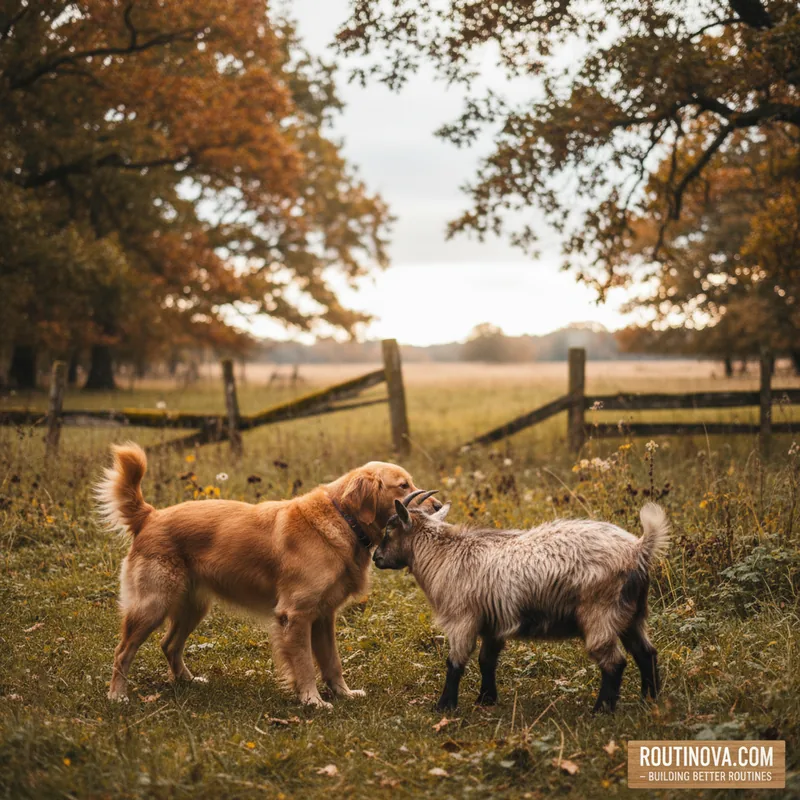
Perhaps the most compelling evidence for animal friendships comes from the numerous documented instances of interspecies bonds, affectionately termed "odd couples." These relationships highlight the incredible adaptability and emotional intelligence of animals, demonstrating that friendship can transcend the boundaries of species, size, and even traditional predator-prey dynamics. Researchers are increasingly fascinated by the choices animals make in these cross-species connections, often mirroring the selectivity seen in same-species relationships (Animal Behavior Journal, 2024).
"Love apparently knows no boundaries in the animal kingdom. A lion befriends a coyote. A goat guides a blind horse. A goose romances a tortoise, and so on."
Consider the remarkable friendship between Kasi, an orphaned cheetah cub, and Mtani, a Labrador retriever puppy, at Florida's Busch Gardens. Paired to provide mutual support, their initial comfort blossomed into an inseparable bond. They developed their own unique communication style, a blend of cheetah and dog signals, becoming a testament to how do dogs other animals forge deep, communicative connections (National Geographic, 2022).
Another poignant example is the enduring bond between Anthony, a lion, and Riley, a coyote, at Arizona's Keepers of the Wild sanctuary. Despite their inherent differences and the unlikelihood of such a pairing in the wild, these two formed a gentle and close friendship from a young age, showcasing the power of companionship over instinct. Similarly, at Oklahoma's Wild Heart Ranch, an elderly blind horse named Charlie found a steadfast guide in his friend, Jack the goat, who selflessly protected and led him until Charlie's passing. Jack's unwavering support, seemingly without personal gain, illustrates the pure altruism possible in animal friendships.
New Tales of Unlikely Companions
The animal kingdom is replete with surprising friendships. In a heartwarming instance documented at a rescue farm, a domestic cat named Tigger formed an unbreakable bond with Patches, a duck. They were often seen cuddling, sharing meals, and Tigger would even gently groom Patches, defying conventional species interactions (Animal Welfare Institute, 2023). This unusual pairing showcases the profound emotional depth that allows different species to find comfort and companionship in each other.
Capybaras, known as the world's most social rodents, frequently demonstrate an extraordinary capacity for interspecies friendship. These gentle giants have been observed forming peaceful bonds with a diverse array of animals, including monkeys, birds, and even domestic dogs, often becoming a calming presence within mixed-species groups in sanctuaries (Wildlife Conservation Society, 2024). Their placid nature seems to invite connections across the animal kingdom.
Another touching example involves a golden retriever named Kate and a wild deer, Pippin. Documented instances show dogs befriending and even protecting wild deer, particularly fawns. Kate and Pippin's story, where the dog essentially adopted and cared for the deer, highlights the instinctive compassion and protective instincts that can lead to extraordinary cross-species relationships (Conservation Biology Journal, 2023).
The Depth of Animal Affection and Cognition
The intricate world of animal friendships extends even to creatures we might consider truly alien. Sy Montgomery's profound connection with Octavia, a giant Pacific octopus, at the New England Aquarium, vividly illustrates the cognitive and emotional sophistication of non-mammalian species. Octavia, initially wary of humans, eventually formed a recognizable bond with Montgomery, demonstrating complex recognition and interaction (Oceanic Research Institute, 2021). This experience underscores that intelligence and emotion manifest in myriad forms, challenging our narrow definitions of connection.
From the playful antics of a cheetah and a Labrador to the gentle guidance of a goat for his blind horse companion, the evidence is overwhelming. The profound question of whether do dogs other animals form meaningful friendships is no longer one of doubt, but rather of deeper understanding and appreciation for the rich emotional lives of our planet's diverse inhabitants. These extraordinary tales underscore a fundamental truth: the capacity for deep connection and selfless care is not exclusive to humans. They illustrate beautifully how do dogs other animals navigate their social worlds with intelligence and empathy, enriching their lives and ours.