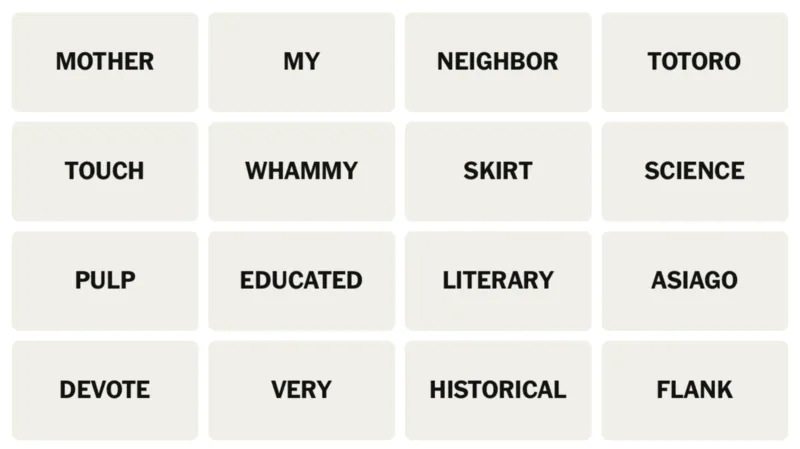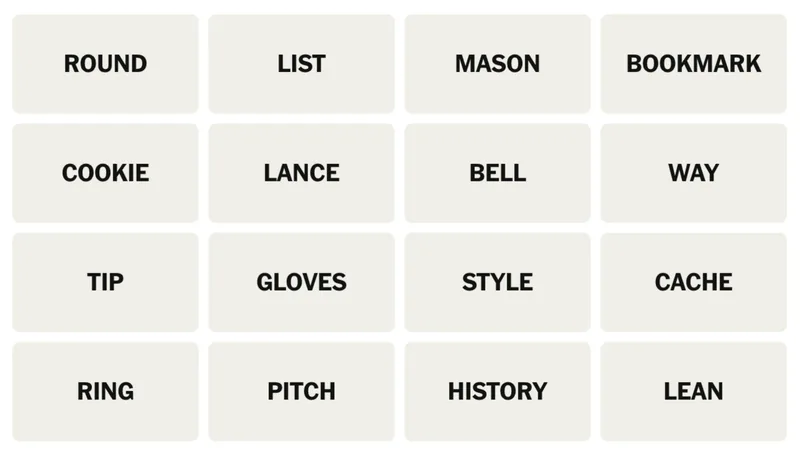
It’s a familiar morning ritual for many: the New York Times Games app open on your phone before the coffee is even brewed. The digital equivalent of a crossword, Connections, offers a satisfying mental warm-up. But some days, the grid feels like an impenetrable fortress, leaving you staring at a jumble of words, wondering how they could possibly fit together. If you're looking for a little guidance to crack today's puzzle, you've come to the right place. This guide provides today's NYT Connections hints and the answer for Monday, March 16, 2026, helping you conquer puzzle #1,009.
Navigating the Connections Challenge
The New York Times Connections puzzle presents players with 16 words, arranged in a grid. The objective is to identify four distinct groups of four words that share a common theme. These themes can range from straightforward categories like types of fruit to more abstract concepts involving wordplay or homophones. It’s a delightful test of vocabulary, lateral thinking, and pattern recognition. If you’re stuck on today's NYT Connections hints, we’ve broken down the categories and solutions to help you understand the logic behind the groupings.
Today's NYT Connections Hints and Strategies
Before diving into the answers, let's explore some hints for today’s puzzle. Think of these as gentle nudges in the right direction, designed to spark your own "aha!" moments without giving everything away immediately. Remember, the joy of Connections lies in the discovery, and these hints aim to facilitate that process.
Category Types Explained
Understanding the nature of the categories can be a significant help. NYT Connections puzzles typically feature a mix:
- Yellow Category: Often the most straightforward, usually related nouns.
- Green Category: Typically also related nouns, sometimes with a slightly more nuanced connection.
- Blue Category: Frequently involves wordplay, puns, or a shared linguistic trick.
- Purple Category: Usually the most challenging, often relying on clever wordplay, homophones, or less obvious associations.
Spoiler-Free Theme Hints
Here are some general hints about the themes you'll find today:
- Yellow: Think about words used to describe groups of animals.
- Green: These words all relate to things that move very slowly.
- Blue: Focus on letters within words that are pronounced silently.
- Purple: Consider words that sound identical to common two-letter abbreviations, especially those related to geography.
Even with these nudges, some words might still feel out of place. For example, the word WRATH could initially seem unrelated to words like CARTWRIGHT or WRESTLE, but a closer look at pronunciation reveals the connection.
The Connections Solution for March 16, 2026
Ready to see how it all fits together? Here are the solutions for today's NYT Connections puzzle, revealed category by category. If you were looking for today's NYT Connections hints and answers, this is where you'll find them.
Yellow Category: ANIMAL GROUP NAMES
This category is often the most accessible. It brings together words that denote a collection of specific animals. The words are:
- GAGGLE (geese)
- PACK (dogs or wolves)
- POD (whales or dolphins)
- PRIDE (lions)
These are all established terms for collective animal groups, making them a classic Connections category.
Green Category: THINGS ASSOCIATED WITH BEING SLOW
This group focuses on concepts or entities that are characterized by a lack of speed. The words are:
- GLACIER
- MOLASSES
- SLOTH
- TRAFFIC
From the geological movement of a glacier to the sticky crawl of molasses, or the famously slow animal, the sloth, and the frustrating standstill of traffic, these words all evoke a sense of slowness.
Blue Category: SILENT “W”
This is where the wordplay starts to become more apparent. This group consists of words where the letter 'W' is present but not pronounced. The words are:
- CARTWRIGHT
- TWO
- WRATH
- WRESTLE
You can see the silent 'W' in WRATH and WRESTLE. The word TWO is a common example of a silent 'W' that often trips people up when distinguishing it from 'to'. CARTWRIGHT, while less common in everyday speech, also follows this pattern.
Purple Category: WORDS THAT SOUND LIKE STATE ABBREVIATIONS
This is typically the trickiest category, relying on phonetic similarities. These words sound like common state abbreviations, often two letters long. The words are:
- ANY (sounds like NY)
- EMMY (sounds like ME)
- ENVY (sounds like NV)
- OKAY (sounds like OK)
This category requires a keen ear for homophones and an awareness of common abbreviations. For instance, ENVY sounds very similar to Nevada's abbreviation, NV, and ANY sounds like New York's NY.
How to Improve Your Connections Game
The beauty of Connections lies in its ability to challenge you in different ways each day. To get better, practice is key. Try to identify patterns not just in meaning, but also in sound, spelling, and word structure. Pay attention to common phrases and idioms, as they often hide connections. For example, think about phrases like "a stitch in time saves nine" or "the early bird gets the worm." Sometimes, a seemingly random word might connect to a famous person (like a painter or musician) or a specific field (like science or literature).
Don't be afraid to experiment with different groupings. If a set of four words doesn't fit a category, reconsider the individual words and look for alternative meanings or associations. Sometimes, a word can belong to multiple potential groups, and the trick is to find the one that perfectly isolates four words without overlap. This process of elimination and discovery is what makes today's NYT Connections hints and the game itself so engaging.
Keep playing, keep thinking, and you'll soon find yourself spotting those connections with increasing ease. Check back tomorrow for more hints and solutions!
Connections Puzzle #1009 Solution Recap:
🟨 Animal Group Names
🟩 Things Associated with Being Slow
🟦 Silent "W"
🟪 Words That Sound Like State Abbreviations