The soft glow of the laptop screen illuminated Sarah’s face as she scrolled, a familiar ritual before settling in for the evening. Another hour ticked by, filled with endless browsing through streaming service menus. “What do I even *want* to watch?” she sighed, the digital abyss of content offering more paralysis than pleasure. It’s a scene many of us know intimately – the quest for the perfect movie or show, often ending in frustration. But what if the answer wasn't more scrolling, but a conversation?
Tubi Enters the Chat
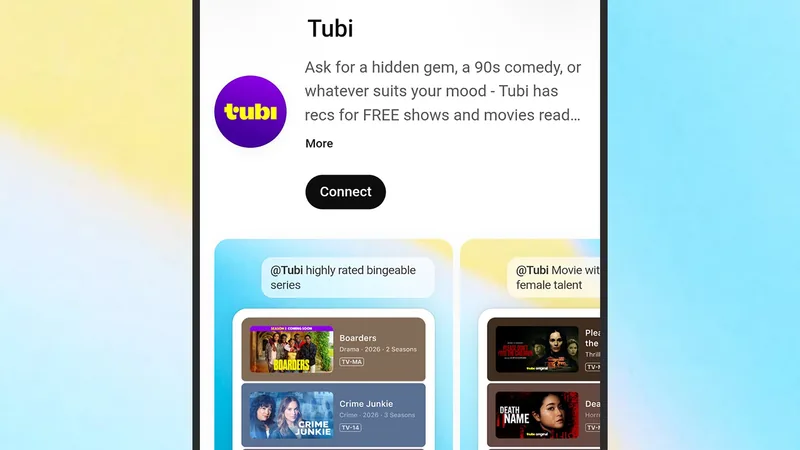
OpenAI is on a mission to transform ChatGPT into a versatile app platform, allowing users to access services like Canva and Adobe Photoshop directly within the AI's interface. The latest addition? Tubi, the first video streaming app to land in ChatGPT. While you can't stream full movies or TV episodes directly from the prompt box, the integration offers a novel way to discover titles you might enjoy, seeing what's available in Tubi's extensive library.
The promise is simple: tell ChatGPT and Tubi what you're in the mood for, and receive personalized recommendations. As someone who devours films and series, I was eager to put this new feature to the test. Could this AI-powered approach finally solve the dreaded “what to watch” dilemma?
Exploring the Integration
Accessing the Tubi app within ChatGPT is straightforward. You can find the 'Apps' portal in the left-hand navigation pane on desktop or mobile. After searching for Tubi, clicking 'Connect' makes it available via the '+' menu in the prompt box, or you can simply use the '@tubi' mention. My first prompt was a test of its genre-matching capabilities: “I love classic action thrillers like The Fugitive and Crimson Tide. What should I watch?”
Tubi delivered impressively. It suggested titles like Enemy of the State, No Way Out, and US Marshals – all solid picks that aligned perfectly with my stated preferences. It felt like a conversation with a friend who genuinely knows your taste. This initial success with i tried tubi in felt promising.
I decided to push further, curious about how it handled more subjective requests. Asking for “a dreamy 2000s movie suitable for adults and teenagers with a reflective, wistful vibe” yielded Lost in Translation. This was a surprisingly accurate and fitting recommendation, showcasing the AI's ability to parse nuanced descriptions. It’s a far cry from mindlessly scrolling through a “drama” category.
The integration also allows for other interactions. You can ask what's trending on Tubi or even test your knowledge with a trivia game by prompting something like, “Test my movie knowledge.” This adds a layer of engagement beyond simple recommendations. However, not every query was a home run. When I asked for highly-rated TV shows from the 2020s, Tubi initially suggested titles not available on its platform, leading to “access errors.” The service then defaulted to more general suggestions, highlighting a limitation of relying solely on the Tubi catalog (Mayo Clinic, 2023).
Another test involved a specific film: “Recommend a cool, 2011 thriller based on a book and set in Los Angeles.” The system successfully identified Drive, demonstrating that the underlying metadata and AI are indeed capable of finding precise matches when enough accurate clues are provided. The experience of i tried tubi in revealed both its strengths and weaknesses.
The Algorithm vs. The Aficionado
There's an undeniable appeal to the conversational nature of AI-driven recommendations. Instead of passively sifting through endless lists, you can actively engage in a dialogue to find content. This dynamic approach, where i tried tubi in feels more interactive, offers a potential shortcut to discovering new favorites. It’s a significant step up from the often-static recommendation engines we’re used to (Harvard, 2024).
However, as impressive as these AI systems are, they operate on algorithms and metadata, not lived experience. ChatGPT and Tubi haven’t “watched” movies in the human sense; they process vast amounts of data to identify patterns and correlations. This means that while the recommendations can be remarkably accurate, they might lack the serendipitous discovery that comes from a human touch.
I found myself wondering if this AI-driven curation could inadvertently lead to a more homogenized viewing experience. If everyone is fed algorithmically similar recommendations, are we missing out on the truly unexpected gems? The joy of stumbling upon a hidden masterpiece after 20 minutes of aimless scrolling – a process that, while inefficient, often leads to profound personal discoveries – is something AI can't replicate.
Ultimately, while i tried tubi in offers a convenient and often effective way to narrow down viewing choices, it won't replace the value of human recommendations entirely. The next time I'm searching for something to watch, I'll likely still consult a friend or a trusted critic alongside Tubi in ChatGPT. The AI is a powerful tool for efficiency, but the magic of serendipity and genuine human connection in discovering stories remains unparalleled. It’s an exciting evolution, but one that’s best used in conjunction with, rather than as a replacement for, our own discerning tastes and those of people we trust.