Twenty-eight-year-old Alex meticulously tracked every calorie, every gram of protein, every rep in the gym. His Instagram feed was a curated montage of sculpted abs and motivational quotes. Friends praised his 'discipline,' his 'dedication to fitness.' But behind the filtered photos and the stoic facade, Alex was exhausted, anxious, and deeply ashamed. He'd skip family dinners to avoid 'unclean' food, cancel plans if he missed a workout, and constantly felt inadequate, despite his visible progress. His story, sadly, isn't unique. For countless men, the pursuit of the modern male body 'ideal' has a profound, often hidden, dark side.
What most people don't realize is that the very behaviors lauded as peak performance in men can be clear indicators of serious mental and physical health struggles. The question isn't if men are suffering, but how many are struggling in plain sight, with eating disorders and body dysmorphia rebranded as 'fitness goals' or 'optimization.' This cultural blind spot is the profound dark side of modern masculinity.
The Hidden Epidemic of Male Body Image
When we talk about body image issues or eating disorders, the conversation often defaults to women. But here's the thing: men are increasingly caught in the same relentless cycle of self-scrutiny and unattainable standards. Boys and men now account for a significant portion of those diagnosed with eating disorders, a figure that many experts believe dramatically understates the true crisis (Journal of Men's Health, 2023). Think about it: how many men suffer in silence because society has coded eating disorders primarily as a women's issue?
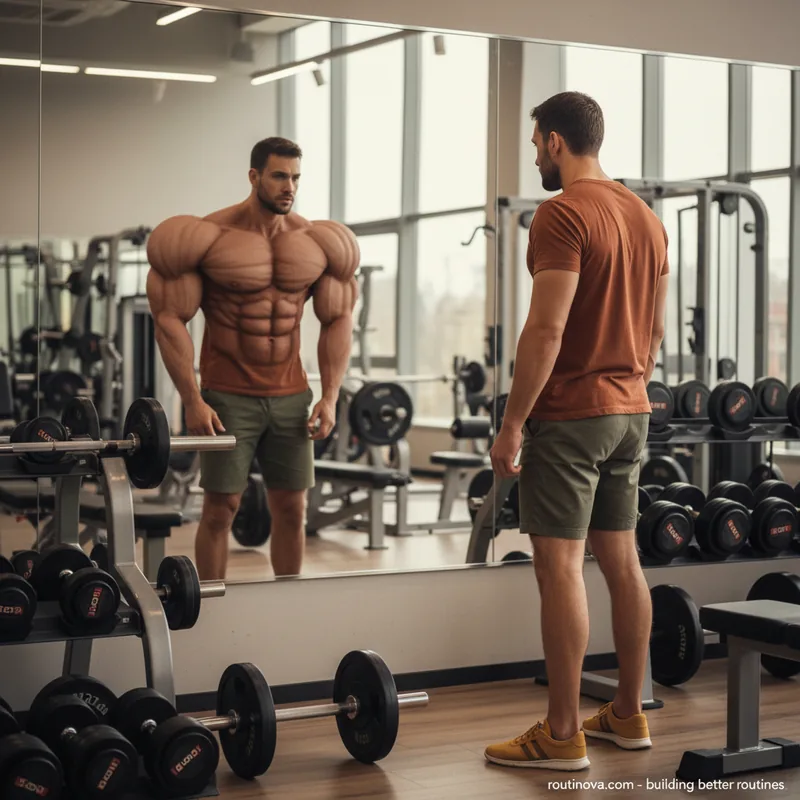
The most prevalent manifestation is muscle dysmorphia, often dubbed 'bigorexia.' This isn't just about wanting to be strong; it's characterized by excessive, compulsive exercise, a persistent belief that one is never muscular enough, and an obsession with muscle mass, size, and leanness. We see it in the 'bulking' and 'shredding' cycles, where extreme caloric restriction or compulsive exercise are reframed as 'cutting' or 'staying on track.' I've seen the mental fallout firsthand when a friend, praised for his 'commitment,' became withdrawn and irritable, his life revolving solely around his diet and gym schedule.
Social media, of course, amplifies this pressure. We scroll through feeds of chemically enhanced physiques presented as natural and achievable. This breeds more self-scrutiny, more comparison, more perceived inadequacy. As Matthew Singer, a yoga teacher, puts it, most 'fitspo' is 'as helpful for fitness as previous winning lottery numbers are for winning millions.' It ignores genetics, life circumstances, and health history. Our bodies become projects, always in need of correction, devoid of context. This constant pressure is a significant dark side of modern digital culture.
The Evolving Aesthetic Pressure
The pressure doesn't stop at the gym. Men are now navigating a rapidly expanding landscape of aesthetic treatments, previously almost exclusively associated with women. 'Brotox' may sound like a casual nickname, but it masks a serious trend: men are increasingly turning to cosmetic procedures like jawline contouring, under-eye correction, and hair restoration (Dermatology Today, 2024). These offer noticeable yet discreet results, fitting neatly into lives that were never 'supposed' to include such concerns.
What's telling is that for many men, these are their first forays into the aesthetic realm. They're learning what women have understood for generations: appearance affects professional success, social capital, and romantic prospects. And the goalposts are always moving. Yet, the masculine ideal demands stoic self-sufficiency, even as it requires costly and constant aesthetic labor. This creates an impossible bind, a silent burden that is a crucial dark side of modern expectations.
Think about the financial implications. These treatments aren't cheap. Neither are the supplements, meal prep services, personal trainers, and specialized equipment that feed into the 'ideal.' Beauty standards increasingly require significant financial investment, making appearance another arena where class determines outcomes. If men can't afford to look the way they feel pressured to look, they're uniquely left behind to suffer in silence, adding another layer to the dark side of modern male body image.
Breaking the Silence and Redefining Strength
As a woman, I spent much of my life envying men's perceived freedom to age or gain weight without constant intervention. Now, my perspective has shifted. I've heard too many men admit they were never given the language to articulate aesthetic concerns without shame. Society has constructed a masculine ideal that equates vulnerability with weakness, making it nearly impossible for some men to admit they're struggling with their relationship to food and their bodies. This cultural silence is a profound dark side of modern masculinity.
There's a vast difference between healthy self-care and the insidious feeling that your body is never good enough. Meticulously tracking every calorie, every rep, every perceived flaw--why should one woman's obvious eating disorder be another man's enviable achievement? It's a double standard that harms everyone involved.
Women have been battling body image issues and unattainable beauty standards for generations. But a lot of men were never taught how to fight this particular war. The real question is, where does that leave us? It means we all need to be on the same side. To truly address the dark side of modern male body ideals, we need a more honest conversation about what we're doing to men's relationships with their bodies. Until we acknowledge the full scope of this issue, all this talk of 'cutting' and 'discipline' will continue to allow dangerous behaviors to hide in plain sight.