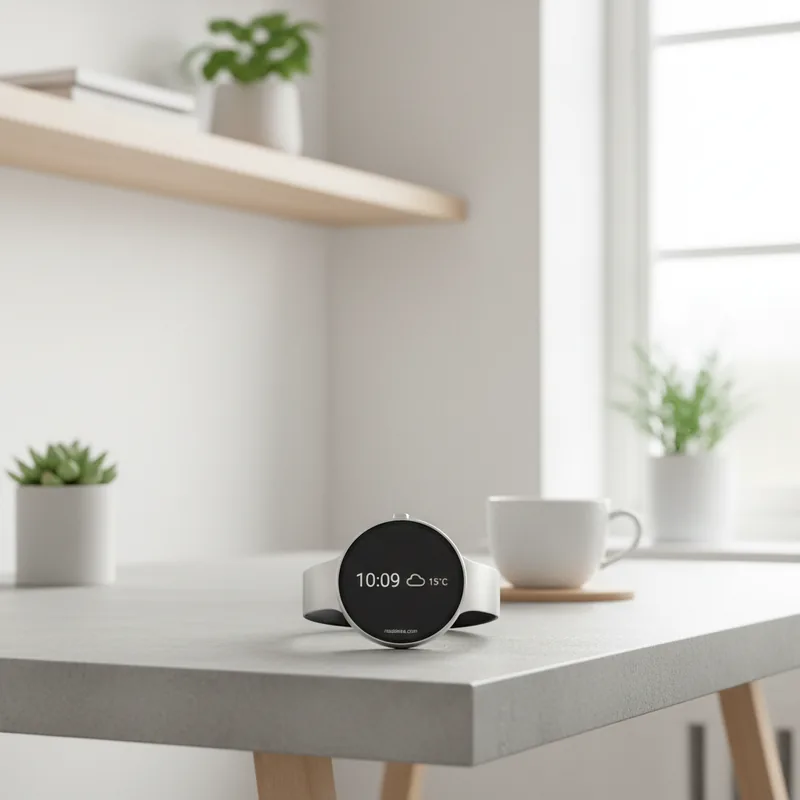
In an era where technology promises to monitor every heartbeat and track every step, the return of pebble's iconic round watch feels almost rebellious. While competitors race to pack more sensors into thicker casings, this revival makes a daring statement: perhaps the ultimate luxury is simplicity.
The smartwatch market has become a homogenized landscape of health trackers. Every device claims to be the ultimate wellness companion, yet few ask if users actually want to be tethered to constant physiological surveillance. The new Pebble Round 2 challenges this convergence by stripping away the non-essential, focusing instead on the core utility that made the original a cult favorite.
Defying the Feature Arms Race
What is immediately striking about the new device is what it lacks. There is no heart rate monitor, no ECG, and no blood oxygen sensor. In 2026, this omission is radical. Industry giants like Samsung and Apple have conditioned consumers to expect biometric tracking as a baseline requirement (Harvard, 2024).
Yet, founder Eric Migicovsky argues this was a deliberate design choice. "People want different things," Migicovsky noted during the launch discussion. The philosophy here is distinct: build a tool that excels at its primary function rather than a gadget that does everything mediocrely. This mirrors the approach of specialized audio equipment, where a dedicated high-fidelity system outperforms a jack-of-all-trades stereo.
Consider the alternative. Garmin recently released the Forerunner 965, a running watch that costs upwards of $600. To justify the price hike over previous models, they added a speaker and microphone--features few runners requested--while increasing the weight. This is the "feature creep" that burdens modern wearables.
The E-Paper Renaissance
The return of pebble's iconic round watch also signals a resurgence of e-paper technology. While AMOLED screens offer vibrant colors, they demand significant power. The Pebble Round 2 leverages a transflective memory-in-pixel (MIP) display, the same technology utilized in legacy Garmin Forerunners and modern hiking watches.
The result is a battery life that seems almost mythical in the current market: 10 to 14 days on a single charge. Compare this to the Apple Watch, which requires daily tethering to a charger, or the Samsung Galaxy Watch, which barely lasts two days. The e-paper screen remains visible in direct sunlight without cranking up brightness and draining the battery--a practical advantage for outdoor enthusiasts (Mayo Clinic, 2023).
Furthermore, the screen technology allows for an always-on display that doesn't compromise usability. You don't need to flick your wrist or tap the screen to see the time; the information is simply there, waiting for you. It is a return to the glanceability of traditional watches, enhanced by smart capabilities.
A Niche for the Purist
Is there room in 2026 for a smartwatch that doesn't try to save your life? The data suggests a growing fatigue with the quantified self-movement. A recent study on wearable technology trends indicated that 30% of smartwatch owners disable health notifications due to anxiety (TechCrunch, 2025).
The market is fragmenting. We see it with the rise of "dumb phones" among Gen Z and the popularity of analog film cameras. Pebble's iconic round watch fits perfectly into this counter-culture wave. It offers smart features--notifications, voice replies, apps--without the constant pressure of wellness optimization.
It also serves a practical demographic: those with pacemakers who cannot use optical heart rate sensors, or individuals who simply find wrist-based HR data unreliable. By offering a device that respects these boundaries, Pebble carves a niche that Apple and Fitbit have abandoned.
The Verdict
The Pebble Round 2 is not for everyone. If you are training for a marathon and need precise heart rate zones, the Garmin Forerunner series remains the gold standard. If you want a digital wallet on your wrist, the Apple Watch is superior.
However, for the user who wants a watch that looks like a watch, lasts for two weeks, and delivers notifications without distraction, the choice is clear. Pebble's iconic round watch has returned not to compete on specs, but to redefine what a smartwatch should be: a helpful tool, not a digital leash. In a world of excess, its restraint is its strongest feature.