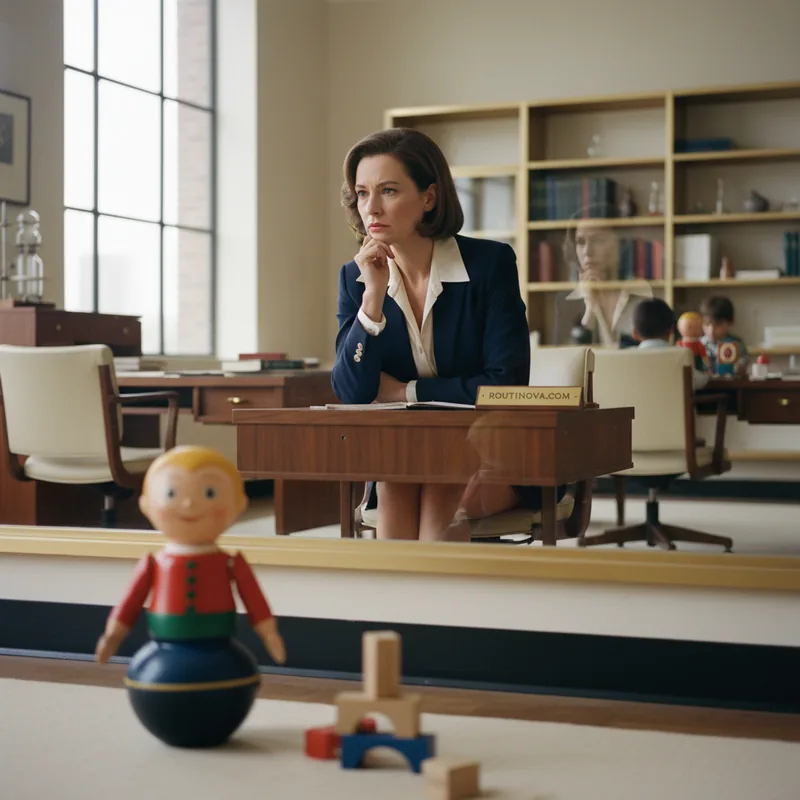
We understand how learning works through textbooks and lectures, yet some of our most profound lessons come from simply watching others. This paradox of human cognition--that we learn as much from observation as from direct experience--was the cornerstone of Albert Bandura's revolutionary work.
The Birth of Social Cognitive Theory
Albert Bandura's influence on psychology began with a simple but profound question: how do people learn without direct reinforcement? Traditional behaviorism suggested that all learning required rewards or punishments, yet Bandura observed that humans constantly acquire new behaviors by watching others. His work fundamentally challenged the behaviorist dominance of mid-20th century psychology.
Born in 1925 in rural Canada, Bandura's early educational experiences shaped his lifelong interest in self-directed learning. He once noted that limited resources forced students to "take charge of their own education," a realization that would later inform his concept of personal agency. This perspective positioned him uniquely between the rigid behaviorism of B.F. Skinner and the cognitive revolution that was emerging in the 1960s.
The Bobo Doll Experiment That Changed Everything
In 1961, Bandura conducted what would become one of psychology's most famous studies. He filmed an adult acting aggressively toward a plastic Bobo doll, then showed this film to children who subsequently entered a playroom with an identical doll. The results were startling: children who witnessed the aggressive model replicated the exact behaviors, including verbal insults and physical attacks.
This experiment demonstrated that observational learning occurs without direct reinforcement. The children weren't rewarded for their aggression, yet they imitated what they saw. Bandura identified four critical processes for effective observational learning: attention (noticing the behavior), retention (remembering it), reproduction (physically performing it), and motivation (having reason to do so).
Consider a modern classroom example: a student observes their teacher calmly solving a complex math problem. The student pays attention to the teacher's method, retains the steps, reproduces the solution, and feels motivated by the teacher's confidence. This modeling process explains how skills transfer without explicit instruction.
Self-Efficacy: The Belief That Matters
Beyond observational learning, Bandura's most enduring contribution is the concept of self-efficacy--the belief in one's ability to succeed in specific situations. This isn't general self-esteem; it's context-specific confidence. Bandura identified four sources of self-efficacy: mastery experiences, vicarious experiences, verbal persuasion, and physiological states.
Research shows that self-efficacy predicts performance more accurately than actual ability. In workplaces, employees with high self-efficacy approach challenges as opportunities to master rather than threats to avoid. For instance, a new manager who believes in their leadership capabilities will likely seek feedback, delegate effectively, and persist through difficulties--behaviors that reinforce their initial belief.
Bandura emphasized that self-efficacy isn't static. It can be developed through mastery experiences--small, manageable successes that build confidence over time. This insight transformed how we approach education, therapy, and personal development.
The Legacy of Social Learning Theory
Bandura's social learning theory integrated cognitive, behavioral, and environmental factors in what he called reciprocal determinism. This triad suggests that behavior, cognition, and environment all influence each other continuously. Unlike simple behaviorism, this model acknowledges that people actively shape their environments while being shaped by them.
The theory's impact extends far beyond psychology. In education, teachers now use modeling techniques to teach complex skills. In therapy, cognitive-behavioral approaches incorporate Bandura's insights about self-efficacy. Even in digital spaces, social media influencers demonstrate the power of observational learning--followers imitate behaviors, styles, and attitudes without direct interaction.
A 2002 survey of psychologists ranked Bandura as the fourth most eminent psychologist of the 20th century, behind only Skinner, Freud, and Piaget. His work continues to influence research on aggression, health behavior, and organizational psychology.
Bandura vs. Behaviorism
Despite his work appearing alongside behaviorist theories in textbooks, Bandura consistently rejected the label. He argued that reducing behavior to simple stimulus-response cycles ignored the cognitive processes that mediate learning. His perspective--what he called "social cognitivism"--recognized that mental processes, including expectations and beliefs, actively shape behavior.
This distinction matters profoundly. While behaviorism might explain why a rat presses a lever for food, Bandura's theory explains why a child might choose not to steal despite opportunity, based on internalized moral standards and anticipated guilt.
Contemporary Applications
Today, Bandura's influence permeates numerous fields:
- Public Health Campaigns - Anti-smoking ads use celebrity role models to demonstrate healthy behaviors
- Corporate Training - Companies use peer mentoring to transfer skills through observation
- Therapeutic Interventions - Exposure therapy helps clients build self-efficacy through gradual mastery
- Digital Learning - Video tutorials leverage observational learning on platforms like YouTube
The COVID-19 pandemic further highlighted Bandura's relevance. As education shifted online, teachers discovered that students learned effectively through recorded demonstrations and peer modeling, validating Bandura's decades-old insights about observational learning's power.
Enduring Impact on Human Understanding
Albert Bandura's influence on psychology extends beyond specific theories to a fundamental shift in how we view human agency. He moved psychology from a science of passive responders to one of active participants who shape their own development. His work reminds us that we are both products of our environment and architects of our future.
As we navigate an increasingly complex world, Bandura's insights about self-efficacy and observational learning offer practical tools for personal growth. Whether learning a new skill, overcoming a challenge, or influencing others, his research provides evidence-based strategies for human development.
His legacy continues through generations of psychologists, educators, and therapists who apply his principles to help people realize their potential. In an age of information overload, his emphasis on learning through observation and building self-belief remains more relevant than ever.