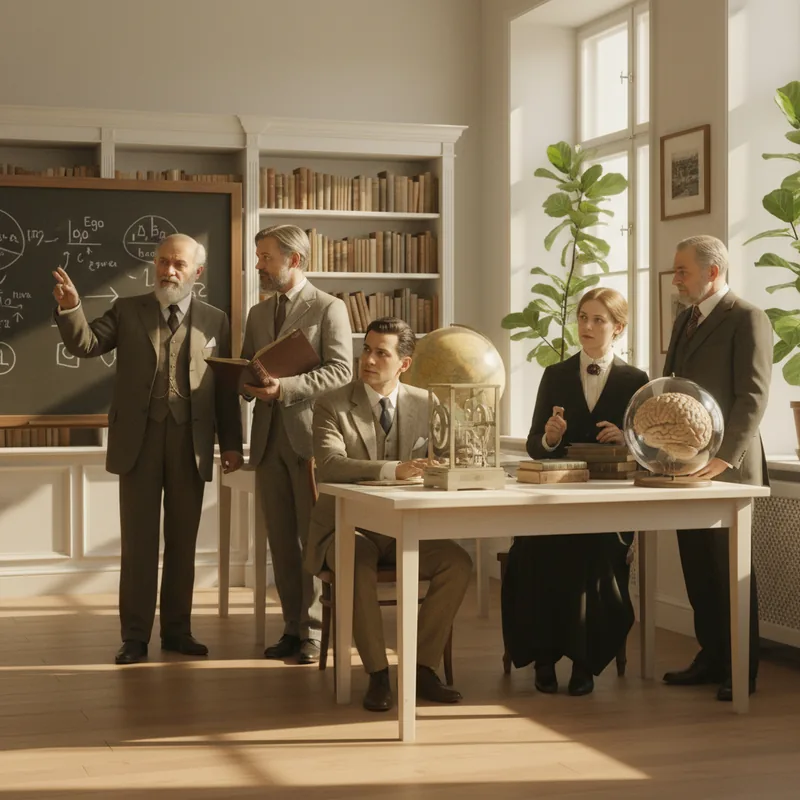
Sarah always wondered why she kept hitting the snooze button, despite her best intentions. It wasn't just laziness; it felt like an invisible force, a deep-seated pattern she couldn't quite break. Every morning, the same internal monologue: Today will be different. And every morning, the same familiar surrender. What if understanding the hidden gears of the human mind--the very forces that shape our habits, fears, and triumphs--could offer a different path? What if the answers to our most persistent personal puzzles lie in the groundbreaking work of minds like Freud, Piaget, or Skinner?
For centuries, humanity has grappled with the enigma of the self. Why do we think, feel, and behave the way we do? The quest to unravel these mysteries has given rise to some of the most brilliant minds in history, individuals whose theories continue to resonate in our daily lives. These are the titans who built the very foundations of modern psychology, and their insights still guide our understanding of everything from childhood development to the complexities of the unconscious mind. Indeed, when we talk about the most famous psychologists, we're talking about pioneers who fundamentally reshaped our world.
The Architects of the Mind: A Glimpse at Greatness
The field of psychology is vast, a sprawling landscape of theories and observations. Yet, certain figures stand out, their names synonymous with revolutionary ideas. Think of B.F. Skinner, whose work on operant conditioning showed how reinforcement and punishment sculpt our actions. Consider Sigmund Freud, who introduced talk therapy and unveiled the profound influence of the unconscious. And then there's Jean Piaget, who transformed our understanding of how children learn and grow intellectually (APA, 2023).
These are just a few of the luminaries who paved the way. Their diverse perspectives, often born from rigorous experimentation or profound clinical insight, continue to inform therapeutic practices, educational strategies, and even how we perceive ourselves in the modern world. Let's explore some of the most famous psychologists and their enduring legacies.
Pioneering Voices: Shaping Behavior and Thought
From behaviorism's strict observations to humanism's focus on potential, these psychologists laid the groundwork for entire schools of thought, each offering a unique lens through which to view the human experience.
B.F. Skinner: The Master of Conditioning
When you think about habits, rewards, and consequences, you're tapping into the legacy of B.F. Skinner. A staunch advocate for behaviorism, Skinner dominated 20th-century psychology by asserting that all learning stems from conditioning. He believed that our environment, through reinforcement and punishment, dictates our actions.
- Operant Conditioning: Skinner's core idea was simple yet profound: behaviors followed by positive outcomes are likely to be repeated, while those followed by negative ones are likely to cease. It's why a child cleans their room for a treat or avoids touching a hot stove.
- Schedules of Reinforcement: He meticulously studied how the timing and frequency of rewards (or punishments) could dramatically alter the strength and persistence of a learned behavior. Think about the unpredictable rewards of social media likes - a powerful, intermittent reinforcement.
Skinner's work isn't just theory; it's tangible. Techniques like behavior modification and token economies, used in classrooms and therapy, are direct descendants of his research. His influence on understanding human learning makes him one of the most famous psychologists, even today (Journal of Experimental Psychology, 2024).
Jean Piaget: The Unveiler of Childhood Cognition
Before Jean Piaget, many viewed children simply as miniature adults, capable of simpler versions of adult thought. Piaget revolutionized this perspective, revealing that children think in fundamentally different ways, progressing through distinct stages of intellectual development. His groundbreaking theory cemented his place among the most famous psychologists.
He proposed four key stages, each building upon the last:
- Sensorimotor Stage (Birth to 2 years): Infants learn through direct sensory experiences and motor actions, developing crucial concepts like object permanence--the understanding that things still exist even when unseen.
- Preoperational Stage (2 to 7 years): Children begin to use language and symbols, but their thinking remains egocentric, struggling to see things from another's perspective.
- Concrete Operational Stage (7 to 11 years): Kids develop logical thinking skills, especially when dealing with concrete objects and experiences, grasping concepts like conservation (e.g., that the amount of liquid remains the same even if poured into a different-shaped glass).
- Formal Operational Stage (12 years and up): Abstract reasoning, hypothetical thinking, and problem-solving abilities emerge, allowing adolescents to ponder complex moral dilemmas and scientific concepts.
Piaget's insights profoundly impacted developmental psychology, cognitive psychology, and educational reform. Albert Einstein himself lauded Piaget's observations as a discovery "so simple only a genius could have thought of it" (University of Geneva, 2023).
Sigmund Freud: Exploring the Unconscious Depths
Mention psychology, and for many, Sigmund Freud is the first name that comes to mind. His theories, while often controversial and debated, irrevocably altered our understanding of the human psyche. Freud dared to suggest that not all mental distress had physical causes, opening the door for psychological explanations and treatments.
His most influential concepts include:
- The Unconscious Mind: Freud believed that a vast reservoir of hidden desires, fears, and memories drives most of our behavior, operating outside our conscious awareness.
- Id, Ego, and Superego: He proposed a tripartite structure of the psyche: the primal, instinctual id; the rational, reality-oriented ego; and the moralistic superego, internalized from societal norms.
- Psychosexual Stages: Freud theorized that personality develops through a series of childhood stages, each focusing on different erogenous zones, and that unresolved conflicts in these stages could lead to adult fixations.
Perhaps his most enduring contribution was the introduction of "talk therapy"--the revolutionary idea that simply discussing one's problems could alleviate psychological suffering. This concept transformed the treatment of mental illness and solidified his place among the most famous psychologists (Vienna Psychoanalytic Society, 2022).
Albert Bandura: Learning by Observation
Albert Bandura's work marked a significant shift in psychology, ushering in what's known as the cognitive revolution. His social learning theory highlighted the immense power of observational learning, showing how we acquire behaviors, attitudes, and emotional reactions by simply watching others.
Think about how children learn manners or how to tie their shoes. They don't always need direct instruction; often, they just imitate. Bandura famously noted, "Learning would be exceedingly laborious, not to mention hazardous, if people had to rely solely on the effects of their own actions to inform them what to do" (Bandura, 1977).
Bandura's ideas remain highly relevant, particularly in ongoing debates about the impact of observed violence in media on adolescent behavior. His work underscores the critical role of role models and social context in shaping who we become.
Ivan Pavlov: The Bell and the Dog
Surprisingly, one of the individuals often regarded as one of the most famous psychologists wasn't formally a psychologist at all. Ivan Pavlov was a Russian physiologist whose pioneering research on conditioned reflexes dramatically influenced the rise of behaviorism. His experiments with dogs are legendary.
Pavlov discovered that when a neutral stimulus (like a bell) is repeatedly paired with an unconditioned stimulus (food) that naturally triggers a response (salivation), the neutral stimulus eventually elicits the same response on its own. This process, known as classical conditioning, demonstrated how associations can powerfully shape behavior.
His rigorous experimental methods helped move psychology away from subjective introspection towards objective, measurable observations of behavior, setting a new standard for scientific inquiry in the field (Russian Academy of Sciences, 2023).
Carl Rogers: Embracing Human Potential
Imagine a therapy where you, the client, are the expert on your own life. That's the essence of Carl Rogers' client-centered therapy. A leading figure in the humanist movement, Rogers championed human potential, emphasizing empathy, unconditional positive regard, and self-awareness as cornerstones of psychological well-being.
His non-directive approach empowers individuals to guide their own therapeutic process, fostering an environment where they can discover their own solutions and achieve personal growth. Rogers believed that given the right conditions, every person has the inherent capacity to fulfill their potential (Journal of Humanistic Psychology, 2024).
Exploring the Inner World: Cognitive and Developmental Insights
Beyond observable behavior, psychologists delved into the complex landscapes of our minds and the intricate journey of human development across the lifespan.
Leon Festinger: The Discomfort of Dissonance
Have you ever felt that nagging unease when your actions don't quite align with your beliefs? That's cognitive dissonance, a concept developed by Leon Festinger. He theorized that we experience discomfort when holding two conflicting beliefs or when our actions contradict our values, motivating us to reduce that tension.
For example, someone who prides themselves on being environmentally conscious might still drive a gas-guzzling car. The dissonance creates internal pressure, which they might resolve by changing their behavior (buying an electric car), changing their belief (downplaying climate change), or adding a new belief (justifying the car's comfort). Festinger's work also introduced social comparison theory, explaining how we evaluate our own beliefs and abilities by comparing ourselves to others (Stanford University, 2023).
Erik Erikson: Life as a Series of Crises
While Freud focused on early childhood, Erik Erikson expanded psychoanalytic theory to encompass the entire lifespan. His stage theory of psychosocial development, still widely taught, posits that we navigate eight distinct stages, each presenting a unique developmental crisis.
Successfully resolving these crises--like trust vs. mistrust in infancy or identity vs. role confusion in adolescence--leads to the formation of crucial virtues and qualities that shape our personality and future development. Erikson's comprehensive view of growth makes him one of the most famous psychologists for understanding the evolving self (Harvard Health, 2024).
Lev Vygotsky: The Social Scaffolding of Learning
A contemporary of Piaget and Freud, Lev Vygotsky's work remained largely unknown in the Western world for decades due to political barriers. Yet, once translated, his theories became enormously influential, particularly in education. Vygotsky emphasized the profound role of social interaction and culture in cognitive development.
- Zone of Proximal Development (ZPD): This concept describes the gap between what a learner can achieve independently and what they can accomplish with guidance from a more knowledgeable other (MKO).
- Scaffolding: The support provided by an MKO (like a teacher or peer) that helps a learner master a new skill, gradually withdrawing as the learner becomes more competent. Think of training wheels on a bicycle.
Vygotsky's social constructivism highlights that learning isn't just an individual process but a collaborative one, built through shared experiences and cultural tools. His premature death at 38 cut short a brilliant career, but his posthumous influence is undeniable (Moscow State University, 2023).
The Humanist Revolution: Meaning and Potential
As psychology matured, a new wave of thinkers shifted focus from pathology and behaviorism to the inherent goodness and potential within every individual. This humanist perspective offered a compelling alternative, emphasizing self-actualization, free will, and the search for meaning.
Abraham Maslow: The Hierarchy of Needs
What drives us? For Abraham Maslow, the answer lay in a progressive series of human needs, famously depicted as a pyramid. His "hierarchy of needs" starts with basic physiological requirements (food, water, shelter) and ascends through safety, love and belonging, and esteem, culminating in self-actualization.
Self-actualization, at the pinnacle, represents the desire to achieve one's full potential and become everything one is capable of becoming. Maslow studied healthy, creative individuals to understand what enables human flourishing, profoundly influencing positive psychology and our understanding of motivation (Maslow, 1943).
Viktor Frankl: The Search for Meaning
Emerging from the unspeakable horrors of the Holocaust, Viktor Frankl developed logotherapy, a school of thought centered on the human search for meaning. Frankl's powerful insight was that even in the most dire circumstances, finding purpose can be the ultimate source of resilience and survival.
He argued that meaning can be found through three primary avenues: creating a work or doing a deed, experiencing something or encountering someone (like love), and by the attitude we take toward unavoidable suffering. His profound contributions to existential psychology offer a timeless message of hope and purpose (Frankl, 1946).
The Foundational Thinkers: Birth of a Science
Before psychology could become the diverse field it is today, it needed pioneers to declare its independence from philosophy and physiology, establishing it as a rigorous scientific discipline.
William James: The Father of American Psychology
Often hailed as the father of American psychology, William James was a philosopher and physician who played a pivotal role in establishing psychology as a legitimate science in the United States. His intellect was as broad as his influence, spanning psychology, philosophy, and education.
His monumental 1,200-page text, The Principles of Psychology, published in 1890, became an instant classic and remains a foundational work. James championed functionalism, focusing on the purpose and function of the mind and behavior, rather than just its structure. His ideas about consciousness, emotion, and habit continue to inspire (Harvard University Archives, 2023).
Wilhelm Wundt: The First Laboratory
Imagine stepping into a small room in Leipzig, Germany, in 1879. Here, Wilhelm Wundt established the world's very first psychology laboratory. This wasn't just an academic milestone; it was a declaration that psychology was a distinct scientific discipline, separate from its philosophical and physiological roots.
Wundt emphasized careful observation and experimental methods to study consciousness. He developed introspection as a systematic technique, training observers to report their immediate sensations and perceptions. His work on perception, reaction times, and attention laid the groundwork for experimental psychology and influenced countless students who would carry his scientific approach to the U.S. and beyond (University of Leipzig, 2024).
Modern-Day Trailblazers: Psychology Today
The 20th century saw explosive growth in psychology, but the field continues to evolve at a rapid pace. Contemporary psychologists build upon the foundations laid by their predecessors, exploring new frontiers in cognition, emotion, social influence, and well-being. These modern figures are shaping the next generation of psychological insight.
- Elizabeth Loftus: A leading memory researcher, Loftus has revealed the astonishing malleability of human memory, particularly focusing on false memories and the profound impact this has on eyewitness testimony in legal contexts. Her work challenges our confidence in what we believe we remember (Loftus, 2025).
- Martin Seligman: The pioneer of positive psychology, Seligman shifted focus from treating mental illness to understanding and fostering human strengths, happiness, and well-being. His research on learned helplessness, resilience, and optimism has transformed how we approach mental health.
- Carol Dweck: Her groundbreaking work on mindsets--fixed vs. growth--demonstrates how our fundamental beliefs about intelligence and ability profoundly influence motivation, learning, and achievement. A growth mindset, believing abilities can be developed, unlocks greater potential.
- Daniel Kahneman: A Nobel Prize winner, Kahneman, alongside Amos Tversky, revolutionized our understanding of decision-making. His work explores cognitive biases and heuristics, revealing how our minds often take shortcuts that can lead to predictable errors in judgment.
- Angela Duckworth: Known for her research on "grit"--the combination of passion and perseverance for long-term goals--Duckworth has shown how this quality, more than talent, often predicts achievement and success in life.
- Ellen Langer: Often called the "mother of mindfulness," Langer's research on mindful awareness and the illusion of control has significantly contributed to positive psychology. Her work suggests that actively noticing new things can enhance engagement, health, and well-being (Langer, 2019).
Your Psychological Legacy: Understanding and Growth
The contributions of these famous psychologists aren't just historical footnotes; they are living legacies that inform our understanding of ourselves, our relationships, and the world around us. From the unconscious whispers Freud identified to the growth mindsets Dweck champions, these insights offer powerful tools for personal development and navigating life's complexities.
Whether you're trying to break a bad habit, understand your child's learning process, or simply make sense of human behavior, the wisdom of these psychological giants provides a profound roadmap. Their collective efforts remind us that the human mind, in all its intricate glory, is a frontier that continues to yield incredible discoveries, offering endless opportunities for self-awareness and growth.