You're assembling furniture from a flat-pack box. The instructions are diagrams, not words. As you rotate a piece in your mind, trying to match it to the illustration, you're not just building a bookshelf--you're exercising a fundamental cognitive ability. This is visual-spatial intelligence in action: your mind's capacity to understand, manipulate, and navigate the three-dimensional world.
This form of intelligence goes beyond simple observation. It's the mental software that allows you to estimate if your car will fit in a parking space, plan the layout of a room before moving furniture, or read a map and translate it into real-world navigation. Understanding developing visual-spatial intelligen begins with recognizing it as a distinct cognitive strength, separate from verbal or mathematical skills, that plays a crucial role in everything from daily tasks to professional mastery.
What Is Visual-Spatial Intelligence?
At its core, visual-spatial intelligence is the ability to perceive the visual world accurately, to perform transformations and modifications upon those perceptions, and to recreate aspects of visual experience even without physical stimuli. It's thinking in pictures, shapes, and space. While traditional IQ tests often emphasized verbal and mathematical reasoning, contemporary psychology recognizes multiple intelligences, with visual-spatial ability standing as a pillar in its own right.
This intelligence involves several key components: spatial visualization (mentally manipulating objects), spatial orientation (understanding relationships between objects as you move through space), and visual memory (recalling visual details). Someone strong in this area doesn't just see a blueprint--they can walk through the finished building in their mind. They don't just look at a chessboard--they foresee moves and countermoves across multiple spatial configurations.
Everyday Examples and Applications
You encounter visual-spatial challenges constantly, often without labeling them as such. Beyond the classic examples of puzzle-solving and map-reading, this intelligence manifests in diverse ways. An interior designer visualizing how different furniture arrangements will affect the flow of a room is using it. A basketball player anticipating the trajectory of a pass and positioning themselves accordingly relies on it. Even packing a suitcase efficiently requires spatial reasoning to fit irregular shapes into a confined space.
Consider these additional, often overlooked applications:
- Interior Design & Architecture: Envisioning structural changes or color schemes before implementation.
- Sports Strategy: A soccer midfielder visualizing passing lanes and player movements.
- Urban Planning: Conceptualizing how a new park will integrate with existing traffic patterns and buildings.
Conversely, challenges might appear as frequently getting lost in familiar places, struggling with tasks like parallel parking, or finding it difficult to interpret graphs and charts. These aren't signs of low overall intelligence but specific areas where visual-spatial processing may work differently. Understanding developing visual-spatial intelligen helps normalize these variations in cognitive style.
Assessing Your Spatial Abilities
How can you gauge your own visual-spatial strengths? Formal assessments exist, but it's crucial to approach them with critical awareness. Historical intelligence testing carries a problematic legacy, with early frameworks often designed to reinforce biased social hierarchies (Harvard, 2024). Modern evaluations should be viewed as tools for self-understanding, not definitive labels of worth or potential.
You can begin a self-assessment with practical observations. How easily do you navigate using landmarks versus street names? Can you mentally rotate an object, like imagining how a chair would look from the other side of the room? Simple online spatial reasoning tests or timed puzzle apps can offer informal benchmarks. The goal isn't to score "high" but to identify patterns in how you interact with spatial information. Research suggests cognitive profiles are diverse, and strengths in other areas, like verbal memory, can often compensate for spatial challenges (Mayo Clinic, 2023).
Can You Improve Visual-Spatial Skills?
The debate around improving core intelligence is complex. Evidence suggests that while there may be a genetic component to our baseline abilities, the brain exhibits remarkable plasticity. You might not radically alter your innate potential, but you can absolutely strengthen specific skills and learn effective compensation strategies. The journey of understanding developing visual-spatial intelligen is as much about working with your natural inclinations as it is about training new ones.
Think of it like physical fitness. You have a natural predisposition, but consistent, targeted exercise leads to improvement. The brain's neural pathways strengthen with use. For individuals who find spatial tasks challenging, technology offers brilliant compensation. GPS has revolutionized navigation for those with a poor sense of direction. Similarly, 3D modeling software can help architects and designers bridge the gap between mental image and physical plan.
Practical Exercises to Engage Your Mind's Eye
Whether you're looking to sharpen existing skills or build new neural connections, deliberate practice is key. The objective is to regularly challenge your brain to process and manipulate visual-spatial information. Consistency matters more than duration.
Incorporate these activities into your routine:
- Spatial Puzzles: Regularly work on jigsaw puzzles, 3D metal or wood puzzles, or apps like Tetris that require shape rotation.
- Mental Mapping: After visiting a new place, try to draw a map from memory. Or, navigate a familiar route without GPS, relying solely on landmarks.
- Visualization Practice: Spend a few minutes daily visualizing a simple object from all angles, then a room in your home, then a more complex scene.
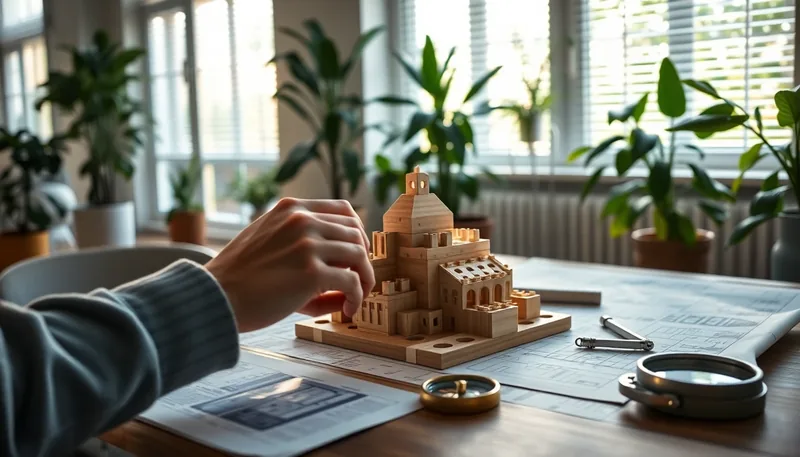
- Hands-On Building: Engage in model-making, LEGO construction, or even cooking from a recipe that requires spatial assembly.
These exercises do more than potentially boost spatial reasoning; they may also help maintain cognitive agility over time. The process of understanding developing visual-spatial intelligen is ongoing, blending self-awareness with active engagement. Remember, intelligence is multifaceted. Excellence in visual-spatial reasoning is one valuable strength among many, and cultivating a diverse cognitive toolkit ultimately enriches how you experience and interact with the world around you.