Everything you've been told about space exploration might be under scrutiny, but what if the biggest hurdles aren't in the stars, but in our own skepticism? The recent Artemis II mission, a monumental journey that sent four astronauts further into space than any humans before, has captivated the world. Yet, amidst the cheers and pride, a persistent whisper has emerged online: Was it all a hoax? People are questioning the very fabric of this historic achievement, convinced that the images, videos, and the entire concept of orbiting the moon are nothing more than elaborate deception. We're diving deep into what people are getting wrong about this incredible feat of human ingenuity.
The Science Behind the Skepticism
It's easy to get lost in the sheer audacity of space travel. The idea that humans, just like you and me, can strap themselves into a rocket, hurtle towards the moon, and return safely can feel almost fantastical. This sense of disbelief is where much of the skepticism around Artemis II originates. Instead of outright denial, some question the specific scientific principles at play, wondering if the mission could truly be real.
To get to the bottom of these concerns, we spoke with Dr. Evelyn Reed, a astrophysicist specializing in orbital mechanics. When asked directly if the Artemis II mission was faked, Dr. Reed was unequivocal: "Absolutely not. The physics and engineering involved are robust and have been validated over decades of space exploration."
One common point of contention is the rocket's initial trajectory. Many observers noted that the rocket didn't shoot straight up towards the moon but seemed to curve back towards Earth, leading some to believe it was heading for a landing in the Bermuda Triangle.
"That's by design," Dr. Reed explains. "The initial phase is about escaping Earth's atmosphere and its powerful gravitational pull. The rocket enters a stable Earth orbit first, essentially 'falling' around the planet at a speed that matches its curvature. Only then do we adjust the trajectory to intercept the moon. Going in a straight line would require exponentially more fuel and complex maneuvers, making it far less efficient."
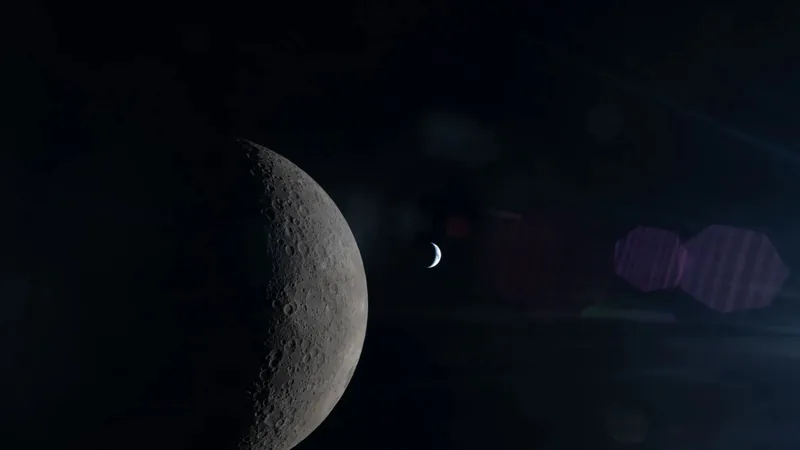
Another area of confusion stems from images of the moon's so-called "dark side." The phrase itself, popularized by Pink Floyd, creates a misconception. "The moon has a 'near side' and a 'far side,'" Dr. Reed clarifies. "Because of tidal locking, the same side always faces Earth. The 'dark side' isn't perpetually dark; it's simply the side not facing us. When we have a new moon here on Earth, the far side is fully illuminated by the sun. The stunning photos from Artemis II show exactly that - the sunlit far side of the moon, with the spacecraft positioned to capture the view."
The dramatic deceleration upon re-entry also raises eyebrows. How can a module traveling at 25,000 miles per hour slow down to a gentle splashdown using just a few parachutes?
"The parachutes are only the final stage," Dr. Reed notes. "The vast majority of deceleration happens as the Orion capsule plunges through Earth's atmosphere. The friction generates immense heat, burning off a significant amount of speed. The parachutes are deployed much later, at speeds where they can safely manage the final descent and ensure a soft landing." This is a prime example of what people are getting wrong by focusing only on the most visible part of the process.
Decoding Video Evidence and Misinterpretations
Beyond the scientific principles, many conspiracy theories latch onto perceived anomalies in the video and photographic evidence sent back from the mission. These often involve misinterpretations of visual artifacts or a lack of understanding of how footage is transmitted from space.
One viral clip shows what appears to be a food bag 'phasing through' an astronaut's ear. The explanation? What people are getting wrong here is mistaking a digital artifact for a physical impossibility. "This is almost certainly a compression artifact," says Dr. Reed. "High-definition video captured in space needs to be compressed significantly to be transmitted back to Earth. During this process, especially with fast-moving objects or complex lighting, glitches can occur where parts of the image briefly appear to overlap or distort. A perfectly clear, artifact-free video would, paradoxically, be more suspicious given the transmission challenges."
Another common claim involves a "glitching green screen." Videos circulating online point to supposed inconsistencies in the background during interviews. However, these often stem from local broadcast issues, not the original NASA feed.
"If you see the same interview on multiple news outlets, and only one shows a 'glitch,' it's likely an issue with that specific station's broadcast setup," Dr. Reed explains. "Some stations use green screens for their own graphics. If an astronaut is wearing something green or blue, it can interfere with the chroma key, causing parts of their clothing or props to be replaced by the station's background. It's a terrestrial broadcast problem, not a spaceflight deception."
The question of why an iPad isn't floating in some shots also surfaces. "In microgravity, objects don't just float away unless acted upon by a force," Dr. Reed points out. "Astronauts use Velcro, magnetic strips, or even simple tethers to keep equipment secured. An iPad might be attached to a console or a surface, making it appear stationary. It's not defying gravity; it's simply secured."
Regarding claims that astronaut Christina Cook's loose hair proves fakery, the opposite is true. "Hair behaves very differently in microgravity," Dr. Reed notes. "It fans out and drifts due to the slightest air currents, lacking the downward pull of Earth's gravity. Recreating that effect convincingly with CGI, especially over hours of footage, would be incredibly complex and expensive. Furthermore, translucent elements like hair are notoriously difficult to key out perfectly on a green screen, often resulting in a visible green 'spill' or halo effect. The natural, unkempt way her hair moves is actually strong evidence of genuine weightlessness."
Finally, the idea that launch footage shows astronauts exiting on a zipline is a misunderstanding of safety protocols. The pods seen shooting away from the rocket before liftoff are part of the Artemis II Emergency Egress System (AEES). This system is designed to rapidly pull the crew capsule away from the rocket in the event of a catastrophic issue on the launchpad, ensuring their safety. It's a critical safety feature, not an escape from a fake mission.
Science Belongs to Everyone
The Artemis II mission, like all scientific endeavors, was meticulously documented. NASA provides extensive data and information, making the spread of these conspiracy theories perplexing. Dr. Reed touches on a deeper issue: "There's a tendency for some to feel they're uncovering hidden truths by questioning authority. But in science, there's no 'authority' in the way people imagine. Scientific discovery is a collaborative, open process that belongs to all of humanity."
Understanding the science, the engineering, and the sheer human effort involved in missions like Artemis II allows us to appreciate these achievements not as something 'they' did, but as something 'we' accomplished. It's a testament to human curiosity and our drive to explore, and it's an invitation for everyone to be part of that journey. The real wonder isn't in questioning if it happened, but in marveling at the fact that it did.